

Imines – and even more so iminium species – are rather reactive compounds
due to their electrophilic character, which makes them susceptible to attack by a
wide range of nucleophiles, including water. As a consequence, imines are
notoriously unstable in aqueous systems at physiological conditions. The only
notable exception are cyclic five- and six-membered imines and those bearing
a carboxylic acid moiety on the imine carbon, which provides a stabilizing
H-bond.
Imine reductases possessing a broad substrate tolerance were first identified
from a large-scale screening encompassing 688 microbial strains including yeasts,
bacteria, actinomycetes and fungi for their activity on 2-methyl-1-pyrroline as
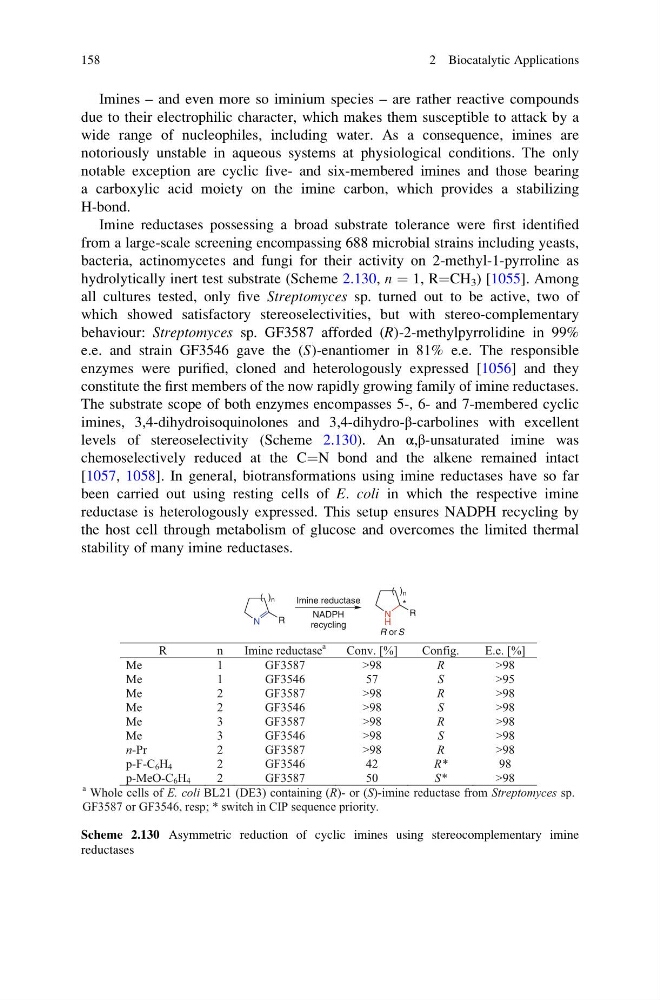
hydrolytically inert test substrate (Scheme 2.130, n ¼ 1, R¼CH 3 ) [1055]. Among
all cultures tested, only five Streptomyces sp. turned out to be active, two of
which showed satisfactory stereoselectivities, but with stereo-complementary
behaviour: Streptomyces sp. GF3587 afforded (R)-2-methylpyrrolidine in 99%
e.e. and strain GF3546 gave the (S)-enantiomer in 81% e.e. The responsible
enzymes were purified, cloned and heterologously expressed [1056] and they
constitute the first members of the now rapidly growing family of imine reductases.
The substrate scope of both enzymes encompasses 5-, 6- and 7-membered cyclic
imines, 3,4-dihydroisoquinolones and 3,4-dihydro-β-carbolines with excellent
levels of stereoselectivity (Scheme 2.130). An α,β-unsaturated imine was
chemoselectively reduced at the C¼N bond and the alkene remained intact
[1057, 1058]. In general, biotransformations using imine reductases have so far
been carried out using resting cells of E. coli in which the respective imine
reductase is heterologously expressed. This setup ensures NADPH recycling by
the host cell through metabolism of glucose and overcomes the limited thermal
stability of many imine reductases.
N
R
Imine reductase
NADPH
recycling
( ) n
N
H
R
( ) n
*
R or S
R
n
Imine reductase
a
Conv. [%]
Config.
E.e. [%]
Me
1
GF3587
>98
R
>98
Me
1
GF3546
57
S
>95
Me
2
GF3587
>98
R
>98
Me
2
GF3546
>98
S
>98
Me
3
GF3587
>98
R
>98
Me
3
GF3546
>98
S
>98
n-Pr
2
GF3587
>98
R
>98
p-F-C 6 H 4
2
GF3546
42
R*
98
p-MeO-C 6 H 4
2
GF3587
50
S*
>98
a Whole cells of E. coli BL21 (DE3) containing (R)- or (S)-imine reductase from Streptomyces sp.
GF3587 or GF3546, resp; * switch in CIP sequence priority.
Scheme 2.130 Asymmetric reduction of cyclic imines using stereocomplementary imine
reductases
158
2 Biocatalytic Applications
due to their electrophilic character, which makes them susceptible to attack by a
wide range of nucleophiles, including water. As a consequence, imines are
notoriously unstable in aqueous systems at physiological conditions. The only
notable exception are cyclic five- and six-membered imines and those bearing
a carboxylic acid moiety on the imine carbon, which provides a stabilizing
H-bond.
Imine reductases possessing a broad substrate tolerance were first identified
from a large-scale screening encompassing 688 microbial strains including yeasts,
bacteria, actinomycetes and fungi for their activity on 2-methyl-1-pyrroline as
hydrolytically inert test substrate (Scheme 2.130, n ¼ 1, R¼CH 3 ) [1055]. Among
all cultures tested, only five Streptomyces sp. turned out to be active, two of
which showed satisfactory stereoselectivities, but with stereo-complementary
behaviour: Streptomyces sp. GF3587 afforded (R)-2-methylpyrrolidine in 99%
e.e. and strain GF3546 gave the (S)-enantiomer in 81% e.e. The responsible
enzymes were purified, cloned and heterologously expressed [1056] and they
constitute the first members of the now rapidly growing family of imine reductases.
The substrate scope of both enzymes encompasses 5-, 6- and 7-membered cyclic
imines, 3,4-dihydroisoquinolones and 3,4-dihydro-β-carbolines with excellent
levels of stereoselectivity (Scheme 2.130). An α,β-unsaturated imine was
chemoselectively reduced at the C¼N bond and the alkene remained intact
[1057, 1058]. In general, biotransformations using imine reductases have so far
been carried out using resting cells of E. coli in which the respective imine
reductase is heterologously expressed. This setup ensures NADPH recycling by
the host cell through metabolism of glucose and overcomes the limited thermal
stability of many imine reductases.
N
R
Imine reductase
NADPH
recycling
( ) n
N
H
R
( ) n
*
R or S
R
n
Imine reductase
a
Conv. [%]
Config.
E.e. [%]
Me
1
GF3587
>98
R
>98
Me
1
GF3546
57
S
>95
Me
2
GF3587
>98
R
>98
Me
2
GF3546
>98
S
>98
Me
3
GF3587
>98
R
>98
Me
3
GF3546
>98
S
>98
n-Pr
2
GF3587
>98
R
>98
p-F-C 6 H 4
2
GF3546
42
R*
98
p-MeO-C 6 H 4
2
GF3587
50
S*
>98
a Whole cells of E. coli BL21 (DE3) containing (R)- or (S)-imine reductase from Streptomyces sp.
GF3587 or GF3546, resp; * switch in CIP sequence priority.
Scheme 2.130 Asymmetric reduction of cyclic imines using stereocomplementary imine
reductases
158
2 Biocatalytic Applications