

dehydrogenases was elucidated to depend on the opposite cofactor-dependence for
NADH and NADPH of the dehydrogenases involved [1036, 1037].
Microbial stereoinversion of sec-alcohols has become quite popular [1038]. For
instance, the deracemization of simple secondary alcohols proceeds with excellent
results using the fungi Geotrichum candidum or Candida parapsilosis. In case the
oxidation and reduction cannot be performed by a single species, two microorganisms may be used instead. For instance, Bacillus stearothermophilus and Yarrowia
lipolytica or Pseudomonas polycolor and Micrococcus freudenreichii were coupled
for the deracemization of the pheromone sulcatol and mandelic acid, respectively.
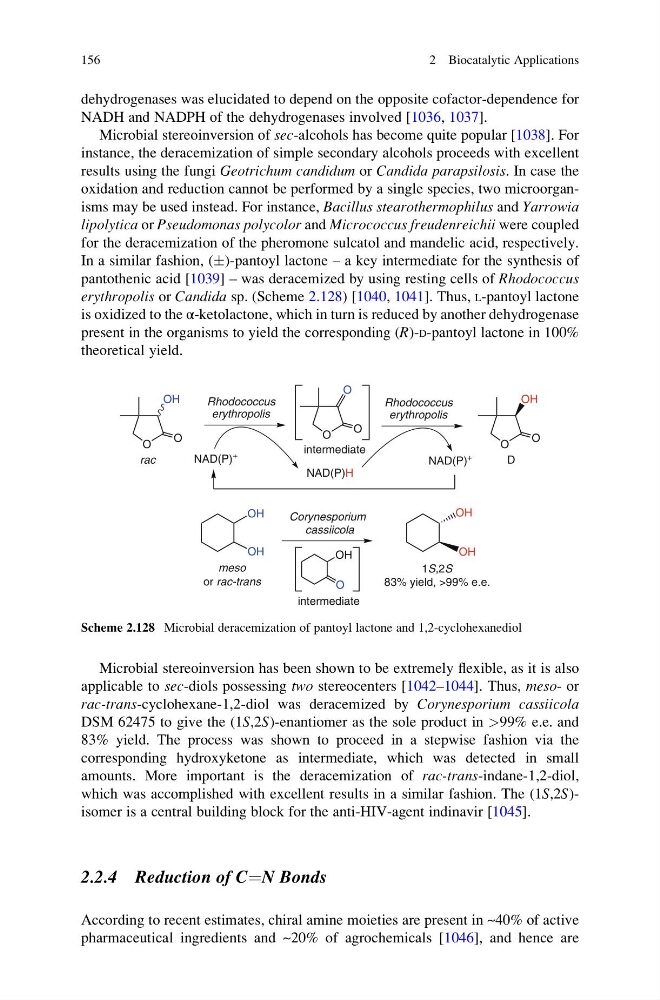
In a similar fashion, (Æ)-pantoyl lactone – a key intermediate for the synthesis of
pantothenic acid [1039] – was deracemized by using resting cells of Rhodococcus
erythropolis or Candida sp. (Scheme 2.128) [1040, 1041]. Thus, L-pantoyl lactone
is oxidized to the α-ketolactone, which in turn is reduced by another dehydrogenase
present in the organisms to yield the corresponding (R)-D-pantoyl lactone in 100%
theoretical yield.
Microbial stereoinversion has been shown to be extremely flexible, as it is also
applicable to sec-diols possessing two stereocenters [1042–1044]. Thus, meso- or
rac-trans-cyclohexane-1,2-diol was deracemized by Corynesporium cassiicola
DSM 62475 to give the (1S,2S)-enantiomer as the sole product in >99% e.e. and
83% yield. The process was shown to proceed in a stepwise fashion via the
corresponding hydroxyketone as intermediate, which was detected in small
amounts. More important is the deracemization of rac-trans-indane-1,2-diol,
which was accomplished with excellent results in a similar fashion. The (1S,2S)isomer is a central building block for the anti-HIV-agent indinavir [1045].
2.2.4 Reduction of C¼N Bonds
According to recent estimates, chiral amine moieties are present in ~40% of active
pharmaceutical ingredients and ~20% of agrochemicals [1046], and hence are
OH
O
O
O
O
O
OH
O
O
intermediate
erythropolis
Rhodococcus
erythropolis
Rhodococcus
NAD(P)H
NAD(P)
+
NAD(P) +
rac
D
OH
OH
O
OH
OH
OH
intermediate
Corynesporium
cassiicola
1S,2S
83% yield, >99% e.e.
meso
or rac-trans
Scheme 2.128 Microbial deracemization of pantoyl lactone and 1,2-cyclohexanediol
156
2 Biocatalytic Applications
NADH and NADPH of the dehydrogenases involved [1036, 1037].
Microbial stereoinversion of sec-alcohols has become quite popular [1038]. For
instance, the deracemization of simple secondary alcohols proceeds with excellent
results using the fungi Geotrichum candidum or Candida parapsilosis. In case the
oxidation and reduction cannot be performed by a single species, two microorganisms may be used instead. For instance, Bacillus stearothermophilus and Yarrowia
lipolytica or Pseudomonas polycolor and Micrococcus freudenreichii were coupled
for the deracemization of the pheromone sulcatol and mandelic acid, respectively.
In a similar fashion, (Æ)-pantoyl lactone – a key intermediate for the synthesis of
pantothenic acid [1039] – was deracemized by using resting cells of Rhodococcus
erythropolis or Candida sp. (Scheme 2.128) [1040, 1041]. Thus, L-pantoyl lactone
is oxidized to the α-ketolactone, which in turn is reduced by another dehydrogenase
present in the organisms to yield the corresponding (R)-D-pantoyl lactone in 100%
theoretical yield.
Microbial stereoinversion has been shown to be extremely flexible, as it is also
applicable to sec-diols possessing two stereocenters [1042–1044]. Thus, meso- or
rac-trans-cyclohexane-1,2-diol was deracemized by Corynesporium cassiicola
DSM 62475 to give the (1S,2S)-enantiomer as the sole product in >99% e.e. and
83% yield. The process was shown to proceed in a stepwise fashion via the
corresponding hydroxyketone as intermediate, which was detected in small
amounts. More important is the deracemization of rac-trans-indane-1,2-diol,
which was accomplished with excellent results in a similar fashion. The (1S,2S)isomer is a central building block for the anti-HIV-agent indinavir [1045].
2.2.4 Reduction of C¼N Bonds
According to recent estimates, chiral amine moieties are present in ~40% of active
pharmaceutical ingredients and ~20% of agrochemicals [1046], and hence are
OH
O
O
O
O
O
OH
O
O
intermediate
erythropolis
Rhodococcus
erythropolis
Rhodococcus
NAD(P)H
NAD(P)
+
NAD(P) +
rac
D
OH
OH
O
OH
OH
OH
intermediate
Corynesporium
cassiicola
1S,2S
83% yield, >99% e.e.
meso
or rac-trans
Scheme 2.128 Microbial deracemization of pantoyl lactone and 1,2-cyclohexanediol
156
2 Biocatalytic Applications