

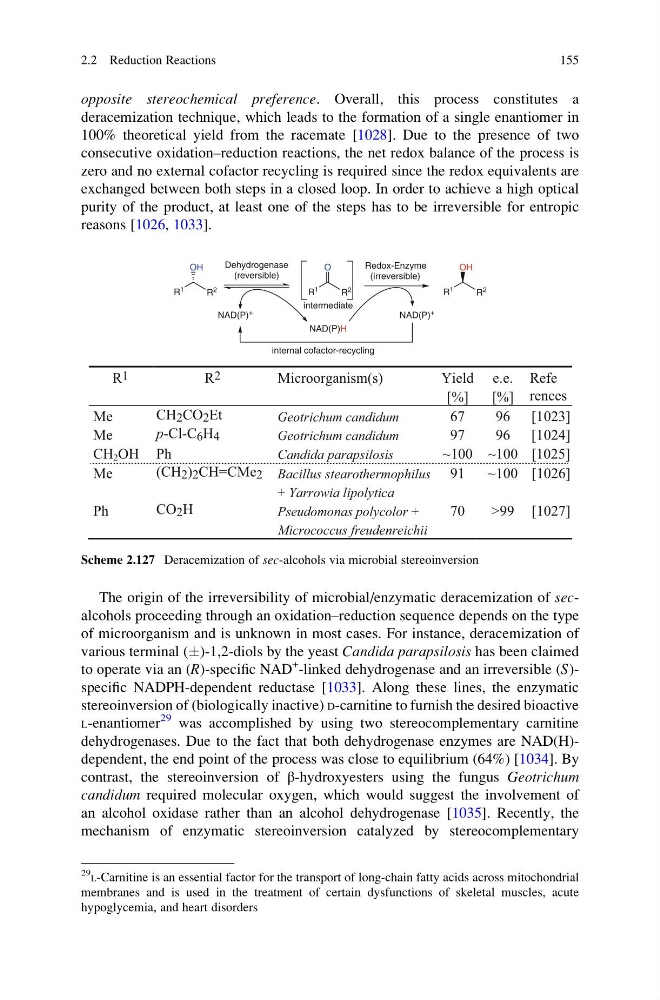
opposite stereochemical preference. Overall, this process constitutes a
deracemization technique, which leads to the formation of a single enantiomer in
100% theoretical yield from the racemate [1028]. Due to the presence of two
consecutive oxidation–reduction reactions, the net redox balance of the process is
zero and no external cofactor recycling is required since the redox equivalents are
exchanged between both steps in a closed loop. In order to achieve a high optical
purity of the product, at least one of the steps has to be irreversible for entropic
reasons [1026, 1033].
The origin of the irreversibility of microbial/enzymatic deracemization of secalcohols proceeding through an oxidation–reduction sequence depends on the type
of microorganism and is unknown in most cases. For instance, deracemization of
various terminal (Æ)-1,2-diols by the yeast Candida parapsilosis has been claimed
to operate via an (R)-specific NAD
+
-linked dehydrogenase and an irreversible (S)specific NADPH-dependent reductase [1033]. Along these lines, the enzymatic
stereoinversion of (biologically inactive) D-carnitine to furnish the desired bioactive
L-enantiomer
29 was accomplished by using two stereocomplementary carnitine
dehydrogenases. Due to the fact that both dehydrogenase enzymes are NAD(H)dependent, the end point of the process was close to equilibrium (64%) [1034]. By
contrast, the stereoinversion of β-hydroxyesters using the fungus Geotrichum
candidum required molecular oxygen, which would suggest the involvement of
an alcohol oxidase rather than an alcohol dehydrogenase [1035]. Recently, the
mechanism of enzymatic stereoinversion catalyzed by stereocomplementary
OH
R 2
R 1
O
R 2
R 1
OH
R 2
R 1
NAD(P)
+
(reversible)
Dehydrogenase
(irreversible)
Redox-Enzyme
NAD(P)H
NAD(P)
+
intermediate
internal cofactor-recycling
R 1
R 2
Microorganism(s)
Yield
[%]
e.e.
[%]
Refe
rences
Me
CH 2 CO 2 Et
Geotrichum candidum
67
96 [1023]
Me
p-Cl-C 6 H 4
Geotrichum candidum
97
96 [1024]
CH 2 OH Ph
Candida parapsilosis
~100 ~100 [1025]
Me
(CH 2 ) 2 CH=CMe 2 Bacillus stearothermophilus
+ Yarrowia lipolytica
91
~100 [1026]
Ph
CO 2 H
Pseudomonas polycolor +
Micrococcus freudenreichii
70
>99 [1027]
Scheme 2.127 Deracemization of sec-alcohols via microbial stereoinversion
29 L-Carnitine is an essential factor for the transport of long-chain fatty acids across mitochondrial
membranes and is used in the treatment of certain dysfunctions of skeletal muscles, acute
hypoglycemia, and heart disorders
2.2 Reduction Reactions
155
deracemization technique, which leads to the formation of a single enantiomer in
100% theoretical yield from the racemate [1028]. Due to the presence of two
consecutive oxidation–reduction reactions, the net redox balance of the process is
zero and no external cofactor recycling is required since the redox equivalents are
exchanged between both steps in a closed loop. In order to achieve a high optical
purity of the product, at least one of the steps has to be irreversible for entropic
reasons [1026, 1033].
The origin of the irreversibility of microbial/enzymatic deracemization of secalcohols proceeding through an oxidation–reduction sequence depends on the type
of microorganism and is unknown in most cases. For instance, deracemization of
various terminal (Æ)-1,2-diols by the yeast Candida parapsilosis has been claimed
to operate via an (R)-specific NAD
+
-linked dehydrogenase and an irreversible (S)specific NADPH-dependent reductase [1033]. Along these lines, the enzymatic
stereoinversion of (biologically inactive) D-carnitine to furnish the desired bioactive
L-enantiomer
29 was accomplished by using two stereocomplementary carnitine
dehydrogenases. Due to the fact that both dehydrogenase enzymes are NAD(H)dependent, the end point of the process was close to equilibrium (64%) [1034]. By
contrast, the stereoinversion of β-hydroxyesters using the fungus Geotrichum
candidum required molecular oxygen, which would suggest the involvement of
an alcohol oxidase rather than an alcohol dehydrogenase [1035]. Recently, the
mechanism of enzymatic stereoinversion catalyzed by stereocomplementary
OH
R 2
R 1
O
R 2
R 1
OH
R 2
R 1
NAD(P)
+
(reversible)
Dehydrogenase
(irreversible)
Redox-Enzyme
NAD(P)H
NAD(P)
+
intermediate
internal cofactor-recycling
R 1
R 2
Microorganism(s)
Yield
[%]
e.e.
[%]
Refe
rences
Me
CH 2 CO 2 Et
Geotrichum candidum
67
96 [1023]
Me
p-Cl-C 6 H 4
Geotrichum candidum
97
96 [1024]
CH 2 OH Ph
Candida parapsilosis
~100 ~100 [1025]
Me
(CH 2 ) 2 CH=CMe 2 Bacillus stearothermophilus
+ Yarrowia lipolytica
91
~100 [1026]
Ph
CO 2 H
Pseudomonas polycolor +
Micrococcus freudenreichii
70
>99 [1027]
Scheme 2.127 Deracemization of sec-alcohols via microbial stereoinversion
29 L-Carnitine is an essential factor for the transport of long-chain fatty acids across mitochondrial
membranes and is used in the treatment of certain dysfunctions of skeletal muscles, acute
hypoglycemia, and heart disorders
2.2 Reduction Reactions
155