

α-Ketoesters and α-ketoamides can be asymmetrically reduced to furnish the
corresponding α-hydroxy derivatives. Thus, following Prelog’s rule, (S)-lactate
[1001] and (R)-mandelate esters [982] were obtained from pyruvate and α-ketophenylacetic esters by fermenting baker’s yeast in excellent optical purity
(e.e. 91–100%).
Cyclic β-diketones are selectively reduced to give β-hydroxyketones without the
formation of dihydroxy products (Scheme 2.124) [1002–1005]. It is important,
however, that the highly acidic protons on the α-carbon atom are fully replaced
by substituents in order to avoid the (spontaneous) chemical condensation of the
substrate with acetaldehyde, which is always present in yeast fermentations and to
avoid racemization of the α-monosubstituted β-hydroxyketone formed as product.
Again, with small-size rings, the corresponding syn-products are formed predominantly, usually with excellent optical purity. However, the diastereoselectivity
becomes less predictable and the yields drop when the rings are enlarged. Again,
the stereochemistry at the newly formed secondary alcohol center can be predicted
by Prelog’s rule.
R
2
OH
CO 2 R
3
R
1
OR
3
O
R
2
O
R
1
OR
3
O
R
2
OH
R
1
OR
3
O
R 2
OH
R
1
OR
3
O
R 2
OH
R
1
OR
3
O
R
2
OH
R 1
R + S
in-situ racemization
B
A
D
C
syn
anti
syn
anti
Pathway
R 1
R 2
R 3
Biocatalyst
yield
[%]
d.e.
[%]
e.e.
[%]
Refer
ences
A
Me
allyl Et
baker´s yeast
94
92
>99 [988]
A
Me
Me
n-Octyl baker´s yeast
82
90
>98 [989]
B
Me
Me
Et
Geotrichum
candidum
80
>98 >98 [990]
B
Et
Me
Et
Geotrichum
candidum
80
96
91
[991]
C
4-MeOC 6 H 4 - Cl
Et
Sporotrichum
exile
52
96
98
[992]
D
4-MeOC 6 H 4 - Cl
Me
Mucor
ambiguus
58
>98 >99 [993]
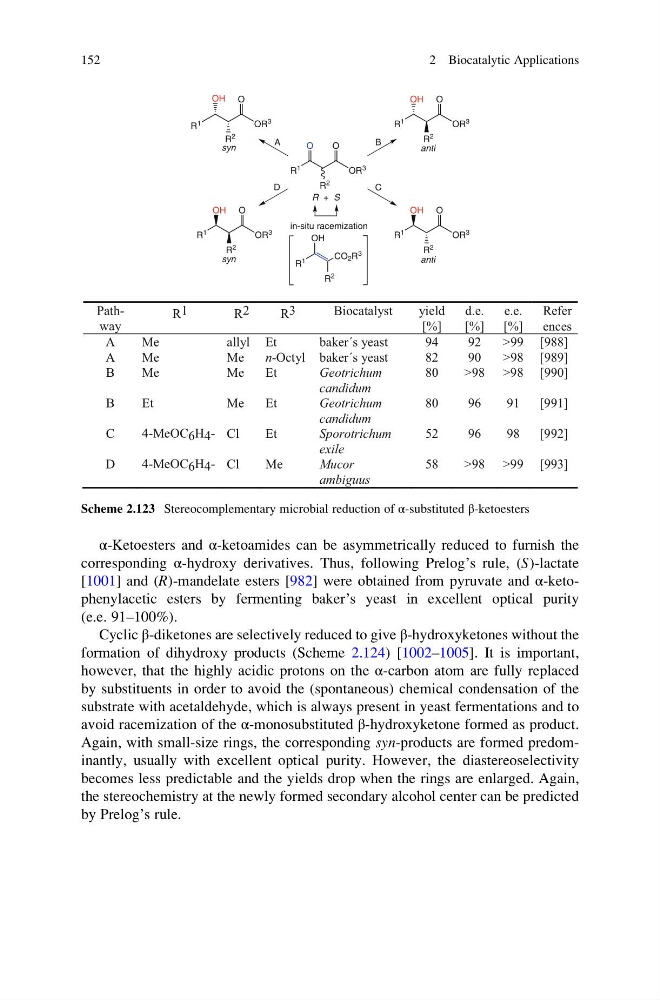
Scheme 2.123 Stereocomplementary microbial reduction of α-substituted β-ketoesters
152
2 Biocatalytic Applications
corresponding α-hydroxy derivatives. Thus, following Prelog’s rule, (S)-lactate
[1001] and (R)-mandelate esters [982] were obtained from pyruvate and α-ketophenylacetic esters by fermenting baker’s yeast in excellent optical purity
(e.e. 91–100%).
Cyclic β-diketones are selectively reduced to give β-hydroxyketones without the
formation of dihydroxy products (Scheme 2.124) [1002–1005]. It is important,
however, that the highly acidic protons on the α-carbon atom are fully replaced
by substituents in order to avoid the (spontaneous) chemical condensation of the
substrate with acetaldehyde, which is always present in yeast fermentations and to
avoid racemization of the α-monosubstituted β-hydroxyketone formed as product.
Again, with small-size rings, the corresponding syn-products are formed predominantly, usually with excellent optical purity. However, the diastereoselectivity
becomes less predictable and the yields drop when the rings are enlarged. Again,
the stereochemistry at the newly formed secondary alcohol center can be predicted
by Prelog’s rule.
R
2
OH
CO 2 R
3
R
1
OR
3
O
R
2
O
R
1
OR
3
O
R
2
OH
R
1
OR
3
O
R 2
OH
R
1
OR
3
O
R 2
OH
R
1
OR
3
O
R
2
OH
R 1
R + S
in-situ racemization
B
A
D
C
syn
anti
syn
anti
Pathway
R 1
R 2
R 3
Biocatalyst
yield
[%]
d.e.
[%]
e.e.
[%]
Refer
ences
A
Me
allyl Et
baker´s yeast
94
92
>99 [988]
A
Me
Me
n-Octyl baker´s yeast
82
90
>98 [989]
B
Me
Me
Et
Geotrichum
candidum
80
>98 >98 [990]
B
Et
Me
Et
Geotrichum
candidum
80
96
91
[991]
C
4-MeOC 6 H 4 - Cl
Et
Sporotrichum
exile
52
96
98
[992]
D
4-MeOC 6 H 4 - Cl
Me
Mucor
ambiguus
58
>98 >99 [993]
Scheme 2.123 Stereocomplementary microbial reduction of α-substituted β-ketoesters
152
2 Biocatalytic Applications