

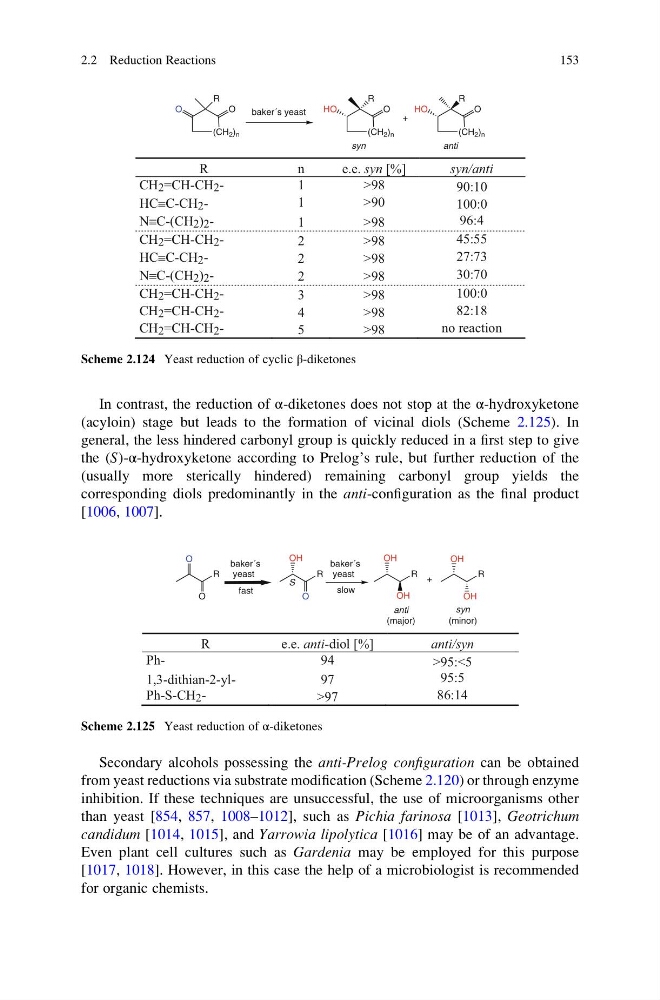
In contrast, the reduction of α-diketones does not stop at the α-hydroxyketone
(acyloin) stage but leads to the formation of vicinal diols (Scheme 2.125). In
general, the less hindered carbonyl group is quickly reduced in a first step to give
the (S)-α-hydroxyketone according to Prelog’s rule, but further reduction of the
(usually more sterically hindered) remaining carbonyl group yields the
corresponding diols predominantly in the anti-configuration as the final product
[1006, 1007].
Secondary alcohols possessing the anti-Prelog configuration can be obtained
from yeast reductions via substrate modification (Scheme 2.120) or through enzyme
inhibition. If these techniques are unsuccessful, the use of microorganisms other
than yeast [854, 857, 1008–1012], such as Pichia farinosa [1013], Geotrichum
candidum [1014, 1015], and Yarrowia lipolytica [1016] may be of an advantage.
Even plant cell cultures such as Gardenia may be employed for this purpose
[1017, 1018]. However, in this case the help of a microbiologist is recommended
for organic chemists.
R
O
O
(CH 2 ) n
R
HO
O
(CH 2 ) n
R
HO
O
(CH 2 ) n
+
baker´s yeast
syn
anti
R
n
e.e. syn [%]
syn/anti
CH 2 =CH-CH 2 -
1
>98
90:10
HC≡C-CH 2 -
1
> 9 0
100:0
N≡C-(CH 2 ) 2 -
1
> 9 8
96:4
CH 2 =CH-CH 2 -
2
> 9 8
45:55
HC≡C-CH 2 -
2
> 9 8
27:73
N≡C-(CH 2 ) 2 -
2
> 9 8
30:70
CH 2 =CH-CH 2 -
3
> 9 8
100:0
CH 2 =CH-CH 2 -
4
> 9 8
82:18
CH 2 =CH-CH 2 -
5
> 9 8
no reaction
Scheme 2.124 Yeast reduction of cyclic β-diketones
O
O
R
O
OH
R
OH
OH
R
OH
OH
R
slow
baker´s
yeast
+
syn
(minor)
anti
(major)
baker´s
yeast
fast
S
R
e.e. anti-diol [%]
anti/syn
Ph94
>95:<5
1,3-dithian-2-yl97
95:5
Ph-S-CH 2 -
>97
86:14
Scheme 2.125 Yeast reduction of α-diketones
2.2 Reduction Reactions
153
(acyloin) stage but leads to the formation of vicinal diols (Scheme 2.125). In
general, the less hindered carbonyl group is quickly reduced in a first step to give
the (S)-α-hydroxyketone according to Prelog’s rule, but further reduction of the
(usually more sterically hindered) remaining carbonyl group yields the
corresponding diols predominantly in the anti-configuration as the final product
[1006, 1007].
Secondary alcohols possessing the anti-Prelog configuration can be obtained
from yeast reductions via substrate modification (Scheme 2.120) or through enzyme
inhibition. If these techniques are unsuccessful, the use of microorganisms other
than yeast [854, 857, 1008–1012], such as Pichia farinosa [1013], Geotrichum
candidum [1014, 1015], and Yarrowia lipolytica [1016] may be of an advantage.
Even plant cell cultures such as Gardenia may be employed for this purpose
[1017, 1018]. However, in this case the help of a microbiologist is recommended
for organic chemists.
R
O
O
(CH 2 ) n
R
HO
O
(CH 2 ) n
R
HO
O
(CH 2 ) n
+
baker´s yeast
syn
anti
R
n
e.e. syn [%]
syn/anti
CH 2 =CH-CH 2 -
1
>98
90:10
HC≡C-CH 2 -
1
> 9 0
100:0
N≡C-(CH 2 ) 2 -
1
> 9 8
96:4
CH 2 =CH-CH 2 -
2
> 9 8
45:55
HC≡C-CH 2 -
2
> 9 8
27:73
N≡C-(CH 2 ) 2 -
2
> 9 8
30:70
CH 2 =CH-CH 2 -
3
> 9 8
100:0
CH 2 =CH-CH 2 -
4
> 9 8
82:18
CH 2 =CH-CH 2 -
5
> 9 8
no reaction
Scheme 2.124 Yeast reduction of cyclic β-diketones
O
O
R
O
OH
R
OH
OH
R
OH
OH
R
slow
baker´s
yeast
+
syn
(minor)
anti
(major)
baker´s
yeast
fast
S
R
e.e. anti-diol [%]
anti/syn
Ph94
>95:<5
1,3-dithian-2-yl97
95:5
Ph-S-CH 2 -
>97
86:14
Scheme 2.125 Yeast reduction of α-diketones
2.2 Reduction Reactions
153