

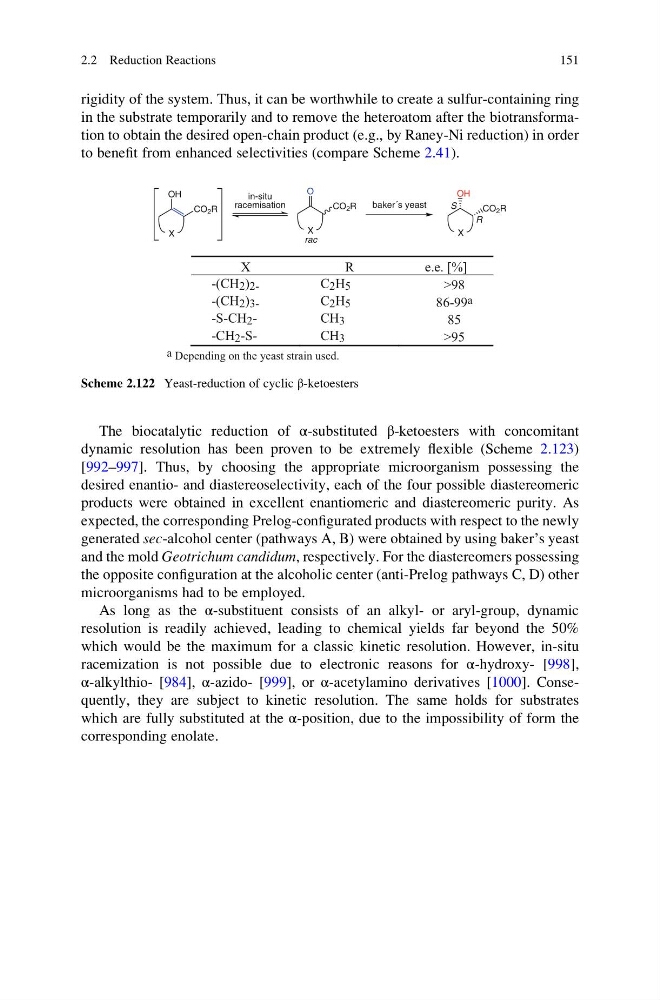
rigidity of the system. Thus, it can be worthwhile to create a sulfur-containing ring
in the substrate temporarily and to remove the heteroatom after the biotransformation to obtain the desired open-chain product (e.g., by Raney-Ni reduction) in order
to benefit from enhanced selectivities (compare Scheme 2.41).
The biocatalytic reduction of α-substituted β-ketoesters with concomitant
dynamic resolution has been proven to be extremely flexible (Scheme 2.123)
[992–997]. Thus, by choosing the appropriate microorganism possessing the
desired enantio- and diastereoselectivity, each of the four possible diastereomeric
products were obtained in excellent enantiomeric and diastereomeric purity. As
expected, the corresponding Prelog-configurated products with respect to the newly
generated sec-alcohol center (pathways A, B) were obtained by using baker’s yeast
and the mold Geotrichum candidum, respectively. For the diastereomers possessing
the opposite configuration at the alcoholic center (anti-Prelog pathways C, D) other
microorganisms had to be employed.
As long as the α-substituent consists of an alkyl- or aryl-group, dynamic
resolution is readily achieved, leading to chemical yields far beyond the 50%
which would be the maximum for a classic kinetic resolution. However, in-situ
racemization is not possible due to electronic reasons for α-hydroxy- [998],
α-alkylthio- [984], α-azido- [999], or α-acetylamino derivatives [1000]. Consequently, they are subject to kinetic resolution. The same holds for substrates
which are fully substituted at the α-position, due to the impossibility of form the
corresponding enolate.
OH
CO 2 R
O
CO 2 R
OH
CO 2 R
baker´s yeast
rac
in-situ
racemisation
X
R
S
X
X
X
R
e . e . [ % ]
-(CH 2 ) 2C 2 H 5
>98
-(CH 2 ) 3C 2 H 5
86-99 a
-S-CH 2 -
C H 3
85
-CH 2 -SCH 3
>95
a Depending on the yeast strain used.
Scheme 2.122 Yeast-reduction of cyclic β-ketoesters
2.2 Reduction Reactions
151
in the substrate temporarily and to remove the heteroatom after the biotransformation to obtain the desired open-chain product (e.g., by Raney-Ni reduction) in order
to benefit from enhanced selectivities (compare Scheme 2.41).
The biocatalytic reduction of α-substituted β-ketoesters with concomitant
dynamic resolution has been proven to be extremely flexible (Scheme 2.123)
[992–997]. Thus, by choosing the appropriate microorganism possessing the
desired enantio- and diastereoselectivity, each of the four possible diastereomeric
products were obtained in excellent enantiomeric and diastereomeric purity. As
expected, the corresponding Prelog-configurated products with respect to the newly
generated sec-alcohol center (pathways A, B) were obtained by using baker’s yeast
and the mold Geotrichum candidum, respectively. For the diastereomers possessing
the opposite configuration at the alcoholic center (anti-Prelog pathways C, D) other
microorganisms had to be employed.
As long as the α-substituent consists of an alkyl- or aryl-group, dynamic
resolution is readily achieved, leading to chemical yields far beyond the 50%
which would be the maximum for a classic kinetic resolution. However, in-situ
racemization is not possible due to electronic reasons for α-hydroxy- [998],
α-alkylthio- [984], α-azido- [999], or α-acetylamino derivatives [1000]. Consequently, they are subject to kinetic resolution. The same holds for substrates
which are fully substituted at the α-position, due to the impossibility of form the
corresponding enolate.
OH
CO 2 R
O
CO 2 R
OH
CO 2 R
baker´s yeast
rac
in-situ
racemisation
X
R
S
X
X
X
R
e . e . [ % ]
-(CH 2 ) 2C 2 H 5
>98
-(CH 2 ) 3C 2 H 5
86-99 a
-S-CH 2 -
C H 3
85
-CH 2 -SCH 3
>95
a Depending on the yeast strain used.
Scheme 2.122 Yeast-reduction of cyclic β-ketoesters
2.2 Reduction Reactions
151