

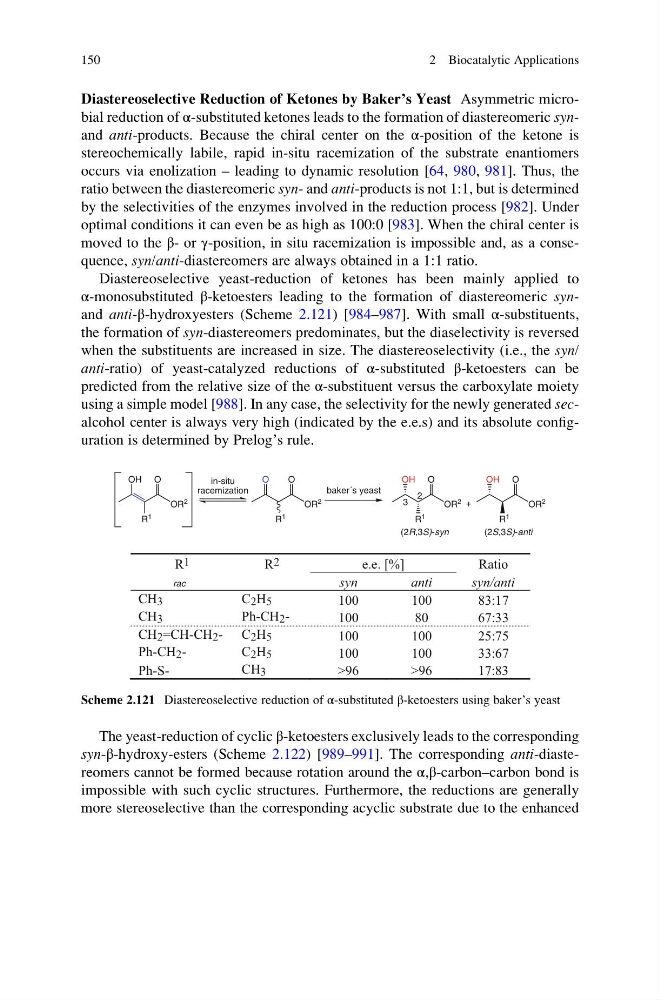
Diastereoselective Reduction of Ketones by Baker’s Yeast Asymmetric microbial reduction of α-substituted ketones leads to the formation of diastereomeric synand anti-products. Because the chiral center on the α-position of the ketone is
stereochemically labile, rapid in-situ racemization of the substrate enantiomers
occurs via enolization – leading to dynamic resolution [64, 980, 981]. Thus, the
ratio between the diastereomeric syn- and anti-products is not 1:1, but is determined
by the selectivities of the enzymes involved in the reduction process [982]. Under
optimal conditions it can even be as high as 100:0 [983]. When the chiral center is
moved to the β- or γ-position, in situ racemization is impossible and, as a consequence, syn/anti-diastereomers are always obtained in a 1:1 ratio.
Diastereoselective yeast-reduction of ketones has been mainly applied to
α-monosubstituted β-ketoesters leading to the formation of diastereomeric synand anti-β-hydroxyesters (Scheme 2.121) [984–987]. With small α-substituents,
the formation of syn-diastereomers predominates, but the diaselectivity is reversed
when the substituents are increased in size. The diastereoselectivity (i.e., the syn/
anti-ratio) of yeast-catalyzed reductions of α-substituted β-ketoesters can be
predicted from the relative size of the α-substituent versus the carboxylate moiety
using a simple model [988]. In any case, the selectivity for the newly generated secalcohol center is always very high (indicated by the e.e.s) and its absolute configuration is determined by Prelog’s rule.
The yeast-reduction of cyclic β-ketoesters exclusively leads to the corresponding
syn-β-hydroxy-esters (Scheme 2.122) [989–991]. The corresponding anti-diastereomers cannot be formed because rotation around the α,β-carbon–carbon bond is
impossible with such cyclic structures. Furthermore, the reductions are generally
more stereoselective than the corresponding acyclic substrate due to the enhanced
R
1
OH O
OR
2
R
1
O
O
OR
2
R
1
OH O
OR
2
R
1
OH O
OR
2
racemization
+
(2R,3S)-syn
(2S,3S)-anti
baker´s yeast
in-situ
2
3
rac
R 1
R 2
e.e. [%]
Ratio
syn
anti
syn/anti
CH 3
C 2 H 5
100
100
83:17
CH 3
Ph-CH 2 -
100
80
67:33
CH 2 =CH-CH 2 - C 2 H 5
100
100
25:75
Ph-CH 2 -
C 2 H 5
100
100
33:67
Ph-SCH 3
>96
>96
17:83
Scheme 2.121 Diastereoselective reduction of α-substituted β-ketoesters using baker’s yeast
150
2 Biocatalytic Applications
stereochemically labile, rapid in-situ racemization of the substrate enantiomers
occurs via enolization – leading to dynamic resolution [64, 980, 981]. Thus, the
ratio between the diastereomeric syn- and anti-products is not 1:1, but is determined
by the selectivities of the enzymes involved in the reduction process [982]. Under
optimal conditions it can even be as high as 100:0 [983]. When the chiral center is
moved to the β- or γ-position, in situ racemization is impossible and, as a consequence, syn/anti-diastereomers are always obtained in a 1:1 ratio.
Diastereoselective yeast-reduction of ketones has been mainly applied to
α-monosubstituted β-ketoesters leading to the formation of diastereomeric synand anti-β-hydroxyesters (Scheme 2.121) [984–987]. With small α-substituents,
the formation of syn-diastereomers predominates, but the diaselectivity is reversed
when the substituents are increased in size. The diastereoselectivity (i.e., the syn/
anti-ratio) of yeast-catalyzed reductions of α-substituted β-ketoesters can be
predicted from the relative size of the α-substituent versus the carboxylate moiety
using a simple model [988]. In any case, the selectivity for the newly generated secalcohol center is always very high (indicated by the e.e.s) and its absolute configuration is determined by Prelog’s rule.
The yeast-reduction of cyclic β-ketoesters exclusively leads to the corresponding
syn-β-hydroxy-esters (Scheme 2.122) [989–991]. The corresponding anti-diastereomers cannot be formed because rotation around the α,β-carbon–carbon bond is
impossible with such cyclic structures. Furthermore, the reductions are generally
more stereoselective than the corresponding acyclic substrate due to the enhanced
R
1
OH O
OR
2
R
1
O
O
OR
2
R
1
OH O
OR
2
R
1
OH O
OR
2
racemization
+
(2R,3S)-syn
(2S,3S)-anti
baker´s yeast
in-situ
2
3
rac
R 1
R 2
e.e. [%]
Ratio
syn
anti
syn/anti
CH 3
C 2 H 5
100
100
83:17
CH 3
Ph-CH 2 -
100
80
67:33
CH 2 =CH-CH 2 - C 2 H 5
100
100
25:75
Ph-CH 2 -
C 2 H 5
100
100
33:67
Ph-SCH 3
>96
>96
17:83
Scheme 2.121 Diastereoselective reduction of α-substituted β-ketoesters using baker’s yeast
150
2 Biocatalytic Applications