

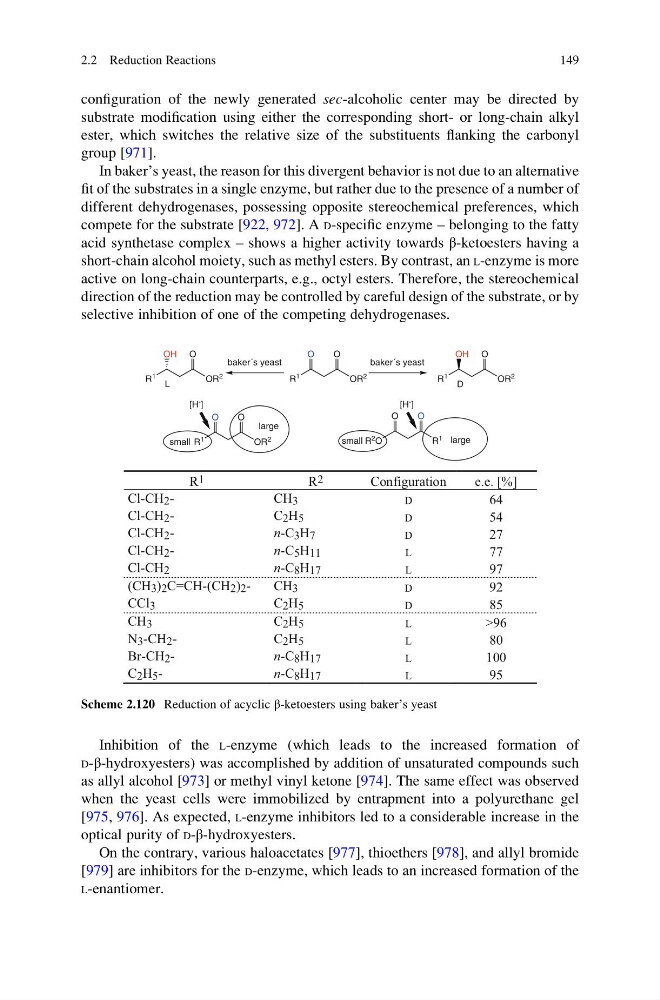
configuration of the newly generated sec-alcoholic center may be directed by
substrate modification using either the corresponding short- or long-chain alkyl
ester, which switches the relative size of the substituents flanking the carbonyl
group [971].
In baker’s yeast, the reason for this divergent behavior is not due to an alternative
fit of the substrates in a single enzyme, but rather due to the presence of a number of
different dehydrogenases, possessing opposite stereochemical preferences, which
compete for the substrate [922, 972]. A D-specific enzyme – belonging to the fatty
acid synthetase complex – shows a higher activity towards β-ketoesters having a
short-chain alcohol moiety, such as methyl esters. By contrast, an L-enzyme is more
active on long-chain counterparts, e.g., octyl esters. Therefore, the stereochemical
direction of the reduction may be controlled by careful design of the substrate, or by
selective inhibition of one of the competing dehydrogenases.
Inhibition of the L-enzyme (which leads to the increased formation of
D-β-hydroxyesters) was accomplished by addition of unsaturated compounds such
as allyl alcohol [973] or methyl vinyl ketone [974]. The same effect was observed
when the yeast cells were immobilized by entrapment into a polyurethane gel
[975, 976]. As expected, L-enzyme inhibitors led to a considerable increase in the
optical purity of D-β-hydroxyesters.
On the contrary, various haloacetates [977], thioethers [978], and allyl bromide
[979] are inhibitors for the D-enzyme, which leads to an increased formation of the
L-enantiomer.
O
O
R
2 O
R
1
O
O
R
1
OR
2
OH O
R
1
OR
2
OH O
R
1
OR
2
O
O
R
1
OR
2
large
small
small
large
L
baker´s yeast
baker´s yeast
D
[H
- ]
[H
- ]
R 1
R 2
Configuration
e.e. [%]
Cl-CH 2 -
C H 3
D
64
Cl-CH 2 -
C 2 H 5
D
54
Cl-CH 2 -
n-C 3 H 7
D
27
Cl-CH 2 -
n-C 5 H 11
L
77
Cl-CH 2
n-C 8 H 17
L
97
(CH 3 ) 2 C=CH-(CH 2 ) 2 -
CH 3
D
92
CCl 3
C 2 H 5
D
85
CH 3
C 2 H 5
L
>96
N 3 -CH 2 -
C 2 H 5
L
80
Br-CH 2 -
n-C 8 H 17
L
100
C 2 H 5 -
n-C 8 H 17
L
95
Scheme 2.120 Reduction of acyclic β-ketoesters using baker’s yeast
2.2 Reduction Reactions
149
substrate modification using either the corresponding short- or long-chain alkyl
ester, which switches the relative size of the substituents flanking the carbonyl
group [971].
In baker’s yeast, the reason for this divergent behavior is not due to an alternative
fit of the substrates in a single enzyme, but rather due to the presence of a number of
different dehydrogenases, possessing opposite stereochemical preferences, which
compete for the substrate [922, 972]. A D-specific enzyme – belonging to the fatty
acid synthetase complex – shows a higher activity towards β-ketoesters having a
short-chain alcohol moiety, such as methyl esters. By contrast, an L-enzyme is more
active on long-chain counterparts, e.g., octyl esters. Therefore, the stereochemical
direction of the reduction may be controlled by careful design of the substrate, or by
selective inhibition of one of the competing dehydrogenases.
Inhibition of the L-enzyme (which leads to the increased formation of
D-β-hydroxyesters) was accomplished by addition of unsaturated compounds such
as allyl alcohol [973] or methyl vinyl ketone [974]. The same effect was observed
when the yeast cells were immobilized by entrapment into a polyurethane gel
[975, 976]. As expected, L-enzyme inhibitors led to a considerable increase in the
optical purity of D-β-hydroxyesters.
On the contrary, various haloacetates [977], thioethers [978], and allyl bromide
[979] are inhibitors for the D-enzyme, which leads to an increased formation of the
L-enantiomer.
O
O
R
2 O
R
1
O
O
R
1
OR
2
OH O
R
1
OR
2
OH O
R
1
OR
2
O
O
R
1
OR
2
large
small
small
large
L
baker´s yeast
baker´s yeast
D
[H
- ]
[H
- ]
R 1
R 2
Configuration
e.e. [%]
Cl-CH 2 -
C H 3
D
64
Cl-CH 2 -
C 2 H 5
D
54
Cl-CH 2 -
n-C 3 H 7
D
27
Cl-CH 2 -
n-C 5 H 11
L
77
Cl-CH 2
n-C 8 H 17
L
97
(CH 3 ) 2 C=CH-(CH 2 ) 2 -
CH 3
D
92
CCl 3
C 2 H 5
D
85
CH 3
C 2 H 5
L
>96
N 3 -CH 2 -
C 2 H 5
L
80
Br-CH 2 -
n-C 8 H 17
L
100
C 2 H 5 -
n-C 8 H 17
L
95
Scheme 2.120 Reduction of acyclic β-ketoesters using baker’s yeast
2.2 Reduction Reactions
149