

using standard laboratory equipment. Thus, it is not surprising that yeast-catalyzed
transformations of nonnatural compounds leading to chiral products have been
reported from the beginning of the twentieth century [940] and the first comprehensive review which covers almost all the different strategies of yeast-reductions
dates back to 1949! [941].
A wide range of functional groups within the ketone are tolerated, including
heterocyclic- [942, 943], fluoro- [944–947], chloro- [948], bromo- [949], perfluoroalkyl- [950], cyano-, azido-, nitro- [951–953], hydroxyl- [954, 955], sulfur- [956–
958], and dithianyl groups [959]. Even organometallic derivatives [960, 961], such
as silyl- [962] and germyl groups [963] are accepted.
Simple aliphatic and aromatic ketones are reduced by fermenting yeast
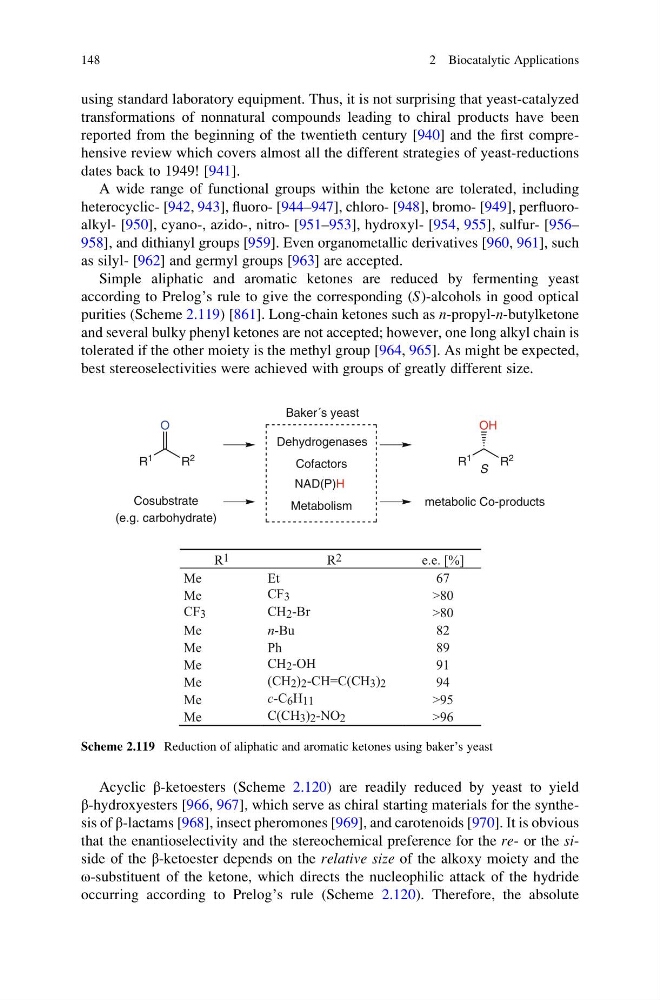
according to Prelog’s rule to give the corresponding (S)-alcohols in good optical
purities (Scheme 2.119) [861]. Long-chain ketones such as n-propyl-n-butylketone
and several bulky phenyl ketones are not accepted; however, one long alkyl chain is
tolerated if the other moiety is the methyl group [964, 965]. As might be expected,
best stereoselectivities were achieved with groups of greatly different size.
Acyclic β-ketoesters (Scheme 2.120) are readily reduced by yeast to yield
β-hydroxyesters [966, 967], which serve as chiral starting materials for the synthesis of β-lactams [968], insect pheromones [969], and carotenoids [970]. It is obvious
that the enantioselectivity and the stereochemical preference for the re- or the siside of the β-ketoester depends on the relative size of the alkoxy moiety and the
ω-substituent of the ketone, which directs the nucleophilic attack of the hydride
occurring according to Prelog’s rule (Scheme 2.120). Therefore, the absolute
OH
R
2
R
1
O
R
2
R
1
(e.g. carbohydrate)
Baker´s yeast
Dehydrogenases
Metabolism
Cosubstrate
Cofactors
NAD(P)H
S
R 1
R 2
e.e. [%]
Me
Et
67
Me
CF 3
>80
CF 3
CH 2 -Br
>80
Me
n-Bu
82
Me
Ph
89
Me
CH 2 -OH
91
Me
(CH 2 ) 2 -CH=C(CH 3 ) 2
94
Me
c-C 6 H 11
>95
Me
C(CH 3 ) 2 -NO 2
>96
metabolic Co-products
Scheme 2.119 Reduction of aliphatic and aromatic ketones using baker’s yeast
148
2 Biocatalytic Applications
transformations of nonnatural compounds leading to chiral products have been
reported from the beginning of the twentieth century [940] and the first comprehensive review which covers almost all the different strategies of yeast-reductions
dates back to 1949! [941].
A wide range of functional groups within the ketone are tolerated, including
heterocyclic- [942, 943], fluoro- [944–947], chloro- [948], bromo- [949], perfluoroalkyl- [950], cyano-, azido-, nitro- [951–953], hydroxyl- [954, 955], sulfur- [956–
958], and dithianyl groups [959]. Even organometallic derivatives [960, 961], such
as silyl- [962] and germyl groups [963] are accepted.
Simple aliphatic and aromatic ketones are reduced by fermenting yeast
according to Prelog’s rule to give the corresponding (S)-alcohols in good optical
purities (Scheme 2.119) [861]. Long-chain ketones such as n-propyl-n-butylketone
and several bulky phenyl ketones are not accepted; however, one long alkyl chain is
tolerated if the other moiety is the methyl group [964, 965]. As might be expected,
best stereoselectivities were achieved with groups of greatly different size.
Acyclic β-ketoesters (Scheme 2.120) are readily reduced by yeast to yield
β-hydroxyesters [966, 967], which serve as chiral starting materials for the synthesis of β-lactams [968], insect pheromones [969], and carotenoids [970]. It is obvious
that the enantioselectivity and the stereochemical preference for the re- or the siside of the β-ketoester depends on the relative size of the alkoxy moiety and the
ω-substituent of the ketone, which directs the nucleophilic attack of the hydride
occurring according to Prelog’s rule (Scheme 2.120). Therefore, the absolute
OH
R
2
R
1
O
R
2
R
1
(e.g. carbohydrate)
Baker´s yeast
Dehydrogenases
Metabolism
Cosubstrate
Cofactors
NAD(P)H
S
R 1
R 2
e.e. [%]
Me
Et
67
Me
CF 3
>80
CF 3
CH 2 -Br
>80
Me
n-Bu
82
Me
Ph
89
Me
CH 2 -OH
91
Me
(CH 2 ) 2 -CH=C(CH 3 ) 2
94
Me
c-C 6 H 11
>95
Me
C(CH 3 ) 2 -NO 2
>96
metabolic Co-products
Scheme 2.119 Reduction of aliphatic and aromatic ketones using baker’s yeast
148
2 Biocatalytic Applications