

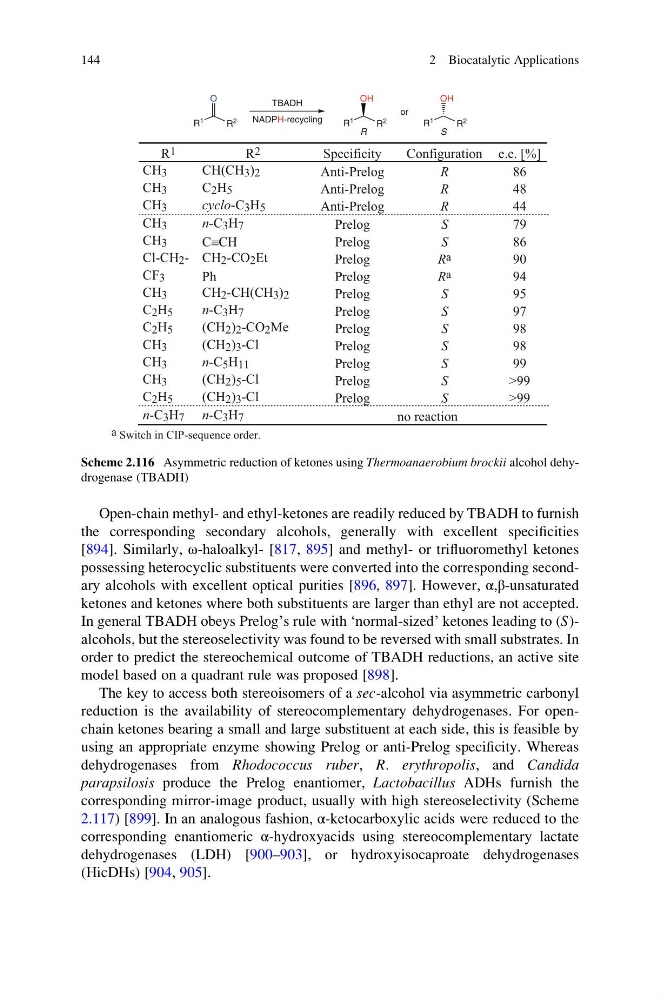
Open-chain methyl- and ethyl-ketones are readily reduced by TBADH to furnish
the corresponding secondary alcohols, generally with excellent specificities
[894]. Similarly, ω-haloalkyl- [817, 895] and methyl- or trifluoromethyl ketones
possessing heterocyclic substituents were converted into the corresponding secondary alcohols with excellent optical purities [896, 897]. However, α,β-unsaturated
ketones and ketones where both substituents are larger than ethyl are not accepted.
In general TBADH obeys Prelog’s rule with ‘normal-sized’ ketones leading to (S)alcohols, but the stereoselectivity was found to be reversed with small substrates. In
order to predict the stereochemical outcome of TBADH reductions, an active site
model based on a quadrant rule was proposed [898].
The key to access both stereoisomers of a sec-alcohol via asymmetric carbonyl
reduction is the availability of stereocomplementary dehydrogenases. For openchain ketones bearing a small and large substituent at each side, this is feasible by
using an appropriate enzyme showing Prelog or anti-Prelog specificity. Whereas
dehydrogenases from Rhodococcus ruber, R. erythropolis, and Candida
parapsilosis produce the Prelog enantiomer, Lactobacillus ADHs furnish the
corresponding mirror-image product, usually with high stereoselectivity (Scheme
2.117) [899]. In an analogous fashion, α-ketocarboxylic acids were reduced to the
corresponding enantiomeric α-hydroxyacids using stereocomplementary lactate
dehydrogenases (LDH) [900–903], or hydroxyisocaproate dehydrogenases
(HicDHs) [904, 905].
OH
R
2
R
1
OH
R
2
R
1
O
R
2
R
1
or
NADPH-recycling
R
S
TBADH
R 1
R 2
Specificity
Configuration e.e. [%]
CH 3
CH(CH 3 ) 2
Anti-Prelog
R
86
CH 3
C 2 H 5
Anti-Prelog
R
48
CH 3
cyclo-C 3 H 5
Anti-Prelog
R
44
CH 3
n-C 3 H 7
Prelog
S
79
CH 3
C≡CH
Prelog
S
86
Cl-CH 2 - CH 2 -CO 2 Et
Prelog
R a
90
CF 3
Ph
Prelog
R a
94
CH 3
CH 2 -CH(CH 3 ) 2
Prelog
S
95
C 2 H 5
n-C 3 H 7
Prelog
S
97
C 2 H 5
(CH 2 ) 2 -CO 2 Me
Prelog
S
98
CH 3
(CH 2 ) 3 -Cl
Prelog
S
98
CH 3
n-C 5 H 11
Prelog
S
99
CH 3
(CH 2 ) 5 -Cl
Prelog
S
>99
C 2 H 5
(CH 2 ) 3 -Cl
Prelog
S
>99
n-C 3 H 7 n-C 3 H 7
no reaction
a Switch in CIP-sequence order.
Scheme 2.116 Asymmetric reduction of ketones using Thermoanaerobium brockii alcohol dehydrogenase (TBADH)
144
2 Biocatalytic Applications
the corresponding secondary alcohols, generally with excellent specificities
[894]. Similarly, ω-haloalkyl- [817, 895] and methyl- or trifluoromethyl ketones
possessing heterocyclic substituents were converted into the corresponding secondary alcohols with excellent optical purities [896, 897]. However, α,β-unsaturated
ketones and ketones where both substituents are larger than ethyl are not accepted.
In general TBADH obeys Prelog’s rule with ‘normal-sized’ ketones leading to (S)alcohols, but the stereoselectivity was found to be reversed with small substrates. In
order to predict the stereochemical outcome of TBADH reductions, an active site
model based on a quadrant rule was proposed [898].
The key to access both stereoisomers of a sec-alcohol via asymmetric carbonyl
reduction is the availability of stereocomplementary dehydrogenases. For openchain ketones bearing a small and large substituent at each side, this is feasible by
using an appropriate enzyme showing Prelog or anti-Prelog specificity. Whereas
dehydrogenases from Rhodococcus ruber, R. erythropolis, and Candida
parapsilosis produce the Prelog enantiomer, Lactobacillus ADHs furnish the
corresponding mirror-image product, usually with high stereoselectivity (Scheme
2.117) [899]. In an analogous fashion, α-ketocarboxylic acids were reduced to the
corresponding enantiomeric α-hydroxyacids using stereocomplementary lactate
dehydrogenases (LDH) [900–903], or hydroxyisocaproate dehydrogenases
(HicDHs) [904, 905].
OH
R
2
R
1
OH
R
2
R
1
O
R
2
R
1
or
NADPH-recycling
R
S
TBADH
R 1
R 2
Specificity
Configuration e.e. [%]
CH 3
CH(CH 3 ) 2
Anti-Prelog
R
86
CH 3
C 2 H 5
Anti-Prelog
R
48
CH 3
cyclo-C 3 H 5
Anti-Prelog
R
44
CH 3
n-C 3 H 7
Prelog
S
79
CH 3
C≡CH
Prelog
S
86
Cl-CH 2 - CH 2 -CO 2 Et
Prelog
R a
90
CF 3
Ph
Prelog
R a
94
CH 3
CH 2 -CH(CH 3 ) 2
Prelog
S
95
C 2 H 5
n-C 3 H 7
Prelog
S
97
C 2 H 5
(CH 2 ) 2 -CO 2 Me
Prelog
S
98
CH 3
(CH 2 ) 3 -Cl
Prelog
S
98
CH 3
n-C 5 H 11
Prelog
S
99
CH 3
(CH 2 ) 5 -Cl
Prelog
S
>99
C 2 H 5
(CH 2 ) 3 -Cl
Prelog
S
>99
n-C 3 H 7 n-C 3 H 7
no reaction
a Switch in CIP-sequence order.
Scheme 2.116 Asymmetric reduction of ketones using Thermoanaerobium brockii alcohol dehydrogenase (TBADH)
144
2 Biocatalytic Applications