

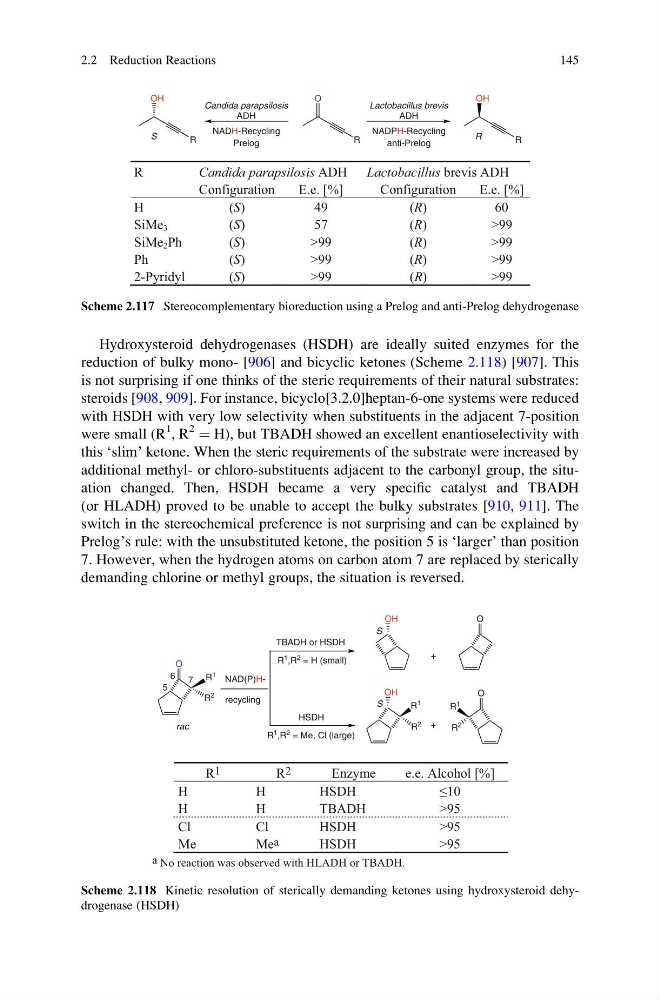
Hydroxysteroid dehydrogenases (HSDH) are ideally suited enzymes for the
reduction of bulky mono- [906] and bicyclic ketones (Scheme 2.118) [907]. This
is not surprising if one thinks of the steric requirements of their natural substrates:
steroids [908, 909]. For instance, bicyclo[3.2.0]heptan-6-one systems were reduced
with HSDH with very low selectivity when substituents in the adjacent 7-position
were small (R
1 , R
2 ¼ H), but TBADH showed an excellent enantioselectivity with
this ‘slim’ ketone. When the steric requirements of the substrate were increased by
additional methyl- or chloro-substituents adjacent to the carbonyl group, the situation changed. Then, HSDH became a very specific catalyst and TBADH
(or HLADH) proved to be unable to accept the bulky substrates [910, 911]. The
switch in the stereochemical preference is not surprising and can be explained by
Prelog’s rule: with the unsubstituted ketone, the position 5 is ‘larger’ than position
7. However, when the hydrogen atoms on carbon atom 7 are replaced by sterically
demanding chlorine or methyl groups, the situation is reversed.
R
OH
R
OH
R
O
Prelog
anti-Prelog
Candida parapsilosis
ADH
Lactobacillus brevis
ADH
NADH-Recycling
NADPH-Recycling
S
R
R
Candida parapsilosis ADH Lactobacillus brevis ADH
Configuration
E.e. [%]
Configuration
E.e. [%]
H
( S)
4 9
( R)
6 0
SiMe 3
(S)
5 7
( R)
> 9 9
SiMe 2 Ph
(S)
> 9 9
( R)
> 9 9
Ph
(S)
> 9 9
( R)
> 9 9
2-Pyridyl
(S)
> 9 9
( R)
> 9 9
Scheme 2.117 Stereocomplementary bioreduction using a Prelog and anti-Prelog dehydrogenase
R 2
R
1
O
R
2
R
1
OH
O
OH
R
2
R
1
O
TBADH or HSDH
NAD(P)Hrecycling
R 1 ,R
2 = Me, Cl (large)
R 1 ,R
2 = H (small)
+
+
5
6 7
rac
HSDH
S
S
R 1
R 2
Enzyme
e.e. Alcohol [%]
H
H
H S D H
≤ 1 0
H
H
TBADH
>95
Cl
Cl
HSDH
>95
Me
Me a
HSDH
>95
a No reaction was observed with HLADH or TBADH.
Scheme 2.118 Kinetic resolution of sterically demanding ketones using hydroxysteroid dehydrogenase (HSDH)
2.2 Reduction Reactions
145
reduction of bulky mono- [906] and bicyclic ketones (Scheme 2.118) [907]. This
is not surprising if one thinks of the steric requirements of their natural substrates:
steroids [908, 909]. For instance, bicyclo[3.2.0]heptan-6-one systems were reduced
with HSDH with very low selectivity when substituents in the adjacent 7-position
were small (R
1 , R
2 ¼ H), but TBADH showed an excellent enantioselectivity with
this ‘slim’ ketone. When the steric requirements of the substrate were increased by
additional methyl- or chloro-substituents adjacent to the carbonyl group, the situation changed. Then, HSDH became a very specific catalyst and TBADH
(or HLADH) proved to be unable to accept the bulky substrates [910, 911]. The
switch in the stereochemical preference is not surprising and can be explained by
Prelog’s rule: with the unsubstituted ketone, the position 5 is ‘larger’ than position
7. However, when the hydrogen atoms on carbon atom 7 are replaced by sterically
demanding chlorine or methyl groups, the situation is reversed.
R
OH
R
OH
R
O
Prelog
anti-Prelog
Candida parapsilosis
ADH
Lactobacillus brevis
ADH
NADH-Recycling
NADPH-Recycling
S
R
R
Candida parapsilosis ADH Lactobacillus brevis ADH
Configuration
E.e. [%]
Configuration
E.e. [%]
H
( S)
4 9
( R)
6 0
SiMe 3
(S)
5 7
( R)
> 9 9
SiMe 2 Ph
(S)
> 9 9
( R)
> 9 9
Ph
(S)
> 9 9
( R)
> 9 9
2-Pyridyl
(S)
> 9 9
( R)
> 9 9
Scheme 2.117 Stereocomplementary bioreduction using a Prelog and anti-Prelog dehydrogenase
R 2
R
1
O
R
2
R
1
OH
O
OH
R
2
R
1
O
TBADH or HSDH
NAD(P)Hrecycling
R 1 ,R
2 = Me, Cl (large)
R 1 ,R
2 = H (small)
+
+
5
6 7
rac
HSDH
S
S
R 1
R 2
Enzyme
e.e. Alcohol [%]
H
H
H S D H
≤ 1 0
H
H
TBADH
>95
Cl
Cl
HSDH
>95
Me
Me a
HSDH
>95
a No reaction was observed with HLADH or TBADH.
Scheme 2.118 Kinetic resolution of sterically demanding ketones using hydroxysteroid dehydrogenase (HSDH)
2.2 Reduction Reactions
145