

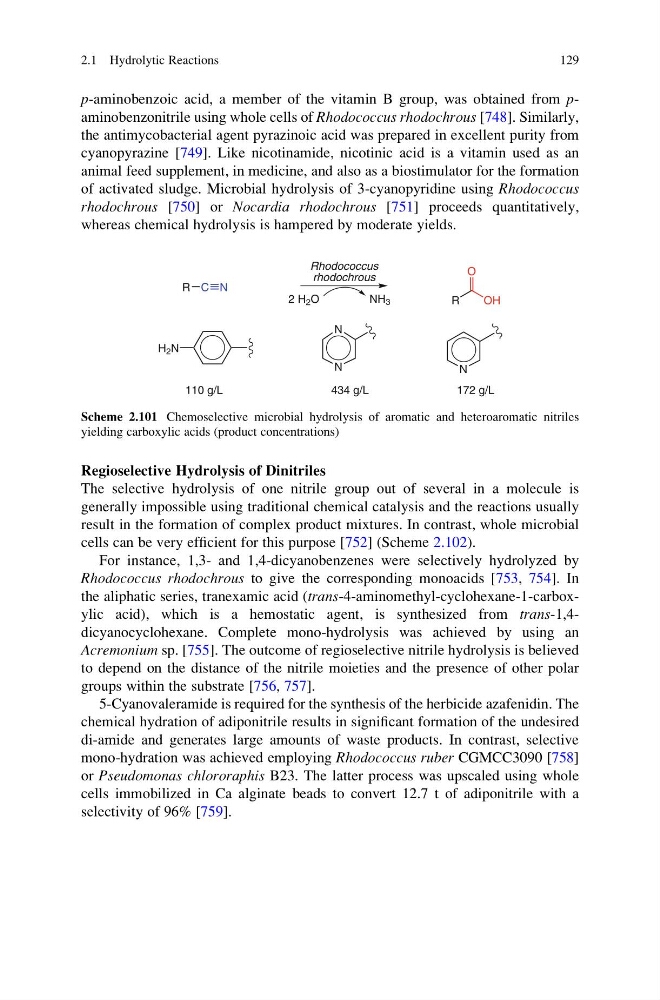
p-aminobenzoic acid, a member of the vitamin B group, was obtained from paminobenzonitrile using whole cells of Rhodococcus rhodochrous [748]. Similarly,
the antimycobacterial agent pyrazinoic acid was prepared in excellent purity from
cyanopyrazine [749]. Like nicotinamide, nicotinic acid is a vitamin used as an
animal feed supplement, in medicine, and also as a biostimulator for the formation
of activated sludge. Microbial hydrolysis of 3-cyanopyridine using Rhodococcus
rhodochrous [750] or Nocardia rhodochrous [751] proceeds quantitatively,
whereas chemical hydrolysis is hampered by moderate yields.
Regioselective Hydrolysis of Dinitriles
The selective hydrolysis of one nitrile group out of several in a molecule is
generally impossible using traditional chemical catalysis and the reactions usually
result in the formation of complex product mixtures. In contrast, whole microbial
cells can be very efficient for this purpose [752] (Scheme 2.102).
For instance, 1,3- and 1,4-dicyanobenzenes were selectively hydrolyzed by
Rhodococcus rhodochrous to give the corresponding monoacids [753, 754]. In
the aliphatic series, tranexamic acid (trans-4-aminomethyl-cyclohexane-1-carboxylic acid), which is a hemostatic agent, is synthesized from trans-1,4dicyanocyclohexane. Complete mono-hydrolysis was achieved by using an
Acremonium sp. [755]. The outcome of regioselective nitrile hydrolysis is believed
to depend on the distance of the nitrile moieties and the presence of other polar
groups within the substrate [756, 757].
5-Cyanovaleramide is required for the synthesis of the herbicide azafenidin. The
chemical hydration of adiponitrile results in significant formation of the undesired
di-amide and generates large amounts of waste products. In contrast, selective
mono-hydration was achieved employing Rhodococcus ruber CGMCC3090 [758]
or Pseudomonas chlororaphis B23. The latter process was upscaled using whole
cells immobilized in Ca alginate beads to convert 12.7 t of adiponitrile with a
selectivity of 96% [759].
N
C
R
OH
O
R
H 2 N
N
N
N
172 g/L
434 g/L
110 g/L
rhodochrous
Rhodococcus
2 H 2 O
NH 3
Scheme 2.101 Chemoselective microbial hydrolysis of aromatic and heteroaromatic nitriles
yielding carboxylic acids (product concentrations)
2.1 Hydrolytic Reactions
129
the antimycobacterial agent pyrazinoic acid was prepared in excellent purity from
cyanopyrazine [749]. Like nicotinamide, nicotinic acid is a vitamin used as an
animal feed supplement, in medicine, and also as a biostimulator for the formation
of activated sludge. Microbial hydrolysis of 3-cyanopyridine using Rhodococcus
rhodochrous [750] or Nocardia rhodochrous [751] proceeds quantitatively,
whereas chemical hydrolysis is hampered by moderate yields.
Regioselective Hydrolysis of Dinitriles
The selective hydrolysis of one nitrile group out of several in a molecule is
generally impossible using traditional chemical catalysis and the reactions usually
result in the formation of complex product mixtures. In contrast, whole microbial
cells can be very efficient for this purpose [752] (Scheme 2.102).
For instance, 1,3- and 1,4-dicyanobenzenes were selectively hydrolyzed by
Rhodococcus rhodochrous to give the corresponding monoacids [753, 754]. In
the aliphatic series, tranexamic acid (trans-4-aminomethyl-cyclohexane-1-carboxylic acid), which is a hemostatic agent, is synthesized from trans-1,4dicyanocyclohexane. Complete mono-hydrolysis was achieved by using an
Acremonium sp. [755]. The outcome of regioselective nitrile hydrolysis is believed
to depend on the distance of the nitrile moieties and the presence of other polar
groups within the substrate [756, 757].
5-Cyanovaleramide is required for the synthesis of the herbicide azafenidin. The
chemical hydration of adiponitrile results in significant formation of the undesired
di-amide and generates large amounts of waste products. In contrast, selective
mono-hydration was achieved employing Rhodococcus ruber CGMCC3090 [758]
or Pseudomonas chlororaphis B23. The latter process was upscaled using whole
cells immobilized in Ca alginate beads to convert 12.7 t of adiponitrile with a
selectivity of 96% [759].
N
C
R
OH
O
R
H 2 N
N
N
N
172 g/L
434 g/L
110 g/L
rhodochrous
Rhodococcus
2 H 2 O
NH 3
Scheme 2.101 Chemoselective microbial hydrolysis of aromatic and heteroaromatic nitriles
yielding carboxylic acids (product concentrations)
2.1 Hydrolytic Reactions
129