

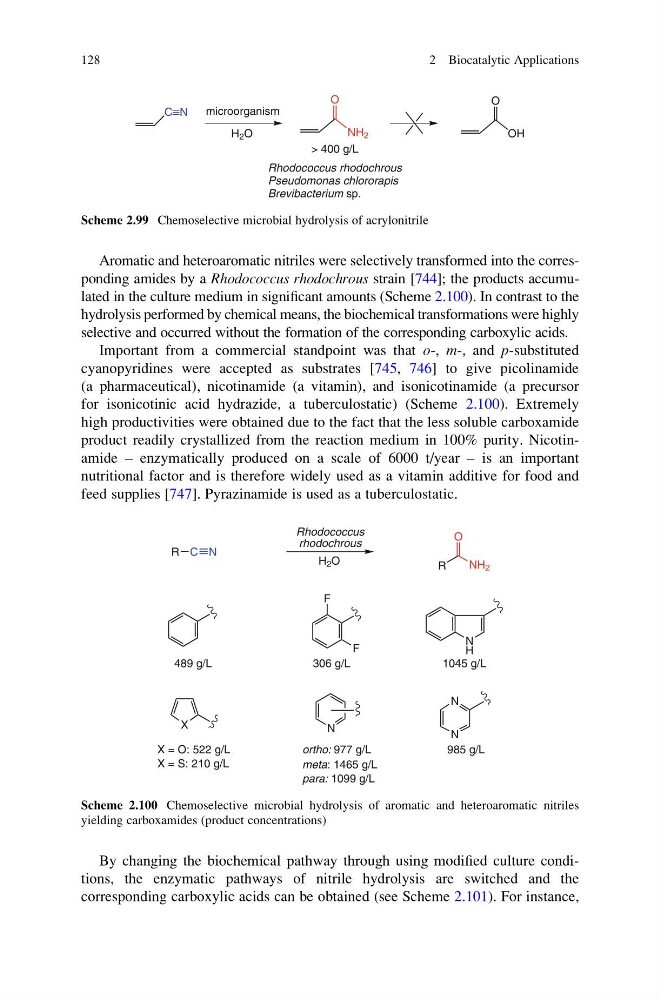
Aromatic and heteroaromatic nitriles were selectively transformed into the corresponding amides by a Rhodococcus rhodochrous strain [744]; the products accumulated in the culture medium in significant amounts (Scheme 2.100). In contrast to the
hydrolysis performed by chemical means, the biochemical transformations were highly
selective and occurred without the formation of the corresponding carboxylic acids.
Important from a commercial standpoint was that o-, m-, and p-substituted
cyanopyridines were accepted as substrates [745, 746] to give picolinamide
(a pharmaceutical), nicotinamide (a vitamin), and isonicotinamide (a precursor
for isonicotinic acid hydrazide, a tuberculostatic) (Scheme 2.100). Extremely
high productivities were obtained due to the fact that the less soluble carboxamide
product readily crystallized from the reaction medium in 100% purity. Nicotinamide – enzymatically produced on a scale of 6000 t/year – is an important
nutritional factor and is therefore widely used as a vitamin additive for food and
feed supplies [747]. Pyrazinamide is used as a tuberculostatic.
By changing the biochemical pathway through using modified culture conditions, the enzymatic pathways of nitrile hydrolysis are switched and the
corresponding carboxylic acids can be obtained (see Scheme 2.101). For instance,
O
OH
O
NH 2
C≡N
> 400 g/L
Rhodococcus rhodochrous
Pseudomonas chlororapis
Brevibacterium sp.
microorganism
H 2 O
Scheme 2.99 Chemoselective microbial hydrolysis of acrylonitrile
N
C
R
NH 2
O
R
F
F
N
N
N
X
N
H
X = O: 522 g/L
rhodochrous
Rhodococcus
489 g/L
306 g/L
1045 g/L
X = S: 210 g/L
985 g/L
para: 1099 g/L
meta: 1465 g/L
ortho: 977 g/L
H 2 O
Scheme 2.100 Chemoselective microbial hydrolysis of aromatic and heteroaromatic nitriles
yielding carboxamides (product concentrations)
128
2 Biocatalytic Applications
hydrolysis performed by chemical means, the biochemical transformations were highly
selective and occurred without the formation of the corresponding carboxylic acids.
Important from a commercial standpoint was that o-, m-, and p-substituted
cyanopyridines were accepted as substrates [745, 746] to give picolinamide
(a pharmaceutical), nicotinamide (a vitamin), and isonicotinamide (a precursor
for isonicotinic acid hydrazide, a tuberculostatic) (Scheme 2.100). Extremely
high productivities were obtained due to the fact that the less soluble carboxamide
product readily crystallized from the reaction medium in 100% purity. Nicotinamide – enzymatically produced on a scale of 6000 t/year – is an important
nutritional factor and is therefore widely used as a vitamin additive for food and
feed supplies [747]. Pyrazinamide is used as a tuberculostatic.
By changing the biochemical pathway through using modified culture conditions, the enzymatic pathways of nitrile hydrolysis are switched and the
corresponding carboxylic acids can be obtained (see Scheme 2.101). For instance,
O
OH
O
NH 2
C≡N
> 400 g/L
Rhodococcus rhodochrous
Pseudomonas chlororapis
Brevibacterium sp.
microorganism
H 2 O
Scheme 2.99 Chemoselective microbial hydrolysis of acrylonitrile
N
C
R
NH 2
O
R
F
F
N
N
N
X
N
H
X = O: 522 g/L
rhodochrous
Rhodococcus
489 g/L
306 g/L
1045 g/L
X = S: 210 g/L
985 g/L
para: 1099 g/L
meta: 1465 g/L
ortho: 977 g/L
H 2 O
Scheme 2.100 Chemoselective microbial hydrolysis of aromatic and heteroaromatic nitriles
yielding carboxamides (product concentrations)
128
2 Biocatalytic Applications