

rely on metal catalysts, e.g. Raney-copper or manganese dioxide. Overall, energy
consumption is high and unwanted side-products arising from over-hydrolysis or
decomposition are common. Considerable amounts of salts are formed during
neutralization. Using enzymatic methods, conducted at physiological pH, most of
these drawbacks can be avoided. Additionally, these transformations can often be
achieved in a chemo-, regio-, and enantioselective manner. Due to the fact that
isolated nitrile-hydrolyzing enzymes are often very sensitive [696], the majority of
transformations have been performed using sturdy whole-cell systems.
Another important aspect is the enzymatic hydrolysis of cyanide and nitriles for
the detoxification of industrial effluents [733–736].
Chemoselective Hydrolysis of Nitriles
The microorganisms used as sources of nitrile-hydrolyzing enzymes usually belong
to the genera Bacillus, Brevibacterium, Micrococcus, Rhodococcus, Pseudomonas,
and Bacteridium and they generally show a broad metabolic diversity. Depending
on the source of carbon and nitrogen – acting as ‘inducer’ – added to the culture
medium, either nitrilases or nitrile hydratases are predominantly produced by the
cell. Thus, the desired hydrolytic pathway leading to an amide or a carboxylic acid
can often be biologically ‘switched on’ during the growth of the culture by using
aliphatic or aromatic nitriles as inducers. In order to avoid substrate inhibition
(which is a more common phenomenon with nitrile-hydrolyzing enzymes than
product inhibition [737]) the substrates are fed continuously to the culture.
Acrylamide is one of the most important commodity chemicals for the synthesis
of various polymers and is produced in an amount of about 2 Mt/year worldwide. In
its conventional synthesis, the hydration of acrylonitrile is performed with copper
catalysts. However, the preparative procedure for the catalyst, difficulties in its
regeneration, problems associated with separation and purification of the formed
acrylamide, undesired polymerization and over-hydrolysis are serious drawbacks.
Using whole cells of Brevibacterium sp. [738, 739], Pseudomonas chlororapis
[740, 741] or Rhodococcus rhodochrous [742] acrylonitrile can be converted into
acrylamide in yields of >99%; the formation of byproducts such as acrylic acid is
circumvented by blocking of the amidase activity. The scale of this biotransformation exceeds 600,000 t/year [743] (Scheme 2.99).
OH
O
R
H
Enz
R
N H 2
S
O
Enz
S
O
R
Enz
S
NH
R
N
C
R
Enz
HS
H 2 O
NH 3
H 2 O
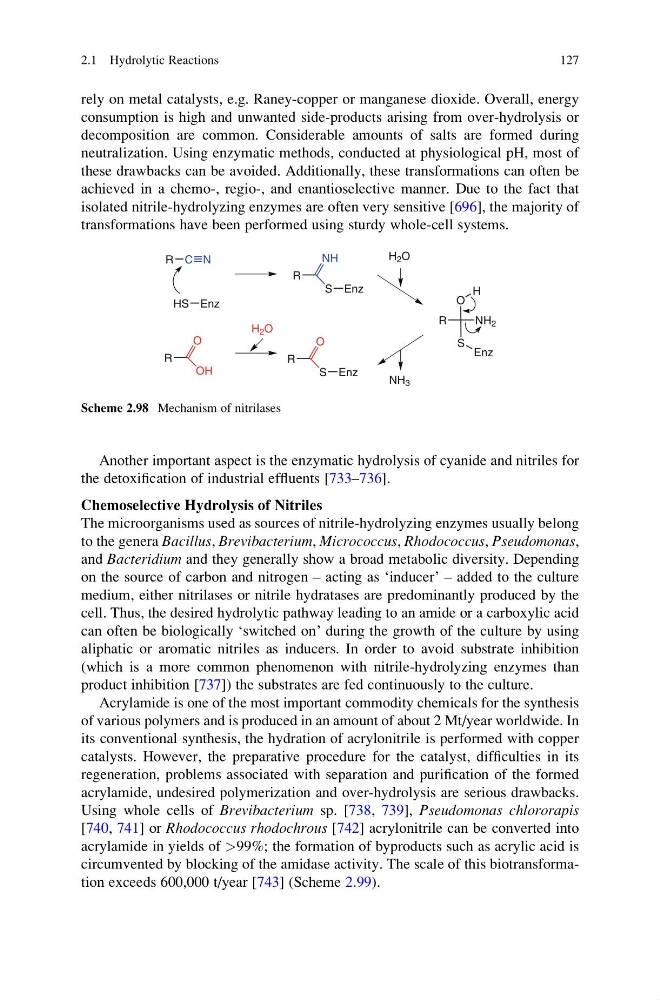
Scheme 2.98 Mechanism of nitrilases
2.1 Hydrolytic Reactions
127
consumption is high and unwanted side-products arising from over-hydrolysis or
decomposition are common. Considerable amounts of salts are formed during
neutralization. Using enzymatic methods, conducted at physiological pH, most of
these drawbacks can be avoided. Additionally, these transformations can often be
achieved in a chemo-, regio-, and enantioselective manner. Due to the fact that
isolated nitrile-hydrolyzing enzymes are often very sensitive [696], the majority of
transformations have been performed using sturdy whole-cell systems.
Another important aspect is the enzymatic hydrolysis of cyanide and nitriles for
the detoxification of industrial effluents [733–736].
Chemoselective Hydrolysis of Nitriles
The microorganisms used as sources of nitrile-hydrolyzing enzymes usually belong
to the genera Bacillus, Brevibacterium, Micrococcus, Rhodococcus, Pseudomonas,
and Bacteridium and they generally show a broad metabolic diversity. Depending
on the source of carbon and nitrogen – acting as ‘inducer’ – added to the culture
medium, either nitrilases or nitrile hydratases are predominantly produced by the
cell. Thus, the desired hydrolytic pathway leading to an amide or a carboxylic acid
can often be biologically ‘switched on’ during the growth of the culture by using
aliphatic or aromatic nitriles as inducers. In order to avoid substrate inhibition
(which is a more common phenomenon with nitrile-hydrolyzing enzymes than
product inhibition [737]) the substrates are fed continuously to the culture.
Acrylamide is one of the most important commodity chemicals for the synthesis
of various polymers and is produced in an amount of about 2 Mt/year worldwide. In
its conventional synthesis, the hydration of acrylonitrile is performed with copper
catalysts. However, the preparative procedure for the catalyst, difficulties in its
regeneration, problems associated with separation and purification of the formed
acrylamide, undesired polymerization and over-hydrolysis are serious drawbacks.
Using whole cells of Brevibacterium sp. [738, 739], Pseudomonas chlororapis
[740, 741] or Rhodococcus rhodochrous [742] acrylonitrile can be converted into
acrylamide in yields of >99%; the formation of byproducts such as acrylic acid is
circumvented by blocking of the amidase activity. The scale of this biotransformation exceeds 600,000 t/year [743] (Scheme 2.99).
OH
O
R
H
Enz
R
N H 2
S
O
Enz
S
O
R
Enz
S
NH
R
N
C
R
Enz
HS
H 2 O
NH 3
H 2 O
Scheme 2.98 Mechanism of nitrilases
2.1 Hydrolytic Reactions
127