

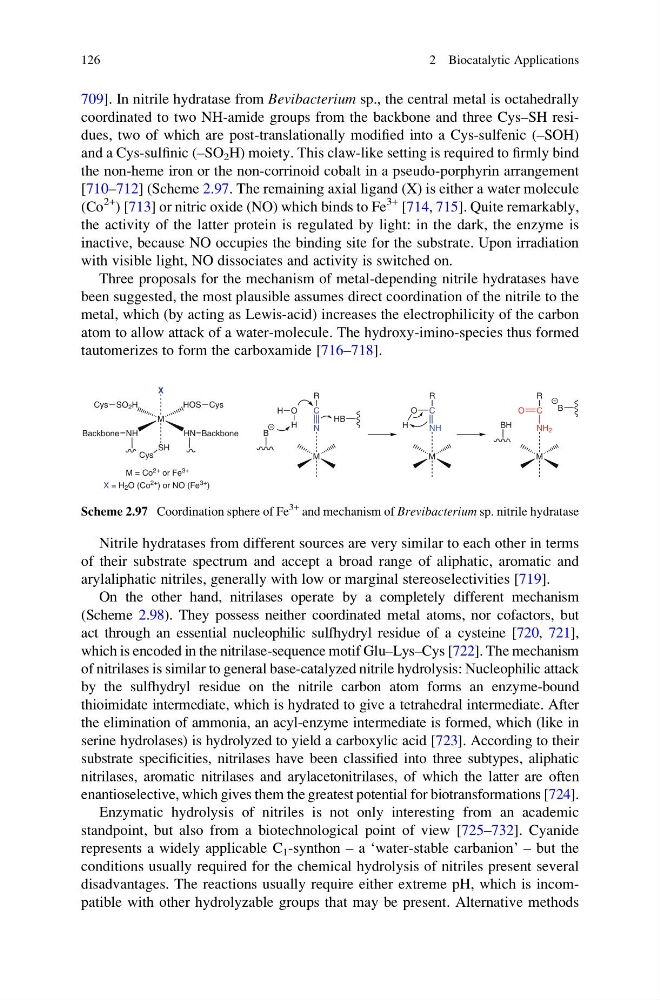
709]. In nitrile hydratase from Bevibacterium sp., the central metal is octahedrally
coordinated to two NH-amide groups from the backbone and three Cys–SH residues, two of which are post-translationally modified into a Cys-sulfenic (–SOH)
and a Cys-sulfinic (–SO 2 H) moiety. This claw-like setting is required to firmly bind
the non-heme iron or the non-corrinoid cobalt in a pseudo-porphyrin arrangement
[710–712] (Scheme 2.97. The remaining axial ligand (X) is either a water molecule
(Co
2+ ) [713] or nitric oxide (NO) which binds to Fe
3+ [714, 715]. Quite remarkably,
the activity of the latter protein is regulated by light: in the dark, the enzyme is
inactive, because NO occupies the binding site for the substrate. Upon irradiation
with visible light, NO dissociates and activity is switched on.
Three proposals for the mechanism of metal-depending nitrile hydratases have
been suggested, the most plausible assumes direct coordination of the nitrile to the
metal, which (by acting as Lewis-acid) increases the electrophilicity of the carbon
atom to allow attack of a water-molecule. The hydroxy-imino-species thus formed
tautomerizes to form the carboxamide [716–718].
Nitrile hydratases from different sources are very similar to each other in terms
of their substrate spectrum and accept a broad range of aliphatic, aromatic and
arylaliphatic nitriles, generally with low or marginal stereoselectivities [719].
On the other hand, nitrilases operate by a completely different mechanism
(Scheme 2.98). They possess neither coordinated metal atoms, nor cofactors, but
act through an essential nucleophilic sulfhydryl residue of a cysteine [720, 721],
which is encoded in the nitrilase-sequence motif Glu–Lys–Cys [722]. The mechanism
of nitrilases is similar to general base-catalyzed nitrile hydrolysis: Nucleophilic attack
by the sulfhydryl residue on the nitrile carbon atom forms an enzyme-bound
thioimidate intermediate, which is hydrated to give a tetrahedral intermediate. After
the elimination of ammonia, an acyl-enzyme intermediate is formed, which (like in
serine hydrolases) is hydrolyzed to yield a carboxylic acid [723]. According to their
substrate specificities, nitrilases have been classified into three subtypes, aliphatic
nitrilases, aromatic nitrilases and arylacetonitrilases, of which the latter are often
enantioselective, which gives them the greatest potential for biotransformations [724].
Enzymatic hydrolysis of nitriles is not only interesting from an academic
standpoint, but also from a biotechnological point of view [725–732]. Cyanide
represents a widely applicable C 1 -synthon – a ‘water-stable carbanion’ – but the
conditions usually required for the chemical hydrolysis of nitriles present several
disadvantages. The reactions usually require either extreme pH, which is incompatible with other hydrolyzable groups that may be present. Alternative methods
Cys
Backbone
Backbone
Cys
Cys SO 2 H
HOS
HN
NH
SH
M
X
H
H O
B
M = Co 2+ or Fe 3+
X = H 2 O (Co 2+ ) or NO (Fe 3+ )
M
R
C
N
HB
M
R
C
NH
O
H
M
R
C
NH 2
O
BH
B
Scheme 2.97 Coordination sphere of Fe
3+ and mechanism of Brevibacterium sp. nitrile hydratase
126
2 Biocatalytic Applications
coordinated to two NH-amide groups from the backbone and three Cys–SH residues, two of which are post-translationally modified into a Cys-sulfenic (–SOH)
and a Cys-sulfinic (–SO 2 H) moiety. This claw-like setting is required to firmly bind
the non-heme iron or the non-corrinoid cobalt in a pseudo-porphyrin arrangement
[710–712] (Scheme 2.97. The remaining axial ligand (X) is either a water molecule
(Co
2+ ) [713] or nitric oxide (NO) which binds to Fe
3+ [714, 715]. Quite remarkably,
the activity of the latter protein is regulated by light: in the dark, the enzyme is
inactive, because NO occupies the binding site for the substrate. Upon irradiation
with visible light, NO dissociates and activity is switched on.
Three proposals for the mechanism of metal-depending nitrile hydratases have
been suggested, the most plausible assumes direct coordination of the nitrile to the
metal, which (by acting as Lewis-acid) increases the electrophilicity of the carbon
atom to allow attack of a water-molecule. The hydroxy-imino-species thus formed
tautomerizes to form the carboxamide [716–718].
Nitrile hydratases from different sources are very similar to each other in terms
of their substrate spectrum and accept a broad range of aliphatic, aromatic and
arylaliphatic nitriles, generally with low or marginal stereoselectivities [719].
On the other hand, nitrilases operate by a completely different mechanism
(Scheme 2.98). They possess neither coordinated metal atoms, nor cofactors, but
act through an essential nucleophilic sulfhydryl residue of a cysteine [720, 721],
which is encoded in the nitrilase-sequence motif Glu–Lys–Cys [722]. The mechanism
of nitrilases is similar to general base-catalyzed nitrile hydrolysis: Nucleophilic attack
by the sulfhydryl residue on the nitrile carbon atom forms an enzyme-bound
thioimidate intermediate, which is hydrated to give a tetrahedral intermediate. After
the elimination of ammonia, an acyl-enzyme intermediate is formed, which (like in
serine hydrolases) is hydrolyzed to yield a carboxylic acid [723]. According to their
substrate specificities, nitrilases have been classified into three subtypes, aliphatic
nitrilases, aromatic nitrilases and arylacetonitrilases, of which the latter are often
enantioselective, which gives them the greatest potential for biotransformations [724].
Enzymatic hydrolysis of nitriles is not only interesting from an academic
standpoint, but also from a biotechnological point of view [725–732]. Cyanide
represents a widely applicable C 1 -synthon – a ‘water-stable carbanion’ – but the
conditions usually required for the chemical hydrolysis of nitriles present several
disadvantages. The reactions usually require either extreme pH, which is incompatible with other hydrolyzable groups that may be present. Alternative methods
Cys
Backbone
Backbone
Cys
Cys SO 2 H
HOS
HN
NH
SH
M
X
H
H O
B
M = Co 2+ or Fe 3+
X = H 2 O (Co 2+ ) or NO (Fe 3+ )
M
R
C
N
HB
M
R
C
NH
O
H
M
R
C
NH 2
O
BH
B
Scheme 2.97 Coordination sphere of Fe
3+ and mechanism of Brevibacterium sp. nitrile hydratase
126
2 Biocatalytic Applications