

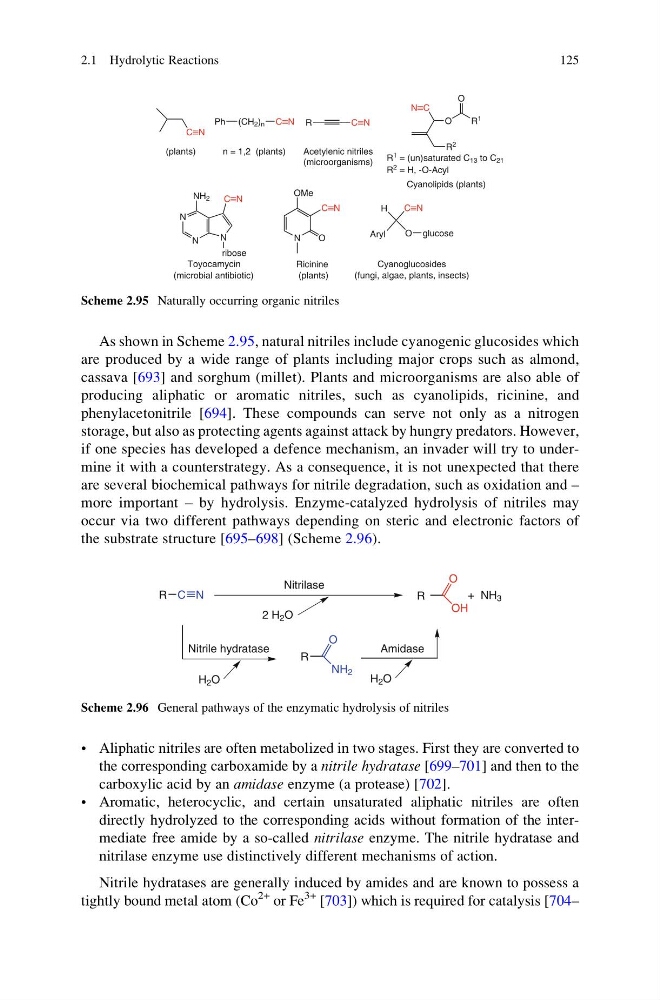
As shown in Scheme 2.95, natural nitriles include cyanogenic glucosides which
are produced by a wide range of plants including major crops such as almond,
cassava [693] and sorghum (millet). Plants and microorganisms are also able of
producing aliphatic or aromatic nitriles, such as cyanolipids, ricinine, and
phenylacetonitrile [694]. These compounds can serve not only as a nitrogen
storage, but also as protecting agents against attack by hungry predators. However,
if one species has developed a defence mechanism, an invader will try to undermine it with a counterstrategy. As a consequence, it is not unexpected that there
are several biochemical pathways for nitrile degradation, such as oxidation and –
more important – by hydrolysis. Enzyme-catalyzed hydrolysis of nitriles may
occur via two different pathways depending on steric and electronic factors of
the substrate structure [695–698] (Scheme 2.96).
• Aliphatic nitriles are often metabolized in two stages. First they are converted to
the corresponding carboxamide by a nitrile hydratase [699–701] and then to the
carboxylic acid by an amidase enzyme (a protease) [702].
• Aromatic, heterocyclic, and certain unsaturated aliphatic nitriles are often
directly hydrolyzed to the corresponding acids without formation of the intermediate free amide by a so-called nitrilase enzyme. The nitrile hydratase and
nitrilase enzyme use distinctively different mechanisms of action.
Nitrile hydratases are generally induced by amides and are known to possess a
tightly bound metal atom (Co
2+ or Fe
3+ [703]) which is required for catalysis [704–
OMe
C≡N
O
N
O
R 1
R
2
N≡C
O
C≡N
(CH 2 ) n
Ph
C≡N
C≡N
R
glucose
Aryl
H
O
C≡N
ribose
NH 2
C≡N
N
N
N
Ricinine
n = 1,2 (plants)
(plants)
Acetylenic nitriles
Cyanoglucosides
Toyocamycin
Cyanolipids (plants)
R 2 = H, -O-Acyl
R
1 = (un)saturated C 13 to C 21
(microorganisms)
(microbial antibiotic)
(plants)
(fungi, algae, plants, insects)
Scheme 2.95 Naturally occurring organic nitriles
NH 2
O
R
OH
O
R
N
C
R
Amidase
Nitrile hydratase
Nitrilase
+ NH 3
H 2 O
H 2 O
2 H 2 O
Scheme 2.96 General pathways of the enzymatic hydrolysis of nitriles
2.1 Hydrolytic Reactions
125
are produced by a wide range of plants including major crops such as almond,
cassava [693] and sorghum (millet). Plants and microorganisms are also able of
producing aliphatic or aromatic nitriles, such as cyanolipids, ricinine, and
phenylacetonitrile [694]. These compounds can serve not only as a nitrogen
storage, but also as protecting agents against attack by hungry predators. However,
if one species has developed a defence mechanism, an invader will try to undermine it with a counterstrategy. As a consequence, it is not unexpected that there
are several biochemical pathways for nitrile degradation, such as oxidation and –
more important – by hydrolysis. Enzyme-catalyzed hydrolysis of nitriles may
occur via two different pathways depending on steric and electronic factors of
the substrate structure [695–698] (Scheme 2.96).
• Aliphatic nitriles are often metabolized in two stages. First they are converted to
the corresponding carboxamide by a nitrile hydratase [699–701] and then to the
carboxylic acid by an amidase enzyme (a protease) [702].
• Aromatic, heterocyclic, and certain unsaturated aliphatic nitriles are often
directly hydrolyzed to the corresponding acids without formation of the intermediate free amide by a so-called nitrilase enzyme. The nitrile hydratase and
nitrilase enzyme use distinctively different mechanisms of action.
Nitrile hydratases are generally induced by amides and are known to possess a
tightly bound metal atom (Co
2+ or Fe
3+ [703]) which is required for catalysis [704–
OMe
C≡N
O
N
O
R 1
R
2
N≡C
O
C≡N
(CH 2 ) n
Ph
C≡N
C≡N
R
glucose
Aryl
H
O
C≡N
ribose
NH 2
C≡N
N
N
N
Ricinine
n = 1,2 (plants)
(plants)
Acetylenic nitriles
Cyanoglucosides
Toyocamycin
Cyanolipids (plants)
R 2 = H, -O-Acyl
R
1 = (un)saturated C 13 to C 21
(microorganisms)
(microbial antibiotic)
(plants)
(fungi, algae, plants, insects)
Scheme 2.95 Naturally occurring organic nitriles
NH 2
O
R
OH
O
R
N
C
R
Amidase
Nitrile hydratase
Nitrilase
+ NH 3
H 2 O
H 2 O
2 H 2 O
Scheme 2.96 General pathways of the enzymatic hydrolysis of nitriles
2.1 Hydrolytic Reactions
125