

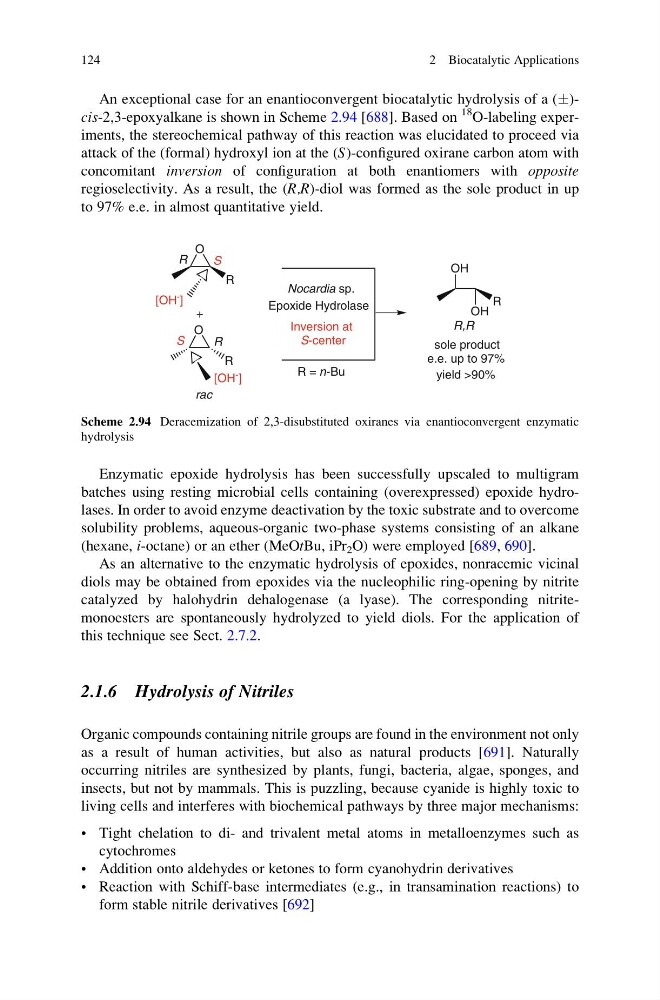
An exceptional case for an enantioconvergent biocatalytic hydrolysis of a (Æ)cis-2,3-epoxyalkane is shown in Scheme 2.94 [688]. Based on
18 O-labeling experiments, the stereochemical pathway of this reaction was elucidated to proceed via
attack of the (formal) hydroxyl ion at the (S)-configured oxirane carbon atom with
concomitant inversion of configuration at both enantiomers with opposite
regioselectivity. As a result, the (R,R)-diol was formed as the sole product in up
to 97% e.e. in almost quantitative yield.
Enzymatic epoxide hydrolysis has been successfully upscaled to multigram
batches using resting microbial cells containing (overexpressed) epoxide hydrolases. In order to avoid enzyme deactivation by the toxic substrate and to overcome
solubility problems, aqueous-organic two-phase systems consisting of an alkane
(hexane, i-octane) or an ether (MeOtBu, iPr 2 O) were employed [689, 690].
As an alternative to the enzymatic hydrolysis of epoxides, nonracemic vicinal
diols may be obtained from epoxides via the nucleophilic ring-opening by nitrite
catalyzed by halohydrin dehalogenase (a lyase). The corresponding nitritemonoesters are spontaneously hydrolyzed to yield diols. For the application of
this technique see Sect. 2.7.2.
2.1.6 Hydrolysis of Nitriles
Organic compounds containing nitrile groups are found in the environment not only
as a result of human activities, but also as natural products [691]. Naturally
occurring nitriles are synthesized by plants, fungi, bacteria, algae, sponges, and
insects, but not by mammals. This is puzzling, because cyanide is highly toxic to
living cells and interferes with biochemical pathways by three major mechanisms:
• Tight chelation to di- and trivalent metal atoms in metalloenzymes such as
cytochromes
• Addition onto aldehydes or ketones to form cyanohydrin derivatives
• Reaction with Schiff-base intermediates (e.g., in transamination reactions) to
form stable nitrile derivatives [692]
OH
OH
R
R
O
R
O
yield >90%
e.e. up to 97%
R = n-Bu
R,R
+
Inversion at
S-center
Epoxide Hydrolase
Nocardia sp.
sole product
rac
R
S
R
S
[OH - ]
[OH
- ]
Scheme 2.94 Deracemization of 2,3-disubstituted oxiranes via enantioconvergent enzymatic
hydrolysis
124
2 Biocatalytic Applications
18 O-labeling experiments, the stereochemical pathway of this reaction was elucidated to proceed via
attack of the (formal) hydroxyl ion at the (S)-configured oxirane carbon atom with
concomitant inversion of configuration at both enantiomers with opposite
regioselectivity. As a result, the (R,R)-diol was formed as the sole product in up
to 97% e.e. in almost quantitative yield.
Enzymatic epoxide hydrolysis has been successfully upscaled to multigram
batches using resting microbial cells containing (overexpressed) epoxide hydrolases. In order to avoid enzyme deactivation by the toxic substrate and to overcome
solubility problems, aqueous-organic two-phase systems consisting of an alkane
(hexane, i-octane) or an ether (MeOtBu, iPr 2 O) were employed [689, 690].
As an alternative to the enzymatic hydrolysis of epoxides, nonracemic vicinal
diols may be obtained from epoxides via the nucleophilic ring-opening by nitrite
catalyzed by halohydrin dehalogenase (a lyase). The corresponding nitritemonoesters are spontaneously hydrolyzed to yield diols. For the application of
this technique see Sect. 2.7.2.
2.1.6 Hydrolysis of Nitriles
Organic compounds containing nitrile groups are found in the environment not only
as a result of human activities, but also as natural products [691]. Naturally
occurring nitriles are synthesized by plants, fungi, bacteria, algae, sponges, and
insects, but not by mammals. This is puzzling, because cyanide is highly toxic to
living cells and interferes with biochemical pathways by three major mechanisms:
• Tight chelation to di- and trivalent metal atoms in metalloenzymes such as
cytochromes
• Addition onto aldehydes or ketones to form cyanohydrin derivatives
• Reaction with Schiff-base intermediates (e.g., in transamination reactions) to
form stable nitrile derivatives [692]
OH
OH
R
R
O
R
O
yield >90%
e.e. up to 97%
R = n-Bu
R,R
+
Inversion at
S-center
Epoxide Hydrolase
Nocardia sp.
sole product
rac
R
S
R
S
[OH - ]
[OH
- ]
Scheme 2.94 Deracemization of 2,3-disubstituted oxiranes via enantioconvergent enzymatic
hydrolysis
124
2 Biocatalytic Applications