

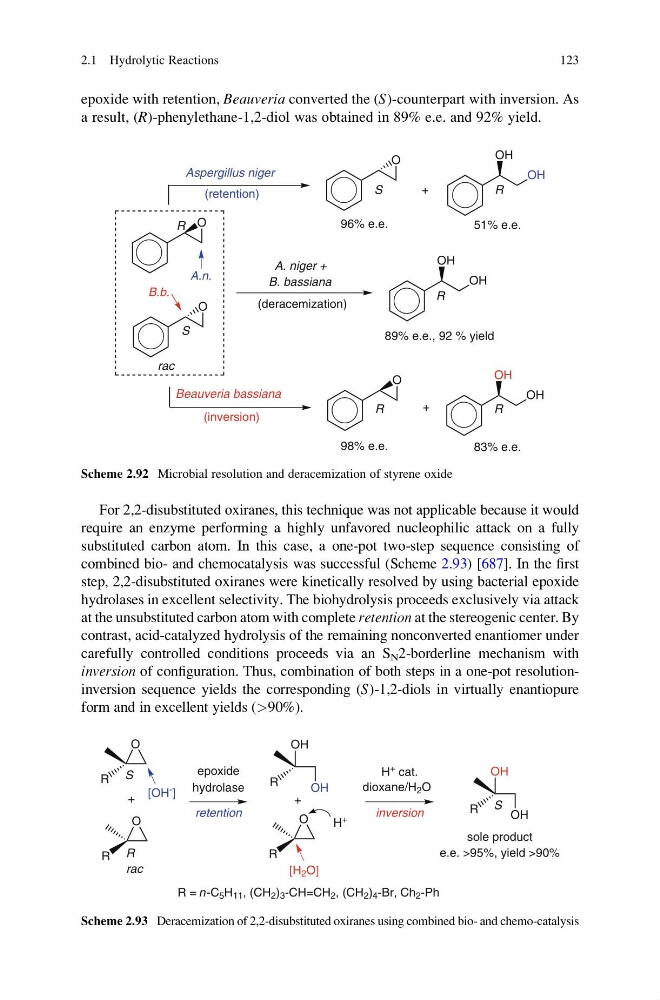
epoxide with retention, Beauveria converted the (S)-counterpart with inversion. As
a result, (R)-phenylethane-1,2-diol was obtained in 89% e.e. and 92% yield.
For 2,2-disubstituted oxiranes, this technique was not applicable because it would
require an enzyme performing a highly unfavored nucleophilic attack on a fully
substituted carbon atom. In this case, a one-pot two-step sequence consisting of
combined bio- and chemocatalysis was successful (Scheme 2.93) [687]. In the first
step, 2,2-disubstituted oxiranes were kinetically resolved by using bacterial epoxide
hydrolases in excellent selectivity. The biohydrolysis proceeds exclusively via attack
at the unsubstituted carbon atom with complete retention at the stereogenic center. By
contrast, acid-catalyzed hydrolysis of the remaining nonconverted enantiomer under
carefully controlled conditions proceeds via an S N 2-borderline mechanism with
inversion of configuration. Thus, combination of both steps in a one-pot resolutioninversion sequence yields the corresponding (S)-1,2-diols in virtually enantiopure
form and in excellent yields (>90%).
O
O
O
O
OH
OH
OH
OH
OH
OH
83% e.e.
98% e.e.
89% e.e., 92 % yield
51% e.e.
96% e.e.
(deracemization)
(inversion)
(retention)
+
+
Beauveria bassiana
Aspergillus niger
B. bassiana
A. niger +
rac
B.b.
A.n.
R
S
R
R
R
R
S
Scheme 2.92 Microbial resolution and deracemization of styrene oxide
R
O
R
O
R
O
OH
OH
R
OH
OH
R
e.e. >95%, yield >90%
retention
inversion
dioxane/H 2 O
H + cat.
+
+
rac
sole product
epoxide
hydrolase
[H 2 O]
[OH
-
]
H
+
S
S
R
R = n-C 5 H 11 , (CH 2 ) 3 -CH=CH 2 , (CH 2 ) 4 -Br, Ch 2 -Ph
Scheme 2.93 Deracemization of 2,2-disubstituted oxiranes using combined bio- and chemo-catalysis
2.1 Hydrolytic Reactions
123
a result, (R)-phenylethane-1,2-diol was obtained in 89% e.e. and 92% yield.
For 2,2-disubstituted oxiranes, this technique was not applicable because it would
require an enzyme performing a highly unfavored nucleophilic attack on a fully
substituted carbon atom. In this case, a one-pot two-step sequence consisting of
combined bio- and chemocatalysis was successful (Scheme 2.93) [687]. In the first
step, 2,2-disubstituted oxiranes were kinetically resolved by using bacterial epoxide
hydrolases in excellent selectivity. The biohydrolysis proceeds exclusively via attack
at the unsubstituted carbon atom with complete retention at the stereogenic center. By
contrast, acid-catalyzed hydrolysis of the remaining nonconverted enantiomer under
carefully controlled conditions proceeds via an S N 2-borderline mechanism with
inversion of configuration. Thus, combination of both steps in a one-pot resolutioninversion sequence yields the corresponding (S)-1,2-diols in virtually enantiopure
form and in excellent yields (>90%).
O
O
O
O
OH
OH
OH
OH
OH
OH
83% e.e.
98% e.e.
89% e.e., 92 % yield
51% e.e.
96% e.e.
(deracemization)
(inversion)
(retention)
+
+
Beauveria bassiana
Aspergillus niger
B. bassiana
A. niger +
rac
B.b.
A.n.
R
S
R
R
R
R
S
Scheme 2.92 Microbial resolution and deracemization of styrene oxide
R
O
R
O
R
O
OH
OH
R
OH
OH
R
e.e. >95%, yield >90%
retention
inversion
dioxane/H 2 O
H + cat.
+
+
rac
sole product
epoxide
hydrolase
[H 2 O]
[OH
-
]
H
+
S
S
R
R = n-C 5 H 11 , (CH 2 ) 3 -CH=CH 2 , (CH 2 ) 4 -Br, Ch 2 -Ph
Scheme 2.93 Deracemization of 2,2-disubstituted oxiranes using combined bio- and chemo-catalysis
2.1 Hydrolytic Reactions
123