

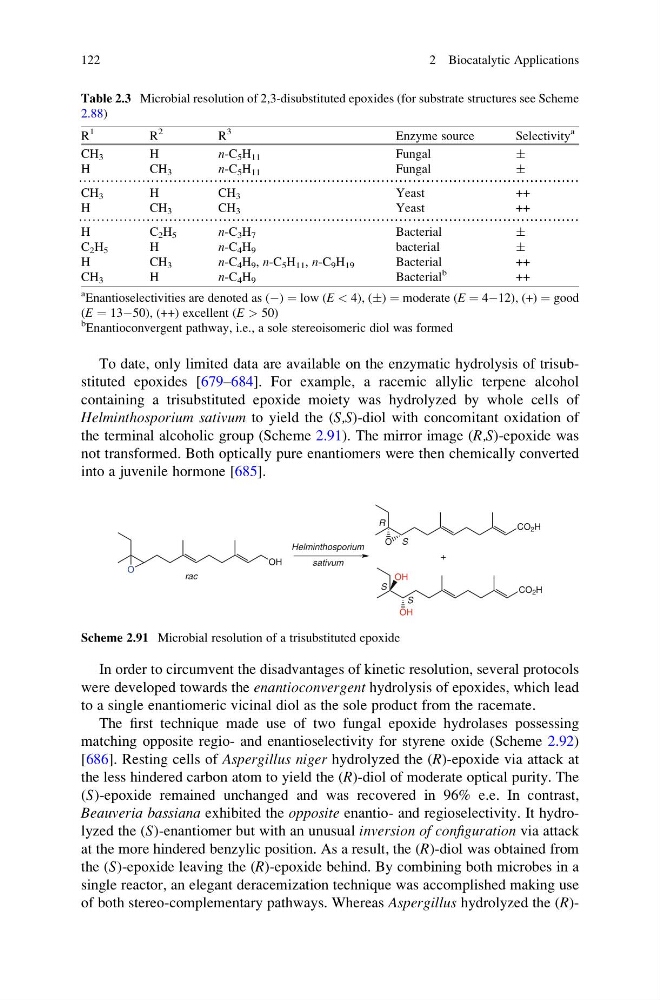
To date, only limited data are available on the enzymatic hydrolysis of trisubstituted epoxides [679–684]. For example, a racemic allylic terpene alcohol
containing a trisubstituted epoxide moiety was hydrolyzed by whole cells of
Helminthosporium sativum to yield the (S,S)-diol with concomitant oxidation of
the terminal alcoholic group (Scheme 2.91). The mirror image (R,S)-epoxide was
not transformed. Both optically pure enantiomers were then chemically converted
into a juvenile hormone [685].
In order to circumvent the disadvantages of kinetic resolution, several protocols
were developed towards the enantioconvergent hydrolysis of epoxides, which lead
to a single enantiomeric vicinal diol as the sole product from the racemate.
The first technique made use of two fungal epoxide hydrolases possessing
matching opposite regio- and enantioselectivity for styrene oxide (Scheme 2.92)
[686]. Resting cells of Aspergillus niger hydrolyzed the (R)-epoxide via attack at
the less hindered carbon atom to yield the (R)-diol of moderate optical purity. The
(S)-epoxide remained unchanged and was recovered in 96% e.e. In contrast,
Beauveria bassiana exhibited the opposite enantio- and regioselectivity. It hydrolyzed the (S)-enantiomer but with an unusual inversion of configuration via attack
at the more hindered benzylic position. As a result, the (R)-diol was obtained from
the (S)-epoxide leaving the (R)-epoxide behind. By combining both microbes in a
single reactor, an elegant deracemization technique was accomplished making use
of both stereo-complementary pathways. Whereas Aspergillus hydrolyzed the (R). . . . . . . . . . . . . . . . . . . . . . . . . . . . . . . . . . . . . . . . . . . . . . . . . . . . . . . . . . . . . . . . . . . . . . . . . . . . . . . . . . . . . . . . . . . . . . . . . . . . . . . . . . . . . . .
. . . . . . . . . . . . . . . . . . . . . . . . . . . . . . . . . . . . . . . . . . . . . . . . . . . . . . . . . . . . . . . . . . . . . . . . . . . . . . . . . . . . . . . . . . . . . . . .
. . . . . . . . . . . . . . . . . . . . . . . . . . . . . . . . . . . . . . . . . . . . . . . . . . . . . . . . . . . . . . . . . . . . . . . . . . . . . . . .
. . . . . . . . . . . . . . . . . . . . . . . . . . . . . . . . . . . . . . . . .
. . . . . . . . . . . . . . . . . . . . . . . . . . . . . . . . . . . . . . . . . . . . . . . . . . . . . . . . . . . . . . . . . . . . . . . . . . . . . . . . . . . . . . . . . . . . . . . . . . . . . . . . . . . . . . .
. . . . . . . . . . . . . . . . . . . . . . . . . . . . . . . . . . . . . . . . . . . . . . . . . . . . . . . . . . . . . . . . . . . . . . . . . . . . . . . . . . . . . . . . . . . . . . . .
. . . . . . . . . . . . . . . . . . . . . . . . . . . . . . . . . . . . . . . . . . . . . . . . . . . . . . . . . . . . . . . . . . . . . . . . . . . . . . . .
. . . . . . . . . . . . . . . . . . . . . . . . . . . . . . . . . . . . . . . . .
Table 2.3 Microbial resolution of 2,3-disubstituted epoxides (for substrate structures see Scheme
2.88)
R
1
R
2
R
3
Enzyme source
Selectivity
a
CH 3
H
n-C 5 H 11
Fungal
Æ
H
C H 3
n-C 5 H 11
Fungal
Æ
CH 3
H
C H 3
Yeast
++
H
C H 3
CH 3
Yeast
++
H
C 2 H 5
n-C 3 H 7
Bacterial
Æ
C 2 H 5
H
n-C 4 H 9
bacterial
Æ
H
C H 3
n-C 4 H 9 , n-C 5 H 11 , n-C 9 H 19
Bacterial
++
CH 3
H
n-C 4 H 9
Bacterial
b
++
a
Enantioselectivities are denoted as (À) ¼ low (E < 4), (Æ) ¼ moderate (E ¼ 4À12), (+) ¼ good
(E ¼ 13À50), (++) excellent (E > 50)
b
Enantioconvergent pathway, i.e., a sole stereoisomeric diol was formed
OH
OH
CO 2 H
O
CO 2 H
O
OH
sativum
Helminthosporium
+
rac
S
S
S
R
Scheme 2.91 Microbial resolution of a trisubstituted epoxide
122
2 Biocatalytic Applications
containing a trisubstituted epoxide moiety was hydrolyzed by whole cells of
Helminthosporium sativum to yield the (S,S)-diol with concomitant oxidation of
the terminal alcoholic group (Scheme 2.91). The mirror image (R,S)-epoxide was
not transformed. Both optically pure enantiomers were then chemically converted
into a juvenile hormone [685].
In order to circumvent the disadvantages of kinetic resolution, several protocols
were developed towards the enantioconvergent hydrolysis of epoxides, which lead
to a single enantiomeric vicinal diol as the sole product from the racemate.
The first technique made use of two fungal epoxide hydrolases possessing
matching opposite regio- and enantioselectivity for styrene oxide (Scheme 2.92)
[686]. Resting cells of Aspergillus niger hydrolyzed the (R)-epoxide via attack at
the less hindered carbon atom to yield the (R)-diol of moderate optical purity. The
(S)-epoxide remained unchanged and was recovered in 96% e.e. In contrast,
Beauveria bassiana exhibited the opposite enantio- and regioselectivity. It hydrolyzed the (S)-enantiomer but with an unusual inversion of configuration via attack
at the more hindered benzylic position. As a result, the (R)-diol was obtained from
the (S)-epoxide leaving the (R)-epoxide behind. By combining both microbes in a
single reactor, an elegant deracemization technique was accomplished making use
of both stereo-complementary pathways. Whereas Aspergillus hydrolyzed the (R). . . . . . . . . . . . . . . . . . . . . . . . . . . . . . . . . . . . . . . . . . . . . . . . . . . . . . . . . . . . . . . . . . . . . . . . . . . . . . . . . . . . . . . . . . . . . . . . . . . . . . . . . . . . . . .
. . . . . . . . . . . . . . . . . . . . . . . . . . . . . . . . . . . . . . . . . . . . . . . . . . . . . . . . . . . . . . . . . . . . . . . . . . . . . . . . . . . . . . . . . . . . . . . .
. . . . . . . . . . . . . . . . . . . . . . . . . . . . . . . . . . . . . . . . . . . . . . . . . . . . . . . . . . . . . . . . . . . . . . . . . . . . . . . .
. . . . . . . . . . . . . . . . . . . . . . . . . . . . . . . . . . . . . . . . .
. . . . . . . . . . . . . . . . . . . . . . . . . . . . . . . . . . . . . . . . . . . . . . . . . . . . . . . . . . . . . . . . . . . . . . . . . . . . . . . . . . . . . . . . . . . . . . . . . . . . . . . . . . . . . . .
. . . . . . . . . . . . . . . . . . . . . . . . . . . . . . . . . . . . . . . . . . . . . . . . . . . . . . . . . . . . . . . . . . . . . . . . . . . . . . . . . . . . . . . . . . . . . . . .
. . . . . . . . . . . . . . . . . . . . . . . . . . . . . . . . . . . . . . . . . . . . . . . . . . . . . . . . . . . . . . . . . . . . . . . . . . . . . . . .
. . . . . . . . . . . . . . . . . . . . . . . . . . . . . . . . . . . . . . . . .
Table 2.3 Microbial resolution of 2,3-disubstituted epoxides (for substrate structures see Scheme
2.88)
R
1
R
2
R
3
Enzyme source
Selectivity
a
CH 3
H
n-C 5 H 11
Fungal
Æ
H
C H 3
n-C 5 H 11
Fungal
Æ
CH 3
H
C H 3
Yeast
++
H
C H 3
CH 3
Yeast
++
H
C 2 H 5
n-C 3 H 7
Bacterial
Æ
C 2 H 5
H
n-C 4 H 9
bacterial
Æ
H
C H 3
n-C 4 H 9 , n-C 5 H 11 , n-C 9 H 19
Bacterial
++
CH 3
H
n-C 4 H 9
Bacterial
b
++
a
Enantioselectivities are denoted as (À) ¼ low (E < 4), (Æ) ¼ moderate (E ¼ 4À12), (+) ¼ good
(E ¼ 13À50), (++) excellent (E > 50)
b
Enantioconvergent pathway, i.e., a sole stereoisomeric diol was formed
OH
OH
CO 2 H
O
CO 2 H
O
OH
sativum
Helminthosporium
+
rac
S
S
S
R
Scheme 2.91 Microbial resolution of a trisubstituted epoxide
122
2 Biocatalytic Applications