

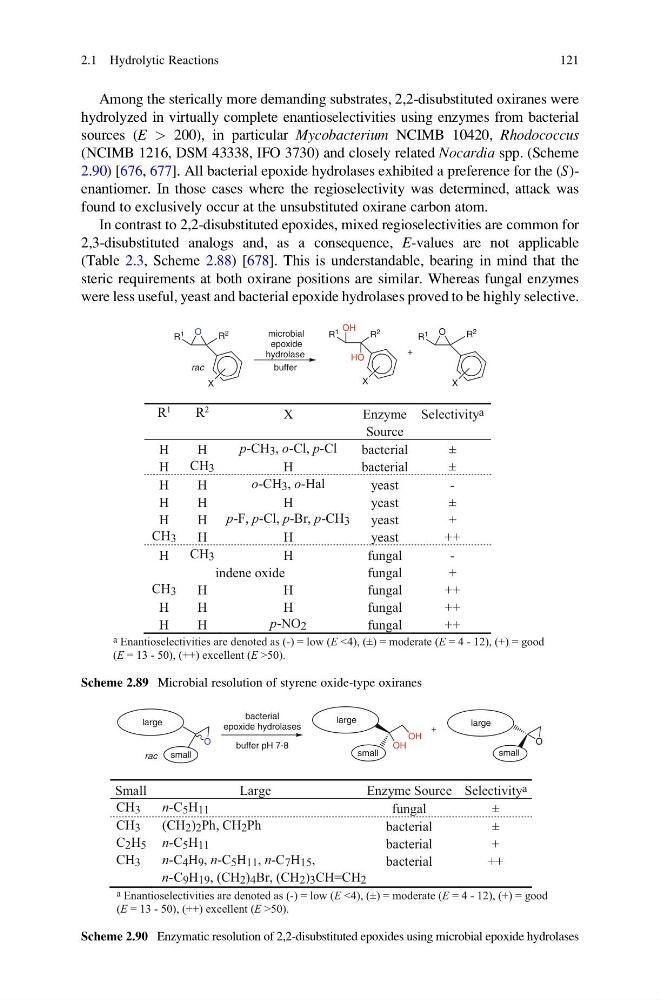
Among the sterically more demanding substrates, 2,2-disubstituted oxiranes were
hydrolyzed in virtually complete enantioselectivities using enzymes from bacterial
sources (E > 200), in particular Mycobacterium NCIMB 10420, Rhodococcus
(NCIMB 1216, DSM 43338, IFO 3730) and closely related Nocardia spp. (Scheme
2.90) [676, 677]. All bacterial epoxide hydrolases exhibited a preference for the (S)enantiomer. In those cases where the regioselectivity was determined, attack was
found to exclusively occur at the unsubstituted oxirane carbon atom.
In contrast to 2,2-disubstituted epoxides, mixed regioselectivities are common for
2,3-disubstituted analogs and, as a consequence, E-values are not applicable
(Table 2.3, Scheme 2.88) [678]. This is understandable, bearing in mind that the
steric requirements at both oxirane positions are similar. Whereas fungal enzymes
were less useful, yeast and bacterial epoxide hydrolases proved to be highly selective.
R
2
R
1
O
X
HO
OH
R
2
R
1
R
2
R
1
O
rac
+
buffer
microbial
epoxide
hydrolase
X
X
R
1
R
2
X
E n z y m e
Source
Selectivity a
H
H
p-CH 3 , o-Cl, p-Cl
bacterial
±
H
CH 3
H
bacterial
±
H
H
o-CH 3 , o-Hal
yeast
-
H
H
H
yeast
±
H
H p-F, p-Cl, p-Br, p-CH 3
yeast
+
CH 3
H
H
yeast
++
H
CH 3
H
fungal
-
indene oxide
fungal
+
CH 3
H
H
fungal
++
H
H
H
fungal
++
H
H
p-NO 2
fungal
++
a Enantioselectivities are denoted as (-) = low (E <4), (±) = moderate (E = 4 - 12), (+) = good
(E = 13 - 50), (++) excellent (E >50).
Scheme 2.89 Microbial resolution of styrene oxide-type oxiranes
OH
OH
O
O
rac
+
bacterial
epoxide hydrolases
buffer pH 7-8
small
large
small
large
small
large
Small
Large
Enzyme Source Selectivity a
CH 3
n-C 5 H 11
fungal
±
CH 3
(CH 2 ) 2 Ph, CH 2 Ph
bacterial
±
C 2 H 5 n-C 5 H 11
bacterial
+
CH 3
n-C 4 H 9 , n-C 5 H 11 , n-C 7 H 15 ,
n-C 9 H 19 , (CH 2 ) 4 Br, (CH 2 ) 3 CH=CH 2
bacterial
++
a Enantioselectivities are denoted as (-) = low (E <4), (±) = moderate (E = 4 - 12), (+) = good
(E = 13 - 50), (++) excellent (E >50).
Scheme 2.90 Enzymatic resolution of 2,2-disubstituted epoxides using microbial epoxide hydrolases
2.1 Hydrolytic Reactions
121
hydrolyzed in virtually complete enantioselectivities using enzymes from bacterial
sources (E > 200), in particular Mycobacterium NCIMB 10420, Rhodococcus
(NCIMB 1216, DSM 43338, IFO 3730) and closely related Nocardia spp. (Scheme
2.90) [676, 677]. All bacterial epoxide hydrolases exhibited a preference for the (S)enantiomer. In those cases where the regioselectivity was determined, attack was
found to exclusively occur at the unsubstituted oxirane carbon atom.
In contrast to 2,2-disubstituted epoxides, mixed regioselectivities are common for
2,3-disubstituted analogs and, as a consequence, E-values are not applicable
(Table 2.3, Scheme 2.88) [678]. This is understandable, bearing in mind that the
steric requirements at both oxirane positions are similar. Whereas fungal enzymes
were less useful, yeast and bacterial epoxide hydrolases proved to be highly selective.
R
2
R
1
O
X
HO
OH
R
2
R
1
R
2
R
1
O
rac
+
buffer
microbial
epoxide
hydrolase
X
X
R
1
R
2
X
E n z y m e
Source
Selectivity a
H
H
p-CH 3 , o-Cl, p-Cl
bacterial
±
H
CH 3
H
bacterial
±
H
H
o-CH 3 , o-Hal
yeast
-
H
H
H
yeast
±
H
H p-F, p-Cl, p-Br, p-CH 3
yeast
+
CH 3
H
H
yeast
++
H
CH 3
H
fungal
-
indene oxide
fungal
+
CH 3
H
H
fungal
++
H
H
H
fungal
++
H
H
p-NO 2
fungal
++
a Enantioselectivities are denoted as (-) = low (E <4), (±) = moderate (E = 4 - 12), (+) = good
(E = 13 - 50), (++) excellent (E >50).
Scheme 2.89 Microbial resolution of styrene oxide-type oxiranes
OH
OH
O
O
rac
+
bacterial
epoxide hydrolases
buffer pH 7-8
small
large
small
large
small
large
Small
Large
Enzyme Source Selectivity a
CH 3
n-C 5 H 11
fungal
±
CH 3
(CH 2 ) 2 Ph, CH 2 Ph
bacterial
±
C 2 H 5 n-C 5 H 11
bacterial
+
CH 3
n-C 4 H 9 , n-C 5 H 11 , n-C 7 H 15 ,
n-C 9 H 19 , (CH 2 ) 4 Br, (CH 2 ) 3 CH=CH 2
bacterial
++
a Enantioselectivities are denoted as (-) = low (E <4), (±) = moderate (E = 4 - 12), (+) = good
(E = 13 - 50), (++) excellent (E >50).
Scheme 2.90 Enzymatic resolution of 2,2-disubstituted epoxides using microbial epoxide hydrolases
2.1 Hydrolytic Reactions
121