

been gathered and featured in several reviews [658–666]. The data available to date
indicate that the enantioselectivities of enzymes from certain microbial sources can
be correlated to the substitutional pattern of various types of substrates [667]:
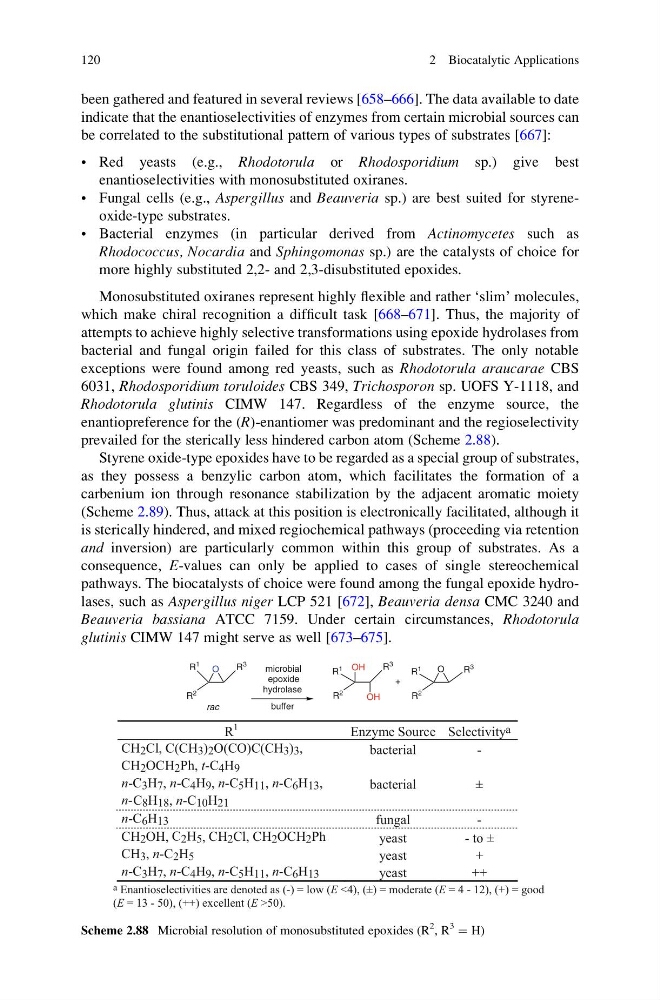
• Red yeasts (e.g., Rhodotorula or Rhodosporidium sp.) give best
enantioselectivities with monosubstituted oxiranes.
• Fungal cells (e.g., Aspergillus and Beauveria sp.) are best suited for styreneoxide-type substrates.
• Bacterial enzymes (in particular derived from Actinomycetes such as
Rhodococcus, Nocardia and Sphingomonas sp.) are the catalysts of choice for
more highly substituted 2,2- and 2,3-disubstituted epoxides.
Monosubstituted oxiranes represent highly flexible and rather ‘slim’ molecules,
which make chiral recognition a difficult task [668–671]. Thus, the majority of
attempts to achieve highly selective transformations using epoxide hydrolases from
bacterial and fungal origin failed for this class of substrates. The only notable
exceptions were found among red yeasts, such as Rhodotorula araucarae CBS
6031, Rhodosporidium toruloides CBS 349, Trichosporon sp. UOFS Y-1118, and
Rhodotorula glutinis CIMW 147. Regardless of the enzyme source, the
enantiopreference for the (R)-enantiomer was predominant and the regioselectivity
prevailed for the sterically less hindered carbon atom (Scheme 2.88).
Styrene oxide-type epoxides have to be regarded as a special group of substrates,
as they possess a benzylic carbon atom, which facilitates the formation of a
carbenium ion through resonance stabilization by the adjacent aromatic moiety
(Scheme 2.89). Thus, attack at this position is electronically facilitated, although it
is sterically hindered, and mixed regiochemical pathways (proceeding via retention
and inversion) are particularly common within this group of substrates. As a
consequence, E-values can only be applied to cases of single stereochemical
pathways. The biocatalysts of choice were found among the fungal epoxide hydrolases, such as Aspergillus niger LCP 521 [672], Beauveria densa CMC 3240 and
Beauveria bassiana ATCC 7159. Under certain circumstances, Rhodotorula
glutinis CIMW 147 might serve as well [673–675].
OH
OH
R 2
R 2
O
R 2
O
rac
+
buffer
microbial
epoxide
hydrolase
R
1
R
3
R 3
R 1
R
1
R 3
R
1
Enzyme Source Selectivity a
CH 2 Cl, C(CH 3 ) 2 O(CO)C(CH 3 ) 3 ,
CH 2 OCH 2 Ph, t-C 4 H 9
bacterial
-
n-C 3 H 7 , n-C 4 H 9 , n-C 5 H 11 , n-C 6 H 13 ,
n-C 8 H 18 , n-C 10 H 21
bacterial
±
n-C 6 H 13
fungal
-
CH 2 OH,
CH 2 Cl, CH 2 OCH 2 Ph
yeast
- to ±
CH 3 , n-C 2 H 5
C 2 H 5,
yeast
+
n-C 3 H 7 , n-C 4 H 9 , n-C 5 H 11 , n-C 6 H 13
yeast
++
a Enantioselectivities are denoted as (-) = low (E <4), (±) = moderate (E = 4 - 12), (+) = good
(E = 13 - 50), (++) excellent (E >50).
Scheme 2.88 Microbial resolution of monosubstituted epoxides (R
2
, R
3 ¼ H)
120
2 Biocatalytic Applications
indicate that the enantioselectivities of enzymes from certain microbial sources can
be correlated to the substitutional pattern of various types of substrates [667]:
• Red yeasts (e.g., Rhodotorula or Rhodosporidium sp.) give best
enantioselectivities with monosubstituted oxiranes.
• Fungal cells (e.g., Aspergillus and Beauveria sp.) are best suited for styreneoxide-type substrates.
• Bacterial enzymes (in particular derived from Actinomycetes such as
Rhodococcus, Nocardia and Sphingomonas sp.) are the catalysts of choice for
more highly substituted 2,2- and 2,3-disubstituted epoxides.
Monosubstituted oxiranes represent highly flexible and rather ‘slim’ molecules,
which make chiral recognition a difficult task [668–671]. Thus, the majority of
attempts to achieve highly selective transformations using epoxide hydrolases from
bacterial and fungal origin failed for this class of substrates. The only notable
exceptions were found among red yeasts, such as Rhodotorula araucarae CBS
6031, Rhodosporidium toruloides CBS 349, Trichosporon sp. UOFS Y-1118, and
Rhodotorula glutinis CIMW 147. Regardless of the enzyme source, the
enantiopreference for the (R)-enantiomer was predominant and the regioselectivity
prevailed for the sterically less hindered carbon atom (Scheme 2.88).
Styrene oxide-type epoxides have to be regarded as a special group of substrates,
as they possess a benzylic carbon atom, which facilitates the formation of a
carbenium ion through resonance stabilization by the adjacent aromatic moiety
(Scheme 2.89). Thus, attack at this position is electronically facilitated, although it
is sterically hindered, and mixed regiochemical pathways (proceeding via retention
and inversion) are particularly common within this group of substrates. As a
consequence, E-values can only be applied to cases of single stereochemical
pathways. The biocatalysts of choice were found among the fungal epoxide hydrolases, such as Aspergillus niger LCP 521 [672], Beauveria densa CMC 3240 and
Beauveria bassiana ATCC 7159. Under certain circumstances, Rhodotorula
glutinis CIMW 147 might serve as well [673–675].
OH
OH
R 2
R 2
O
R 2
O
rac
+
buffer
microbial
epoxide
hydrolase
R
1
R
3
R 3
R 1
R
1
R 3
R
1
Enzyme Source Selectivity a
CH 2 Cl, C(CH 3 ) 2 O(CO)C(CH 3 ) 3 ,
CH 2 OCH 2 Ph, t-C 4 H 9
bacterial
-
n-C 3 H 7 , n-C 4 H 9 , n-C 5 H 11 , n-C 6 H 13 ,
n-C 8 H 18 , n-C 10 H 21
bacterial
±
n-C 6 H 13
fungal
-
CH 2 OH,
CH 2 Cl, CH 2 OCH 2 Ph
yeast
- to ±
CH 3 , n-C 2 H 5
C 2 H 5,
yeast
+
n-C 3 H 7 , n-C 4 H 9 , n-C 5 H 11 , n-C 6 H 13
yeast
++
a Enantioselectivities are denoted as (-) = low (E <4), (±) = moderate (E = 4 - 12), (+) = good
(E = 13 - 50), (++) excellent (E >50).
Scheme 2.88 Microbial resolution of monosubstituted epoxides (R
2
, R
3 ¼ H)
120
2 Biocatalytic Applications