

Enantioselective Hydrolysis of Nitriles
While most biocatalytic hydrolyses of nitriles make use of the mild reactions
conditions and the chemo- and regioselectivity of nitrile-hydrolyzing enzymes,
their stereoselectivity has been investigated more scarcely. It seems to be a common
trend that both nitrilases and nitrile hydratases are often less specific with respect to
the chirality of the substrate and that in nitrile hydratase-amidase pathways
enantiodiscrimination often occurs during the hydrolysis of the intermediate
carboxamide by the amidase [760] (Scheme 2.96). As a rule, the ‘natural’ Lconfigured enantiomer is usually converted into the acid leaving the D-counterpart
behind. This is not unexpected bearing in mind the high specificities of proteases on
α-substituted carboxamides (see Sect. 2.1.2).
Desymmetrization of Prochiral Dinitriles Prochiral α,α-disubstituted malononitriles can be hydrolyzed in an asymmetric manner by the aid of Rhodococcus
rhodochrous [761] (Scheme 2.103). In accordance with the above-mentioned trend,
the dinitrile was nonselectively hydrolyzed by the nitrile hydratase in the cells to
give the dicarboxamide. In a second consecutive step, the latter was subsequently
transformed by the amidase with high selectivity for the pro-(R) amide group to
yield the (R)-amide-acid in 96% e.e. and 92% yield. This pathway was confirmed
by the fact that identical results were obtained when the dicarboxamide was used as
substrate. The nonracemic amide-acid product thus obtained serves as a starting
material for the synthesis of nonnatural α-methyl-α-amino acids [762].
In contrast, prochiral glutarodinitriles were stereoselectively hydrolyzed via two
steps using whole microbial cells: in a first step, a stereoselective nitrile hydratase
furnished the (R)-monoamide, which was further hydrolyzed to the corresponding
carboxylic acid by an amidase [726, 763]. The cyano-acids thus obtained served as
C≡N
C≡N
C≡N
CO 2 H
C≡N
CO 2 H
NH 2
CO 2 H
C≡N
C≡N
chemical
rhodochrous
Rhodococcus
reduction
Tranexamic acid
3.25 g/l
Acremonium sp.
2 H 2 O
NH 3
2 H 2 O
NH 3
N≡C
C≡N
Pseudomonas
chlororaphis B23
H 2 O
NH 3
N≡C
O
NH 2
93% yield, 96% selectivity
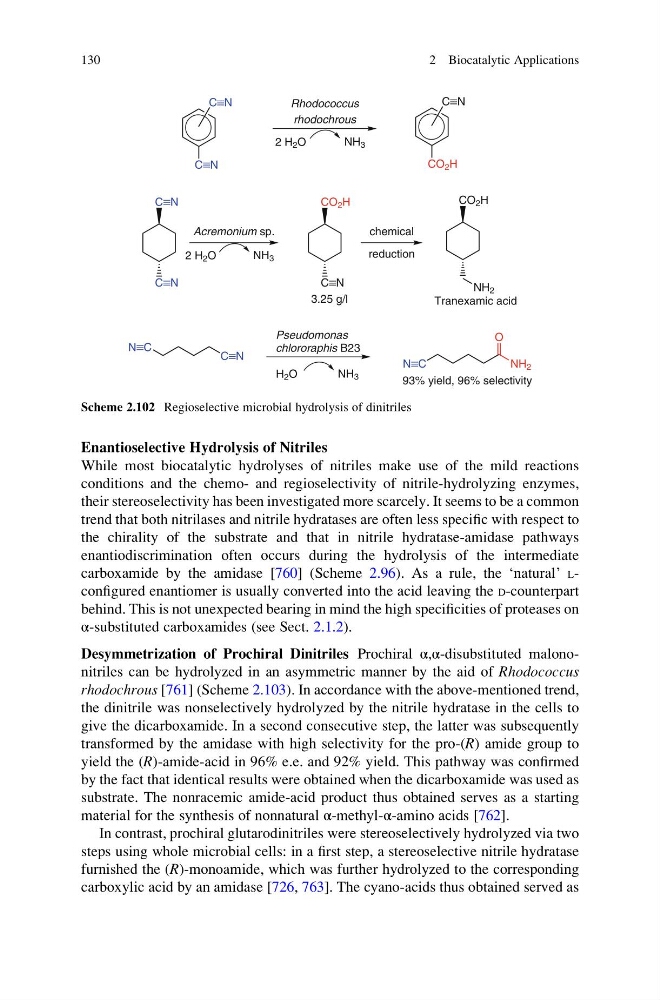
Scheme 2.102 Regioselective microbial hydrolysis of dinitriles
130
2 Biocatalytic Applications
While most biocatalytic hydrolyses of nitriles make use of the mild reactions
conditions and the chemo- and regioselectivity of nitrile-hydrolyzing enzymes,
their stereoselectivity has been investigated more scarcely. It seems to be a common
trend that both nitrilases and nitrile hydratases are often less specific with respect to
the chirality of the substrate and that in nitrile hydratase-amidase pathways
enantiodiscrimination often occurs during the hydrolysis of the intermediate
carboxamide by the amidase [760] (Scheme 2.96). As a rule, the ‘natural’ Lconfigured enantiomer is usually converted into the acid leaving the D-counterpart
behind. This is not unexpected bearing in mind the high specificities of proteases on
α-substituted carboxamides (see Sect. 2.1.2).
Desymmetrization of Prochiral Dinitriles Prochiral α,α-disubstituted malononitriles can be hydrolyzed in an asymmetric manner by the aid of Rhodococcus
rhodochrous [761] (Scheme 2.103). In accordance with the above-mentioned trend,
the dinitrile was nonselectively hydrolyzed by the nitrile hydratase in the cells to
give the dicarboxamide. In a second consecutive step, the latter was subsequently
transformed by the amidase with high selectivity for the pro-(R) amide group to
yield the (R)-amide-acid in 96% e.e. and 92% yield. This pathway was confirmed
by the fact that identical results were obtained when the dicarboxamide was used as
substrate. The nonracemic amide-acid product thus obtained serves as a starting
material for the synthesis of nonnatural α-methyl-α-amino acids [762].
In contrast, prochiral glutarodinitriles were stereoselectively hydrolyzed via two
steps using whole microbial cells: in a first step, a stereoselective nitrile hydratase
furnished the (R)-monoamide, which was further hydrolyzed to the corresponding
carboxylic acid by an amidase [726, 763]. The cyano-acids thus obtained served as
C≡N
C≡N
C≡N
CO 2 H
C≡N
CO 2 H
NH 2
CO 2 H
C≡N
C≡N
chemical
rhodochrous
Rhodococcus
reduction
Tranexamic acid
3.25 g/l
Acremonium sp.
2 H 2 O
NH 3
2 H 2 O
NH 3
N≡C
C≡N
Pseudomonas
chlororaphis B23
H 2 O
NH 3
N≡C
O
NH 2
93% yield, 96% selectivity
Scheme 2.102 Regioselective microbial hydrolysis of dinitriles
130
2 Biocatalytic Applications