

[631, 632]. In addition, a mechanistic relationship with β-glycosidases which act via
formation of a covalent glycosyl-enzyme intermediate by retaining the configuration
at the anomeric center is obvious (Scheme 2.217) [633].
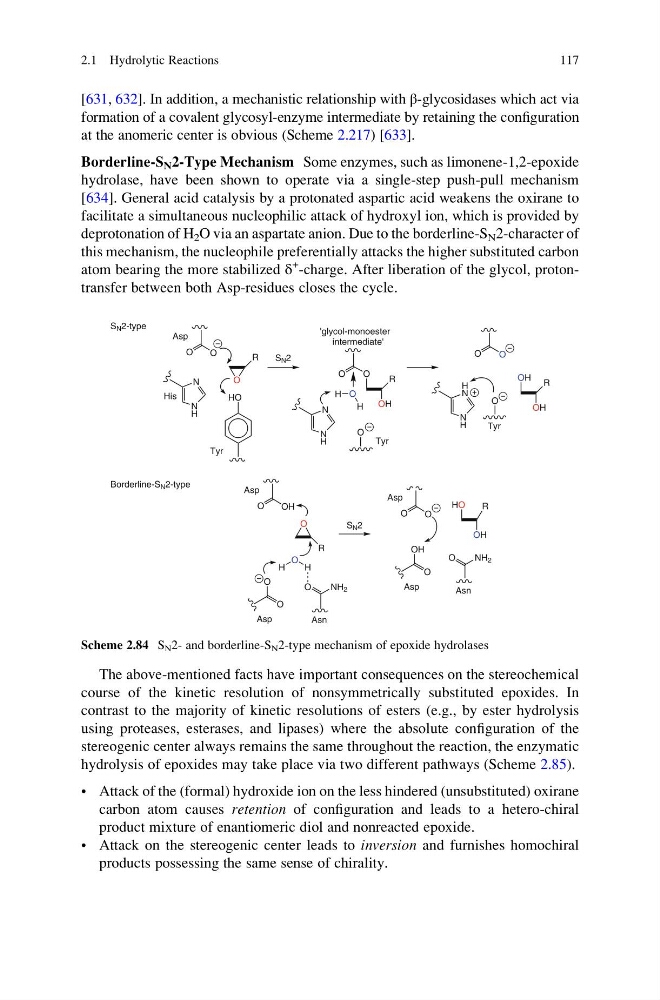
Borderline-S N 2-Type Mechanism Some enzymes, such as limonene-1,2-epoxide
hydrolase, have been shown to operate via a single-step push-pull mechanism
[634]. General acid catalysis by a protonated aspartic acid weakens the oxirane to
facilitate a simultaneous nucleophilic attack of hydroxyl ion, which is provided by
deprotonation of H 2 O via an aspartate anion. Due to the borderline-S N 2-character of
this mechanism, the nucleophile preferentially attacks the higher substituted carbon
atom bearing the more stabilized δ
+ -charge. After liberation of the glycol, protontransfer between both Asp-residues closes the cycle.
The above-mentioned facts have important consequences on the stereochemical
course of the kinetic resolution of nonsymmetrically substituted epoxides. In
contrast to the majority of kinetic resolutions of esters (e.g., by ester hydrolysis
using proteases, esterases, and lipases) where the absolute configuration of the
stereogenic center always remains the same throughout the reaction, the enzymatic
hydrolysis of epoxides may take place via two different pathways (Scheme 2.85).
• Attack of the (formal) hydroxide ion on the less hindered (unsubstituted) oxirane
carbon atom causes retention of configuration and leads to a hetero-chiral
product mixture of enantiomeric diol and nonreacted epoxide.
• Attack on the stereogenic center leads to inversion and furnishes homochiral
products possessing the same sense of chirality.
HO
H
H
O
N
N
H
R
OH
O
O
O
O
R
OH
OH
N
N
H
O
O
R
O
H
N
N
H
R
O
OH
O
H
O
H
NH 2
O
O
O
O
O
OH
HO
R
O
O
O
OH
NH 2
O
'glycol-monoester
intermediate'
S N 2-type
Borderline-S N 2-type
S N 2
S N 2
His
Asp
Asp
Asn
Asp
Asp
Tyr
Asn
Asp
Tyr
Tyr
Scheme 2.84 S N 2- and borderline-S N 2-type mechanism of epoxide hydrolases
2.1 Hydrolytic Reactions
117
formation of a covalent glycosyl-enzyme intermediate by retaining the configuration
at the anomeric center is obvious (Scheme 2.217) [633].
Borderline-S N 2-Type Mechanism Some enzymes, such as limonene-1,2-epoxide
hydrolase, have been shown to operate via a single-step push-pull mechanism
[634]. General acid catalysis by a protonated aspartic acid weakens the oxirane to
facilitate a simultaneous nucleophilic attack of hydroxyl ion, which is provided by
deprotonation of H 2 O via an aspartate anion. Due to the borderline-S N 2-character of
this mechanism, the nucleophile preferentially attacks the higher substituted carbon
atom bearing the more stabilized δ
+ -charge. After liberation of the glycol, protontransfer between both Asp-residues closes the cycle.
The above-mentioned facts have important consequences on the stereochemical
course of the kinetic resolution of nonsymmetrically substituted epoxides. In
contrast to the majority of kinetic resolutions of esters (e.g., by ester hydrolysis
using proteases, esterases, and lipases) where the absolute configuration of the
stereogenic center always remains the same throughout the reaction, the enzymatic
hydrolysis of epoxides may take place via two different pathways (Scheme 2.85).
• Attack of the (formal) hydroxide ion on the less hindered (unsubstituted) oxirane
carbon atom causes retention of configuration and leads to a hetero-chiral
product mixture of enantiomeric diol and nonreacted epoxide.
• Attack on the stereogenic center leads to inversion and furnishes homochiral
products possessing the same sense of chirality.
HO
H
H
O
N
N
H
R
OH
O
O
O
O
R
OH
OH
N
N
H
O
O
R
O
H
N
N
H
R
O
OH
O
H
O
H
NH 2
O
O
O
O
O
OH
HO
R
O
O
O
OH
NH 2
O
'glycol-monoester
intermediate'
S N 2-type
Borderline-S N 2-type
S N 2
S N 2
His
Asp
Asp
Asn
Asp
Asp
Tyr
Asn
Asp
Tyr
Tyr
Scheme 2.84 S N 2- and borderline-S N 2-type mechanism of epoxide hydrolases
2.1 Hydrolytic Reactions
117