

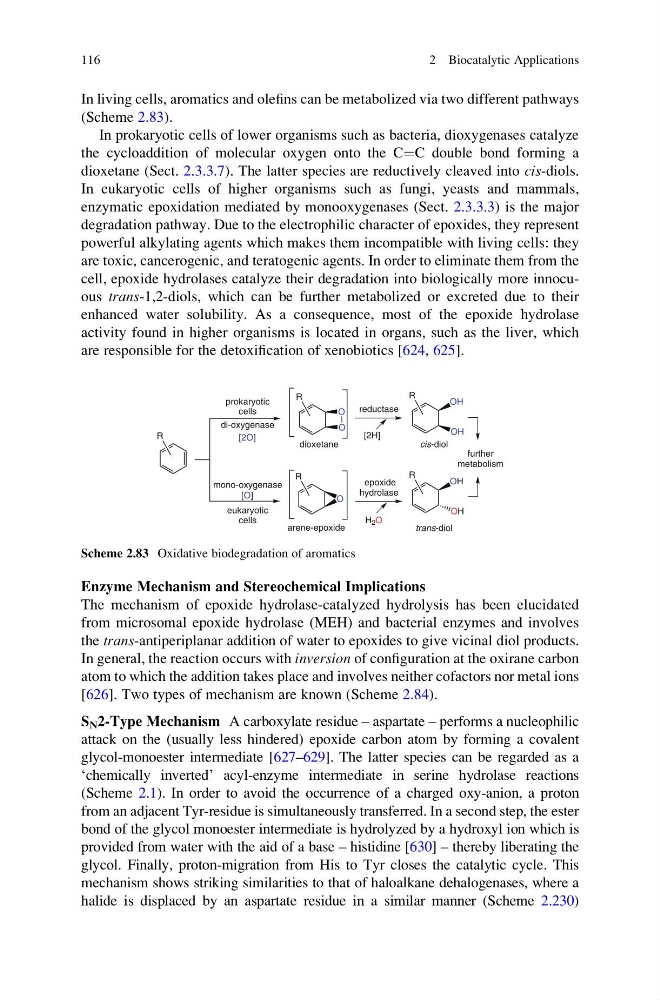
In living cells, aromatics and olefins can be metabolized via two different pathways
(Scheme 2.83).
In prokaryotic cells of lower organisms such as bacteria, dioxygenases catalyze
the cycloaddition of molecular oxygen onto the C¼C double bond forming a
dioxetane (Sect. 2.3.3.7). The latter species are reductively cleaved into cis-diols.
In eukaryotic cells of higher organisms such as fungi, yeasts and mammals,
enzymatic epoxidation mediated by monooxygenases (Sect. 2.3.3.3) is the major
degradation pathway. Due to the electrophilic character of epoxides, they represent
powerful alkylating agents which makes them incompatible with living cells: they
are toxic, cancerogenic, and teratogenic agents. In order to eliminate them from the
cell, epoxide hydrolases catalyze their degradation into biologically more innocuous trans-1,2-diols, which can be further metabolized or excreted due to their
enhanced water solubility. As a consequence, most of the epoxide hydrolase
activity found in higher organisms is located in organs, such as the liver, which
are responsible for the detoxification of xenobiotics [624, 625].
Enzyme Mechanism and Stereochemical Implications
The mechanism of epoxide hydrolase-catalyzed hydrolysis has been elucidated
from microsomal epoxide hydrolase (MEH) and bacterial enzymes and involves
the trans-antiperiplanar addition of water to epoxides to give vicinal diol products.
In general, the reaction occurs with inversion of configuration at the oxirane carbon
atom to which the addition takes place and involves neither cofactors nor metal ions
[626]. Two types of mechanism are known (Scheme 2.84).
S N 2-Type Mechanism A carboxylate residue – aspartate – performs a nucleophilic
attack on the (usually less hindered) epoxide carbon atom by forming a covalent
glycol-monoester intermediate [627–629]. The latter species can be regarded as a
‘chemically inverted’ acyl-enzyme intermediate in serine hydrolase reactions
(Scheme 2.1). In order to avoid the occurrence of a charged oxy-anion, a proton
from an adjacent Tyr-residue is simultaneously transferred. In a second step, the ester
bond of the glycol monoester intermediate is hydrolyzed by a hydroxyl ion which is
provided from water with the aid of a base – histidine [630] – thereby liberating the
glycol. Finally, proton-migration from His to Tyr closes the catalytic cycle. This
mechanism shows striking similarities to that of haloalkane dehalogenases, where a
halide is displaced by an aspartate residue in a similar manner (Scheme 2.230)
R
R
O
O
R
O
R
OH
OH
R
OH
OH
dioxetane
arene-epoxide
cis-diol
trans-diol
reductase
epoxide
hydrolase
prokaryotic
eukaryotic
further
metabolism
di-oxygenase
mono-oxygenase
cells
cells
H 2 O
[2H]
[2O]
[O]
Scheme 2.83 Oxidative biodegradation of aromatics
116
2 Biocatalytic Applications
(Scheme 2.83).
In prokaryotic cells of lower organisms such as bacteria, dioxygenases catalyze
the cycloaddition of molecular oxygen onto the C¼C double bond forming a
dioxetane (Sect. 2.3.3.7). The latter species are reductively cleaved into cis-diols.
In eukaryotic cells of higher organisms such as fungi, yeasts and mammals,
enzymatic epoxidation mediated by monooxygenases (Sect. 2.3.3.3) is the major
degradation pathway. Due to the electrophilic character of epoxides, they represent
powerful alkylating agents which makes them incompatible with living cells: they
are toxic, cancerogenic, and teratogenic agents. In order to eliminate them from the
cell, epoxide hydrolases catalyze their degradation into biologically more innocuous trans-1,2-diols, which can be further metabolized or excreted due to their
enhanced water solubility. As a consequence, most of the epoxide hydrolase
activity found in higher organisms is located in organs, such as the liver, which
are responsible for the detoxification of xenobiotics [624, 625].
Enzyme Mechanism and Stereochemical Implications
The mechanism of epoxide hydrolase-catalyzed hydrolysis has been elucidated
from microsomal epoxide hydrolase (MEH) and bacterial enzymes and involves
the trans-antiperiplanar addition of water to epoxides to give vicinal diol products.
In general, the reaction occurs with inversion of configuration at the oxirane carbon
atom to which the addition takes place and involves neither cofactors nor metal ions
[626]. Two types of mechanism are known (Scheme 2.84).
S N 2-Type Mechanism A carboxylate residue – aspartate – performs a nucleophilic
attack on the (usually less hindered) epoxide carbon atom by forming a covalent
glycol-monoester intermediate [627–629]. The latter species can be regarded as a
‘chemically inverted’ acyl-enzyme intermediate in serine hydrolase reactions
(Scheme 2.1). In order to avoid the occurrence of a charged oxy-anion, a proton
from an adjacent Tyr-residue is simultaneously transferred. In a second step, the ester
bond of the glycol monoester intermediate is hydrolyzed by a hydroxyl ion which is
provided from water with the aid of a base – histidine [630] – thereby liberating the
glycol. Finally, proton-migration from His to Tyr closes the catalytic cycle. This
mechanism shows striking similarities to that of haloalkane dehalogenases, where a
halide is displaced by an aspartate residue in a similar manner (Scheme 2.230)
R
R
O
O
R
O
R
OH
OH
R
OH
OH
dioxetane
arene-epoxide
cis-diol
trans-diol
reductase
epoxide
hydrolase
prokaryotic
eukaryotic
further
metabolism
di-oxygenase
mono-oxygenase
cells
cells
H 2 O
[2H]
[2O]
[O]
Scheme 2.83 Oxidative biodegradation of aromatics
116
2 Biocatalytic Applications