

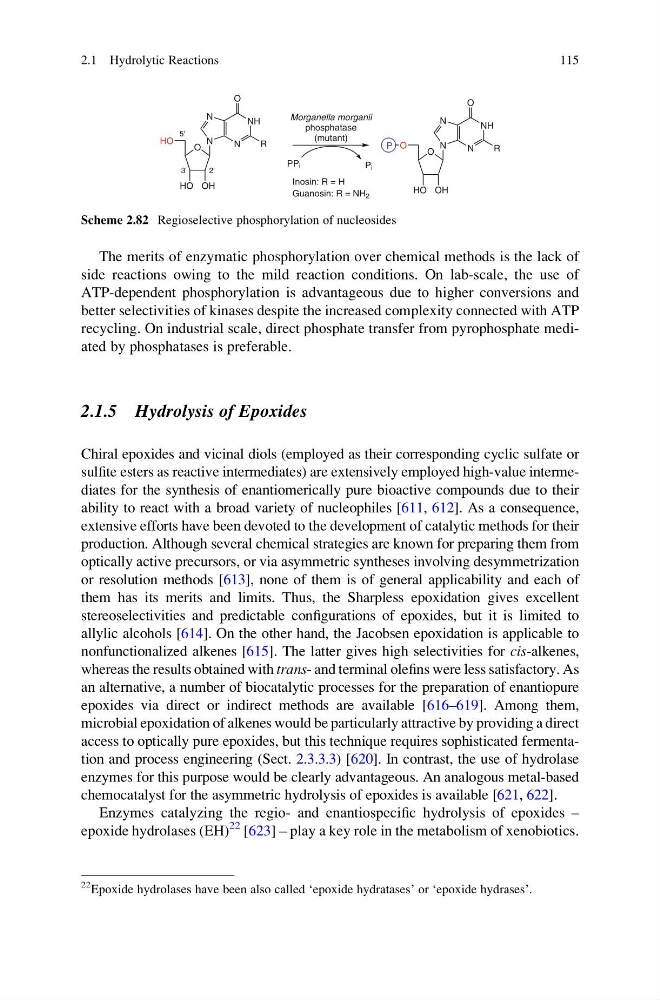
The merits of enzymatic phosphorylation over chemical methods is the lack of
side reactions owing to the mild reaction conditions. On lab-scale, the use of
ATP-dependent phosphorylation is advantageous due to higher conversions and
better selectivities of kinases despite the increased complexity connected with ATP
recycling. On industrial scale, direct phosphate transfer from pyrophosphate mediated by phosphatases is preferable.
2.1.5 Hydrolysis of Epoxides
Chiral epoxides and vicinal diols (employed as their corresponding cyclic sulfate or
sulfite esters as reactive intermediates) are extensively employed high-value intermediates for the synthesis of enantiomerically pure bioactive compounds due to their
ability to react with a broad variety of nucleophiles [611, 612]. As a consequence,
extensive efforts have been devoted to the development of catalytic methods for their
production. Although several chemical strategies are known for preparing them from
optically active precursors, or via asymmetric syntheses involving desymmetrization
or resolution methods [613], none of them is of general applicability and each of
them has its merits and limits. Thus, the Sharpless epoxidation gives excellent
stereoselectivities and predictable configurations of epoxides, but it is limited to
allylic alcohols [614]. On the other hand, the Jacobsen epoxidation is applicable to
nonfunctionalized alkenes [615]. The latter gives high selectivities for cis-alkenes,
whereas the results obtained with trans- and terminal olefins were less satisfactory. As
an alternative, a number of biocatalytic processes for the preparation of enantiopure
epoxides via direct or indirect methods are available [616–619]. Among them,
microbial epoxidation of alkenes would be particularly attractive by providing a direct
access to optically pure epoxides, but this technique requires sophisticated fermentation and process engineering (Sect. 2.3.3.3) [620]. In contrast, the use of hydrolase
enzymes for this purpose would be clearly advantageous. An analogous metal-based
chemocatalyst for the asymmetric hydrolysis of epoxides is available [621, 622].
Enzymes catalyzing the regio- and enantiospecific hydrolysis of epoxides –
epoxide hydrolases (EH)
22 [623] – play a key role in the metabolism of xenobiotics.
O
HO
N
N
N
NH
R
O
HO
OH
Inosin: R = H
Guanosin: R = NH 2
P
O
HO
N
N
N
NH
R
O
O
OH
PP i
P i
Morganella morganii
phosphatase
(mutant)
3'
2'
5'
Scheme 2.82 Regioselective phosphorylation of nucleosides
22 Epoxide hydrolases have been also called ‘epoxide hydratases’ or ‘epoxide hydrases’.
2.1 Hydrolytic Reactions
115
side reactions owing to the mild reaction conditions. On lab-scale, the use of
ATP-dependent phosphorylation is advantageous due to higher conversions and
better selectivities of kinases despite the increased complexity connected with ATP
recycling. On industrial scale, direct phosphate transfer from pyrophosphate mediated by phosphatases is preferable.
2.1.5 Hydrolysis of Epoxides
Chiral epoxides and vicinal diols (employed as their corresponding cyclic sulfate or
sulfite esters as reactive intermediates) are extensively employed high-value intermediates for the synthesis of enantiomerically pure bioactive compounds due to their
ability to react with a broad variety of nucleophiles [611, 612]. As a consequence,
extensive efforts have been devoted to the development of catalytic methods for their
production. Although several chemical strategies are known for preparing them from
optically active precursors, or via asymmetric syntheses involving desymmetrization
or resolution methods [613], none of them is of general applicability and each of
them has its merits and limits. Thus, the Sharpless epoxidation gives excellent
stereoselectivities and predictable configurations of epoxides, but it is limited to
allylic alcohols [614]. On the other hand, the Jacobsen epoxidation is applicable to
nonfunctionalized alkenes [615]. The latter gives high selectivities for cis-alkenes,
whereas the results obtained with trans- and terminal olefins were less satisfactory. As
an alternative, a number of biocatalytic processes for the preparation of enantiopure
epoxides via direct or indirect methods are available [616–619]. Among them,
microbial epoxidation of alkenes would be particularly attractive by providing a direct
access to optically pure epoxides, but this technique requires sophisticated fermentation and process engineering (Sect. 2.3.3.3) [620]. In contrast, the use of hydrolase
enzymes for this purpose would be clearly advantageous. An analogous metal-based
chemocatalyst for the asymmetric hydrolysis of epoxides is available [621, 622].
Enzymes catalyzing the regio- and enantiospecific hydrolysis of epoxides –
epoxide hydrolases (EH)
22 [623] – play a key role in the metabolism of xenobiotics.
O
HO
N
N
N
NH
R
O
HO
OH
Inosin: R = H
Guanosin: R = NH 2
P
O
HO
N
N
N
NH
R
O
O
OH
PP i
P i
Morganella morganii
phosphatase
(mutant)
3'
2'
5'
Scheme 2.82 Regioselective phosphorylation of nucleosides
22 Epoxide hydrolases have been also called ‘epoxide hydratases’ or ‘epoxide hydrases’.
2.1 Hydrolytic Reactions
115