

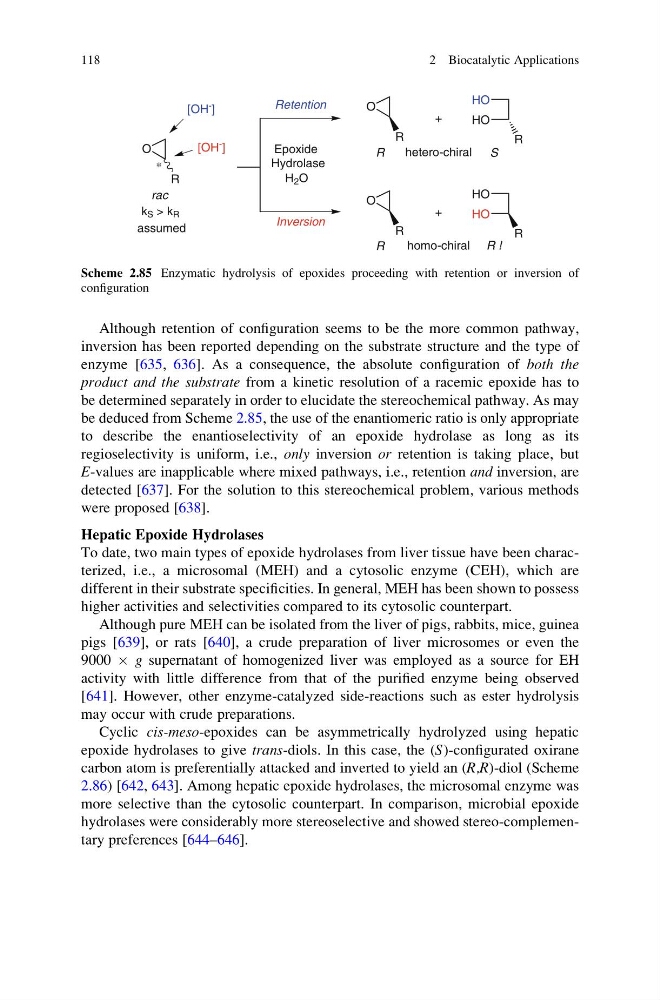
Although retention of configuration seems to be the more common pathway,
inversion has been reported depending on the substrate structure and the type of
enzyme [635, 636]. As a consequence, the absolute configuration of both the
product and the substrate from a kinetic resolution of a racemic epoxide has to
be determined separately in order to elucidate the stereochemical pathway. As may
be deduced from Scheme 2.85, the use of the enantiomeric ratio is only appropriate
to describe the enantioselectivity of an epoxide hydrolase as long as its
regioselectivity is uniform, i.e., only inversion or retention is taking place, but
E-values are inapplicable where mixed pathways, i.e., retention and inversion, are
detected [637]. For the solution to this stereochemical problem, various methods
were proposed [638].
Hepatic Epoxide Hydrolases
To date, two main types of epoxide hydrolases from liver tissue have been characterized, i.e., a microsomal (MEH) and a cytosolic enzyme (CEH), which are
different in their substrate specificities. In general, MEH has been shown to possess
higher activities and selectivities compared to its cytosolic counterpart.
Although pure MEH can be isolated from the liver of pigs, rabbits, mice, guinea
pigs [639], or rats [640], a crude preparation of liver microsomes or even the
9000 Â g supernatant of homogenized liver was employed as a source for EH
activity with little difference from that of the purified enzyme being observed
[641]. However, other enzyme-catalyzed side-reactions such as ester hydrolysis
may occur with crude preparations.
Cyclic cis-meso-epoxides can be asymmetrically hydrolyzed using hepatic
epoxide hydrolases to give trans-diols. In this case, the (S)-configurated oxirane
carbon atom is preferentially attacked and inverted to yield an (R,R)-diol (Scheme
2.86) [642, 643]. Among hepatic epoxide hydrolases, the microsomal enzyme was
more selective than the cytosolic counterpart. In comparison, microbial epoxide
hydrolases were considerably more stereoselective and showed stereo-complementary preferences [644–646].
HO
HO
R
R
O
HO
HO
R
R
O
R
O
assumed
k S > k R
homo-chiral
hetero-chiral
R !
+
+
Inversion
Retention
rac
Epoxide
Hydrolase
[OH
-
]
[OH
- ]
R
S
R
H 2 O
*
Scheme 2.85 Enzymatic hydrolysis of epoxides proceeding with retention or inversion of
configuration
118
2 Biocatalytic Applications
inversion has been reported depending on the substrate structure and the type of
enzyme [635, 636]. As a consequence, the absolute configuration of both the
product and the substrate from a kinetic resolution of a racemic epoxide has to
be determined separately in order to elucidate the stereochemical pathway. As may
be deduced from Scheme 2.85, the use of the enantiomeric ratio is only appropriate
to describe the enantioselectivity of an epoxide hydrolase as long as its
regioselectivity is uniform, i.e., only inversion or retention is taking place, but
E-values are inapplicable where mixed pathways, i.e., retention and inversion, are
detected [637]. For the solution to this stereochemical problem, various methods
were proposed [638].
Hepatic Epoxide Hydrolases
To date, two main types of epoxide hydrolases from liver tissue have been characterized, i.e., a microsomal (MEH) and a cytosolic enzyme (CEH), which are
different in their substrate specificities. In general, MEH has been shown to possess
higher activities and selectivities compared to its cytosolic counterpart.
Although pure MEH can be isolated from the liver of pigs, rabbits, mice, guinea
pigs [639], or rats [640], a crude preparation of liver microsomes or even the
9000 Â g supernatant of homogenized liver was employed as a source for EH
activity with little difference from that of the purified enzyme being observed
[641]. However, other enzyme-catalyzed side-reactions such as ester hydrolysis
may occur with crude preparations.
Cyclic cis-meso-epoxides can be asymmetrically hydrolyzed using hepatic
epoxide hydrolases to give trans-diols. In this case, the (S)-configurated oxirane
carbon atom is preferentially attacked and inverted to yield an (R,R)-diol (Scheme
2.86) [642, 643]. Among hepatic epoxide hydrolases, the microsomal enzyme was
more selective than the cytosolic counterpart. In comparison, microbial epoxide
hydrolases were considerably more stereoselective and showed stereo-complementary preferences [644–646].
HO
HO
R
R
O
HO
HO
R
R
O
R
O
assumed
k S > k R
homo-chiral
hetero-chiral
R !
+
+
Inversion
Retention
rac
Epoxide
Hydrolase
[OH
-
]
[OH
- ]
R
S
R
H 2 O
*
Scheme 2.85 Enzymatic hydrolysis of epoxides proceeding with retention or inversion of
configuration
118
2 Biocatalytic Applications