

ester which is excreted by plants in order to protect their leaves against microbial
attack [520]. The enzyme has been purified to homogeneity [521] and has been made
readily available by genetic engineering [522]. Due to its modest stereoselectivities it
has not been used widely for asymmetric ester hydrolyses [523], but its unique ability
to act on macroscopic polymer esters made it a prime candidate for the enzymatic
modification of polyesters [524] and their biodegradation [525].
Optimization of Selectivity
Most of the general techniques for an enzymatic selectivity enhancement such as
adjustment of temperature [526], buffer type and pH [307], and the kinetic parameters of the reaction which were described for the hydrolysis of esters using
esterases and proteases, are applicable to lipase-catalyzed reactions as well. Furthermore, the switch to another enzyme to obtain a better selectivity is relatively
easy due to the large number of available lipases. Substrate modification involving
not only the chiral alcohol moiety of an ester but also its acyl group [527], as
described above, is a valuable technique for the selectivity improvement of lipasecatalyzed transformations. Bearing in mind that lipases are subject to a strong
induced-fit and pronounced interfacial activation (Fig. 2.12), medium engineering
with lipases is generally more effective by applying biphasic systems (aqueous
buffer plus a water-immiscible organic solvent) instead of monophasic solvents
(buffer plus a water-miscible organic cosolvent).
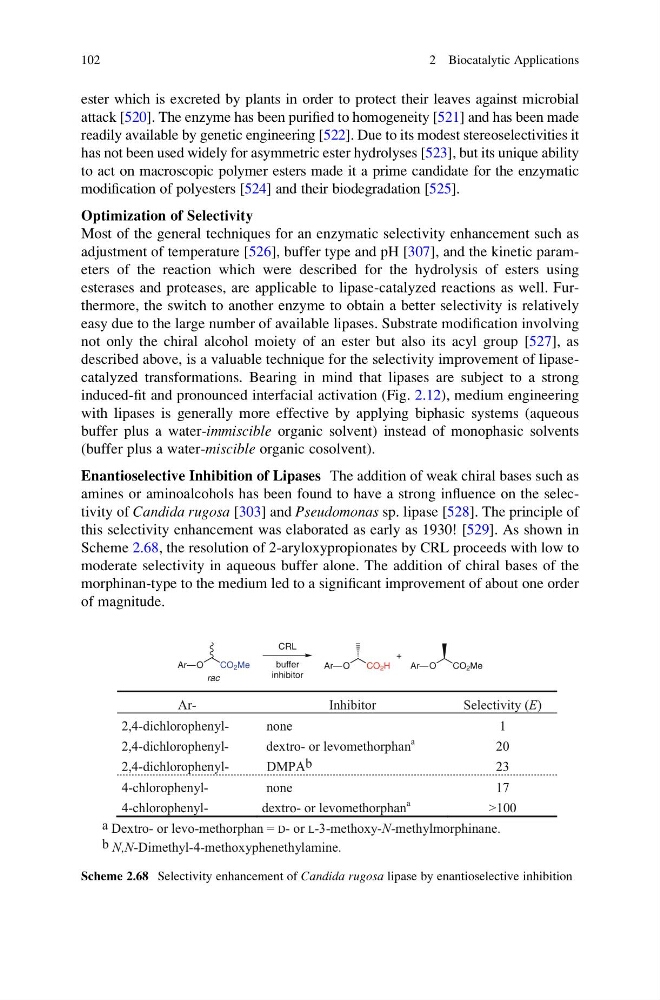
Enantioselective Inhibition of Lipases The addition of weak chiral bases such as
amines or aminoalcohols has been found to have a strong influence on the selectivity of Candida rugosa [303] and Pseudomonas sp. lipase [528]. The principle of
this selectivity enhancement was elaborated as early as 1930! [529]. As shown in
Scheme 2.68, the resolution of 2-aryloxypropionates by CRL proceeds with low to
moderate selectivity in aqueous buffer alone. The addition of chiral bases of the
morphinan-type to the medium led to a significant improvement of about one order
of magnitude.
CO 2 Me
Ar—O
CO 2 H
Ar—O
CO 2 Me
Ar—O
inhibitor
buffer
CRL
+
rac
ArInhibitor
Selectivity (E)
2,4-dichlorophenylnone
1
2,4-dichlorophenyldextro- or levomethorphan
a
20
2,4-dichlorophenylDMPA b
23
4-chlorophenylnone
17
4-chlorophenyldextro- or levomethorphan
a
>100
a Dextro- or levo-methorphan = D- or L-3-methoxy-N-methylmorphinane.
b N,N-Dimethyl-4-methoxyphenethylamine.
Scheme 2.68 Selectivity enhancement of Candida rugosa lipase by enantioselective inhibition
102
2 Biocatalytic Applications
attack [520]. The enzyme has been purified to homogeneity [521] and has been made
readily available by genetic engineering [522]. Due to its modest stereoselectivities it
has not been used widely for asymmetric ester hydrolyses [523], but its unique ability
to act on macroscopic polymer esters made it a prime candidate for the enzymatic
modification of polyesters [524] and their biodegradation [525].
Optimization of Selectivity
Most of the general techniques for an enzymatic selectivity enhancement such as
adjustment of temperature [526], buffer type and pH [307], and the kinetic parameters of the reaction which were described for the hydrolysis of esters using
esterases and proteases, are applicable to lipase-catalyzed reactions as well. Furthermore, the switch to another enzyme to obtain a better selectivity is relatively
easy due to the large number of available lipases. Substrate modification involving
not only the chiral alcohol moiety of an ester but also its acyl group [527], as
described above, is a valuable technique for the selectivity improvement of lipasecatalyzed transformations. Bearing in mind that lipases are subject to a strong
induced-fit and pronounced interfacial activation (Fig. 2.12), medium engineering
with lipases is generally more effective by applying biphasic systems (aqueous
buffer plus a water-immiscible organic solvent) instead of monophasic solvents
(buffer plus a water-miscible organic cosolvent).
Enantioselective Inhibition of Lipases The addition of weak chiral bases such as
amines or aminoalcohols has been found to have a strong influence on the selectivity of Candida rugosa [303] and Pseudomonas sp. lipase [528]. The principle of
this selectivity enhancement was elaborated as early as 1930! [529]. As shown in
Scheme 2.68, the resolution of 2-aryloxypropionates by CRL proceeds with low to
moderate selectivity in aqueous buffer alone. The addition of chiral bases of the
morphinan-type to the medium led to a significant improvement of about one order
of magnitude.
CO 2 Me
Ar—O
CO 2 H
Ar—O
CO 2 Me
Ar—O
inhibitor
buffer
CRL
+
rac
ArInhibitor
Selectivity (E)
2,4-dichlorophenylnone
1
2,4-dichlorophenyldextro- or levomethorphan
a
20
2,4-dichlorophenylDMPA b
23
4-chlorophenylnone
17
4-chlorophenyldextro- or levomethorphan
a
>100
a Dextro- or levo-methorphan = D- or L-3-methoxy-N-methylmorphinane.
b N,N-Dimethyl-4-methoxyphenethylamine.
Scheme 2.68 Selectivity enhancement of Candida rugosa lipase by enantioselective inhibition
102
2 Biocatalytic Applications