

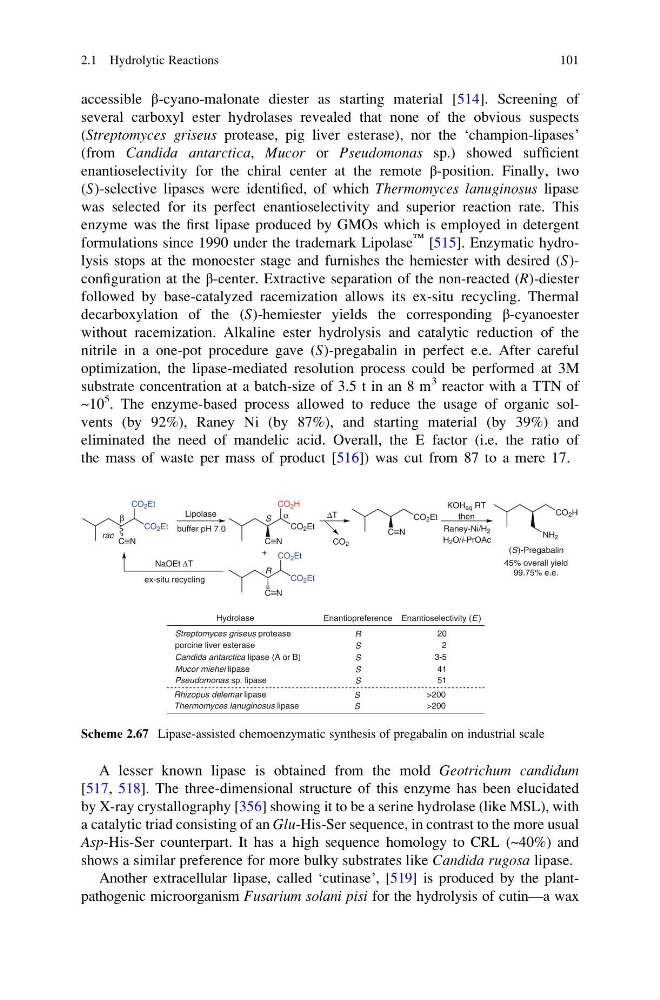
accessible β-cyano-malonate diester as starting material [514]. Screening of
several carboxyl ester hydrolases revealed that none of the obvious suspects
(Streptomyces griseus protease, pig liver esterase), nor the ‘champion-lipases’
(from Candida antarctica, Mucor or Pseudomonas sp.) showed sufficient
enantioselectivity for the chiral center at the remote β-position. Finally, two
(S)-selective lipases were identified, of which Thermomyces lanuginosus lipase
was selected for its perfect enantioselectivity and superior reaction rate. This
enzyme was the first lipase produced by GMOs which is employed in detergent
formulations since 1990 under the trademark Lipolase
™ [515]. Enzymatic hydrolysis stops at the monoester stage and furnishes the hemiester with desired (S)configuration at the β-center. Extractive separation of the non-reacted (R)-diester
followed by base-catalyzed racemization allows its ex-situ recycling. Thermal
decarboxylation of the (S)-hemiester yields the corresponding β-cyanoester
without racemization. Alkaline ester hydrolysis and catalytic reduction of the
nitrile in a one-pot procedure gave (S)-pregabalin in perfect e.e. After careful
optimization, the lipase-mediated resolution process could be performed at 3M
substrate concentration at a batch-size of 3.5 t in an 8 m
3 reactor with a TTN of
~10
5 . The enzyme-based process allowed to reduce the usage of organic solvents (by 92%), Raney Ni (by 87%), and starting material (by 39%) and
eliminated the need of mandelic acid. Overall, the E factor (i.e. the ratio of
the mass of waste per mass of product [516]) was cut from 87 to a mere 17.
A lesser known lipase is obtained from the mold Geotrichum candidum
[517, 518]. The three-dimensional structure of this enzyme has been elucidated
by X-ray crystallography [356] showing it to be a serine hydrolase (like MSL), with
a catalytic triad consisting of an Glu-His-Ser sequence, in contrast to the more usual
Asp-His-Ser counterpart. It has a high sequence homology to CRL (~40%) and
shows a similar preference for more bulky substrates like Candida rugosa lipase.
Another extracellular lipase, called ‘cutinase’, [519] is produced by the plantpathogenic microorganism Fusarium solani pisi for the hydrolysis of cutin—a wax
CO 2 H
NH 2
(S)-Pregabalin
CO 2 Et
C≡N
KOH aq RT
then
Raney-Ni/H 2
H 2 O/i-PrOAc
45% overall yield
99.75% e.e.
CO 2
CO 2 Et
C≡N
CO 2 H
CO 2 Et
C≡N
CO 2 Et
CO 2 Et
C≡N
CO 2 Et
rac
+
Lipolase
buffer pH 7.0
ex-situ recycling
ΔT
NaOEt ΔT
S
R
Hydrolase
Enantioselectivity (E )
Enantiopreference
Streptomyces griseus protease
R
20
porcine liver esterase
S
2
Candida antarctica lipase (A or B)
S
3-5
Mucor miehei lipase
S
41
Pseudomonas sp. lipase
S
51
Rhizopus delemar lipase
S
>200
Thermomyces lanuginosus lipase
S
>200
β
α
Scheme 2.67 Lipase-assisted chemoenzymatic synthesis of pregabalin on industrial scale
2.1 Hydrolytic Reactions
101
several carboxyl ester hydrolases revealed that none of the obvious suspects
(Streptomyces griseus protease, pig liver esterase), nor the ‘champion-lipases’
(from Candida antarctica, Mucor or Pseudomonas sp.) showed sufficient
enantioselectivity for the chiral center at the remote β-position. Finally, two
(S)-selective lipases were identified, of which Thermomyces lanuginosus lipase
was selected for its perfect enantioselectivity and superior reaction rate. This
enzyme was the first lipase produced by GMOs which is employed in detergent
formulations since 1990 under the trademark Lipolase
™ [515]. Enzymatic hydrolysis stops at the monoester stage and furnishes the hemiester with desired (S)configuration at the β-center. Extractive separation of the non-reacted (R)-diester
followed by base-catalyzed racemization allows its ex-situ recycling. Thermal
decarboxylation of the (S)-hemiester yields the corresponding β-cyanoester
without racemization. Alkaline ester hydrolysis and catalytic reduction of the
nitrile in a one-pot procedure gave (S)-pregabalin in perfect e.e. After careful
optimization, the lipase-mediated resolution process could be performed at 3M
substrate concentration at a batch-size of 3.5 t in an 8 m
3 reactor with a TTN of
~10
5 . The enzyme-based process allowed to reduce the usage of organic solvents (by 92%), Raney Ni (by 87%), and starting material (by 39%) and
eliminated the need of mandelic acid. Overall, the E factor (i.e. the ratio of
the mass of waste per mass of product [516]) was cut from 87 to a mere 17.
A lesser known lipase is obtained from the mold Geotrichum candidum
[517, 518]. The three-dimensional structure of this enzyme has been elucidated
by X-ray crystallography [356] showing it to be a serine hydrolase (like MSL), with
a catalytic triad consisting of an Glu-His-Ser sequence, in contrast to the more usual
Asp-His-Ser counterpart. It has a high sequence homology to CRL (~40%) and
shows a similar preference for more bulky substrates like Candida rugosa lipase.
Another extracellular lipase, called ‘cutinase’, [519] is produced by the plantpathogenic microorganism Fusarium solani pisi for the hydrolysis of cutin—a wax
CO 2 H
NH 2
(S)-Pregabalin
CO 2 Et
C≡N
KOH aq RT
then
Raney-Ni/H 2
H 2 O/i-PrOAc
45% overall yield
99.75% e.e.
CO 2
CO 2 Et
C≡N
CO 2 H
CO 2 Et
C≡N
CO 2 Et
CO 2 Et
C≡N
CO 2 Et
rac
+
Lipolase
buffer pH 7.0
ex-situ recycling
ΔT
NaOEt ΔT
S
R
Hydrolase
Enantioselectivity (E )
Enantiopreference
Streptomyces griseus protease
R
20
porcine liver esterase
S
2
Candida antarctica lipase (A or B)
S
3-5
Mucor miehei lipase
S
41
Pseudomonas sp. lipase
S
51
Rhizopus delemar lipase
S
>200
Thermomyces lanuginosus lipase
S
>200
β
α
Scheme 2.67 Lipase-assisted chemoenzymatic synthesis of pregabalin on industrial scale
2.1 Hydrolytic Reactions
101