

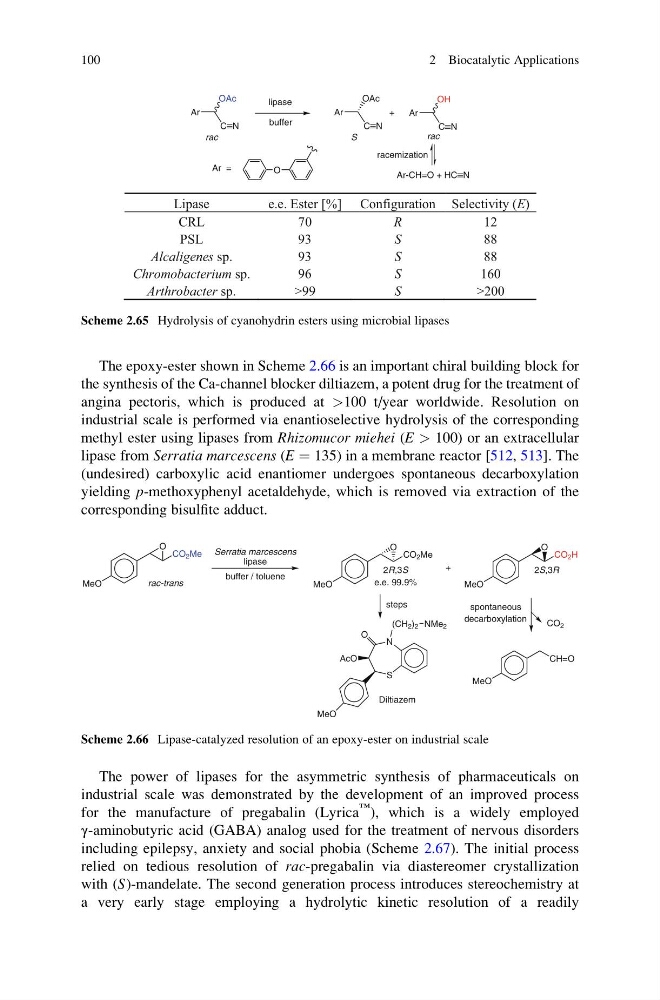
The epoxy-ester shown in Scheme 2.66 is an important chiral building block for
the synthesis of the Ca-channel blocker diltiazem, a potent drug for the treatment of
angina pectoris, which is produced at >100 t/year worldwide. Resolution on
industrial scale is performed via enantioselective hydrolysis of the corresponding
methyl ester using lipases from Rhizomucor miehei (E > 100) or an extracellular
lipase from Serratia marcescens (E ¼ 135) in a membrane reactor [512, 513]. The
(undesired) carboxylic acid enantiomer undergoes spontaneous decarboxylation
yielding p-methoxyphenyl acetaldehyde, which is removed via extraction of the
corresponding bisulfite adduct.
The power of lipases for the asymmetric synthesis of pharmaceuticals on
industrial scale was demonstrated by the development of an improved process
for the manufacture of pregabalin (Lyrica
™ ), which is a widely employed
γ-aminobutyric acid (GABA) analog used for the treatment of nervous disorders
including epilepsy, anxiety and social phobia (Scheme 2.67). The initial process
relied on tedious resolution of rac-pregabalin via diastereomer crystallization
with (S)-mandelate. The second generation process introduces stereochemistry at
a very early stage employing a hydrolytic kinetic resolution of a readily
O
OH
C≡N
Ar
OAc
C≡N
Ar
OAc
C≡N
Ar
Ar =
racemization
rac
rac
+
buffer
lipase
Ar-CH=O + HC≡N
S
Lipase
e.e. Ester [%] Configuration Selectivity (E)
CRL
70
R
12
PSL
93
S
88
Alcaligenes sp.
93
S
88
Chromobacterium sp.
96
S
160
Arthrobacter sp.
>99
S
>200
Scheme 2.65 Hydrolysis of cyanohydrin esters using microbial lipases
MeO
(CH 2 ) 2
O
AcO
N
S
MeO
CH=O
MeO
O
CO 2 H
MeO
O
CO 2 Me
MeO
O
CO 2 Me
Diltiazem
steps
+
decarboxylation
spontaneous
2S,3R
2R,3S
buffer / toluene
lipase
Serratia marcescens
rac-trans
e.e. 99.9%
CO 2
NMe 2
Scheme 2.66 Lipase-catalyzed resolution of an epoxy-ester on industrial scale
100
2 Biocatalytic Applications
the synthesis of the Ca-channel blocker diltiazem, a potent drug for the treatment of
angina pectoris, which is produced at >100 t/year worldwide. Resolution on
industrial scale is performed via enantioselective hydrolysis of the corresponding
methyl ester using lipases from Rhizomucor miehei (E > 100) or an extracellular
lipase from Serratia marcescens (E ¼ 135) in a membrane reactor [512, 513]. The
(undesired) carboxylic acid enantiomer undergoes spontaneous decarboxylation
yielding p-methoxyphenyl acetaldehyde, which is removed via extraction of the
corresponding bisulfite adduct.
The power of lipases for the asymmetric synthesis of pharmaceuticals on
industrial scale was demonstrated by the development of an improved process
for the manufacture of pregabalin (Lyrica
™ ), which is a widely employed
γ-aminobutyric acid (GABA) analog used for the treatment of nervous disorders
including epilepsy, anxiety and social phobia (Scheme 2.67). The initial process
relied on tedious resolution of rac-pregabalin via diastereomer crystallization
with (S)-mandelate. The second generation process introduces stereochemistry at
a very early stage employing a hydrolytic kinetic resolution of a readily
O
OH
C≡N
Ar
OAc
C≡N
Ar
OAc
C≡N
Ar
Ar =
racemization
rac
rac
+
buffer
lipase
Ar-CH=O + HC≡N
S
Lipase
e.e. Ester [%] Configuration Selectivity (E)
CRL
70
R
12
PSL
93
S
88
Alcaligenes sp.
93
S
88
Chromobacterium sp.
96
S
160
Arthrobacter sp.
>99
S
>200
Scheme 2.65 Hydrolysis of cyanohydrin esters using microbial lipases
MeO
(CH 2 ) 2
O
AcO
N
S
MeO
CH=O
MeO
O
CO 2 H
MeO
O
CO 2 Me
MeO
O
CO 2 Me
Diltiazem
steps
+
decarboxylation
spontaneous
2S,3R
2R,3S
buffer / toluene
lipase
Serratia marcescens
rac-trans
e.e. 99.9%
CO 2
NMe 2
Scheme 2.66 Lipase-catalyzed resolution of an epoxy-ester on industrial scale
100
2 Biocatalytic Applications