

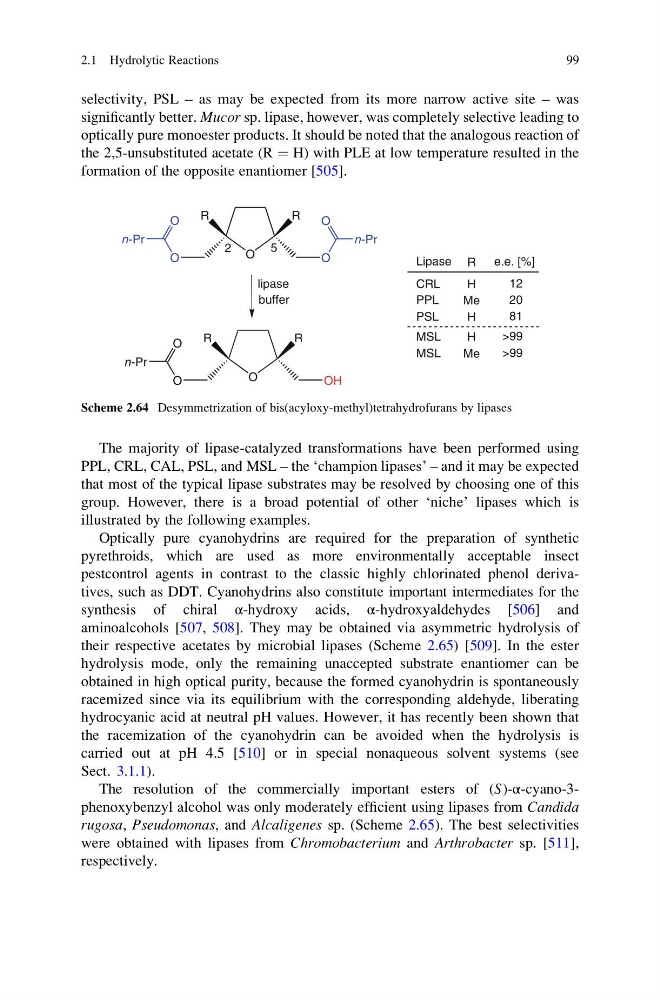
selectivity, PSL – as may be expected from its more narrow active site – was
significantly better. Mucor sp. lipase, however, was completely selective leading to
optically pure monoester products. It should be noted that the analogous reaction of
the 2,5-unsubstituted acetate (R ¼ H) with PLE at low temperature resulted in the
formation of the opposite enantiomer [505].
The majority of lipase-catalyzed transformations have been performed using
PPL, CRL, CAL, PSL, and MSL – the ‘champion lipases’ – and it may be expected
that most of the typical lipase substrates may be resolved by choosing one of this
group. However, there is a broad potential of other ‘niche’ lipases which is
illustrated by the following examples.
Optically pure cyanohydrins are required for the preparation of synthetic
pyrethroids, which are used as more environmentally acceptable insect
pestcontrol agents in contrast to the classic highly chlorinated phenol derivatives, such as DDT. Cyanohydrins also constitute important intermediates for the
synthesis of chiral α-hydroxy acids, α-hydroxyaldehydes [506] and
aminoalcohols [507, 508]. They may be obtained via asymmetric hydrolysis of
their respective acetates by microbial lipases (Scheme 2.65) [509]. In the ester
hydrolysis mode, only the remaining unaccepted substrate enantiomer can be
obtained in high optical purity, because the formed cyanohydrin is spontaneously
racemized since via its equilibrium with the corresponding aldehyde, liberating
hydrocyanic acid at neutral pH values. However, it has recently been shown that
the racemization of the cyanohydrin can be avoided when the hydrolysis is
carried out at pH 4.5 [510] or in special nonaqueous solvent systems (see
Sect. 3.1.1).
The resolution of the commercially important esters of (S)-α-cyano-3phenoxybenzyl alcohol was only moderately efficient using lipases from Candida
rugosa, Pseudomonas, and Alcaligenes sp. (Scheme 2.65). The best selectivities
were obtained with lipases from Chromobacterium and Arthrobacter sp. [511],
respectively.
5
2
buffer
lipase
O
R
R
O
O
O
n-Pr
O
n-Pr
O
R
R
OH
O
O
n-Pr
Lipase R
e.e. [%]
CRL
PPL
PSL
MSL
MSL
H
Me
H
H
Me
12
20
81
>99
>99
Scheme 2.64 Desymmetrization of bis(acyloxy-methyl)tetrahydrofurans by lipases
2.1 Hydrolytic Reactions
99
significantly better. Mucor sp. lipase, however, was completely selective leading to
optically pure monoester products. It should be noted that the analogous reaction of
the 2,5-unsubstituted acetate (R ¼ H) with PLE at low temperature resulted in the
formation of the opposite enantiomer [505].
The majority of lipase-catalyzed transformations have been performed using
PPL, CRL, CAL, PSL, and MSL – the ‘champion lipases’ – and it may be expected
that most of the typical lipase substrates may be resolved by choosing one of this
group. However, there is a broad potential of other ‘niche’ lipases which is
illustrated by the following examples.
Optically pure cyanohydrins are required for the preparation of synthetic
pyrethroids, which are used as more environmentally acceptable insect
pestcontrol agents in contrast to the classic highly chlorinated phenol derivatives, such as DDT. Cyanohydrins also constitute important intermediates for the
synthesis of chiral α-hydroxy acids, α-hydroxyaldehydes [506] and
aminoalcohols [507, 508]. They may be obtained via asymmetric hydrolysis of
their respective acetates by microbial lipases (Scheme 2.65) [509]. In the ester
hydrolysis mode, only the remaining unaccepted substrate enantiomer can be
obtained in high optical purity, because the formed cyanohydrin is spontaneously
racemized since via its equilibrium with the corresponding aldehyde, liberating
hydrocyanic acid at neutral pH values. However, it has recently been shown that
the racemization of the cyanohydrin can be avoided when the hydrolysis is
carried out at pH 4.5 [510] or in special nonaqueous solvent systems (see
Sect. 3.1.1).
The resolution of the commercially important esters of (S)-α-cyano-3phenoxybenzyl alcohol was only moderately efficient using lipases from Candida
rugosa, Pseudomonas, and Alcaligenes sp. (Scheme 2.65). The best selectivities
were obtained with lipases from Chromobacterium and Arthrobacter sp. [511],
respectively.
5
2
buffer
lipase
O
R
R
O
O
O
n-Pr
O
n-Pr
O
R
R
OH
O
O
n-Pr
Lipase R
e.e. [%]
CRL
PPL
PSL
MSL
MSL
H
Me
H
H
Me
12
20
81
>99
>99
Scheme 2.64 Desymmetrization of bis(acyloxy-methyl)tetrahydrofurans by lipases
2.1 Hydrolytic Reactions
99