

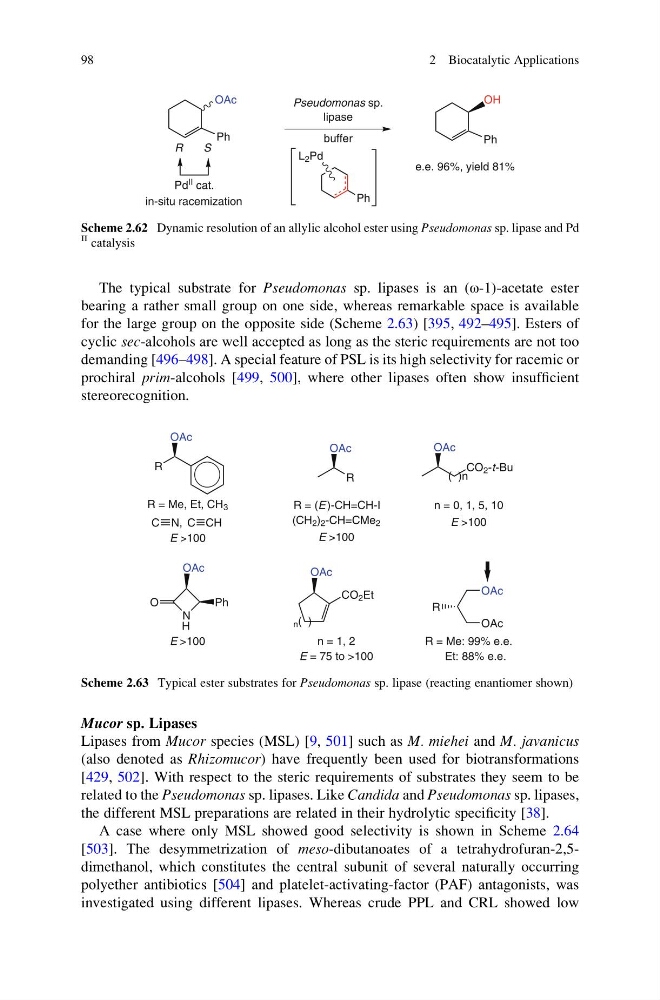
The typical substrate for Pseudomonas sp. lipases is an (ω-1)-acetate ester
bearing a rather small group on one side, whereas remarkable space is available
for the large group on the opposite side (Scheme 2.63) [395, 492–495]. Esters of
cyclic sec-alcohols are well accepted as long as the steric requirements are not too
demanding [496–498]. A special feature of PSL is its high selectivity for racemic or
prochiral prim-alcohols [499, 500], where other lipases often show insufficient
stereorecognition.
Mucor sp. Lipases
Lipases from Mucor species (MSL) [9, 501] such as M. miehei and M. javanicus
(also denoted as Rhizomucor) have frequently been used for biotransformations
[429, 502]. With respect to the steric requirements of substrates they seem to be
related to the Pseudomonas sp. lipases. Like Candida and Pseudomonas sp. lipases,
the different MSL preparations are related in their hydrolytic specificity [38].
A case where only MSL showed good selectivity is shown in Scheme 2.64
[503]. The desymmetrization of meso-dibutanoates of a tetrahydrofuran-2,5dimethanol, which constitutes the central subunit of several naturally occurring
polyether antibiotics [504] and platelet-activating-factor (PAF) antagonists, was
investigated using different lipases. Whereas crude PPL and CRL showed low
Ph
OH
Ph
OAc
Ph
e.e. 96%, yield 81%
in-situ racemization
Pd II cat.
Pseudomonas sp.
buffer
lipase
S
R
L 2 Pd
Scheme 2.62 Dynamic resolution of an allylic alcohol ester using Pseudomonas sp. lipase and Pd
II catalysis
OAc
R
OAc
R
OAc
CO 2 -t-Bu
OAc
CO 2 Et
Ph
OAc
O
N
OAc
OAc
R
N,
C
C H
C
E >100
R = Me, Et, CH 3
E >100
E >100
n = 0, 1, 5, 10
E >100
R = Me: 99% e.e.
Et: 88% e.e.
n = 1, 2
E = 75 to >100
R = (E )-CH=CH-I
(CH 2 ) 2 -CH=CMe 2
( )n
n ( )
H
≡
≡
Scheme 2.63 Typical ester substrates for Pseudomonas sp. lipase (reacting enantiomer shown)
98
2 Biocatalytic Applications
bearing a rather small group on one side, whereas remarkable space is available
for the large group on the opposite side (Scheme 2.63) [395, 492–495]. Esters of
cyclic sec-alcohols are well accepted as long as the steric requirements are not too
demanding [496–498]. A special feature of PSL is its high selectivity for racemic or
prochiral prim-alcohols [499, 500], where other lipases often show insufficient
stereorecognition.
Mucor sp. Lipases
Lipases from Mucor species (MSL) [9, 501] such as M. miehei and M. javanicus
(also denoted as Rhizomucor) have frequently been used for biotransformations
[429, 502]. With respect to the steric requirements of substrates they seem to be
related to the Pseudomonas sp. lipases. Like Candida and Pseudomonas sp. lipases,
the different MSL preparations are related in their hydrolytic specificity [38].
A case where only MSL showed good selectivity is shown in Scheme 2.64
[503]. The desymmetrization of meso-dibutanoates of a tetrahydrofuran-2,5dimethanol, which constitutes the central subunit of several naturally occurring
polyether antibiotics [504] and platelet-activating-factor (PAF) antagonists, was
investigated using different lipases. Whereas crude PPL and CRL showed low
Ph
OH
Ph
OAc
Ph
e.e. 96%, yield 81%
in-situ racemization
Pd II cat.
Pseudomonas sp.
buffer
lipase
S
R
L 2 Pd
Scheme 2.62 Dynamic resolution of an allylic alcohol ester using Pseudomonas sp. lipase and Pd
II catalysis
OAc
R
OAc
R
OAc
CO 2 -t-Bu
OAc
CO 2 Et
Ph
OAc
O
N
OAc
OAc
R
N,
C
C H
C
E >100
R = Me, Et, CH 3
E >100
E >100
n = 0, 1, 5, 10
E >100
R = Me: 99% e.e.
Et: 88% e.e.
n = 1, 2
E = 75 to >100
R = (E )-CH=CH-I
(CH 2 ) 2 -CH=CMe 2
( )n
n ( )
H
≡
≡
Scheme 2.63 Typical ester substrates for Pseudomonas sp. lipase (reacting enantiomer shown)
98
2 Biocatalytic Applications