

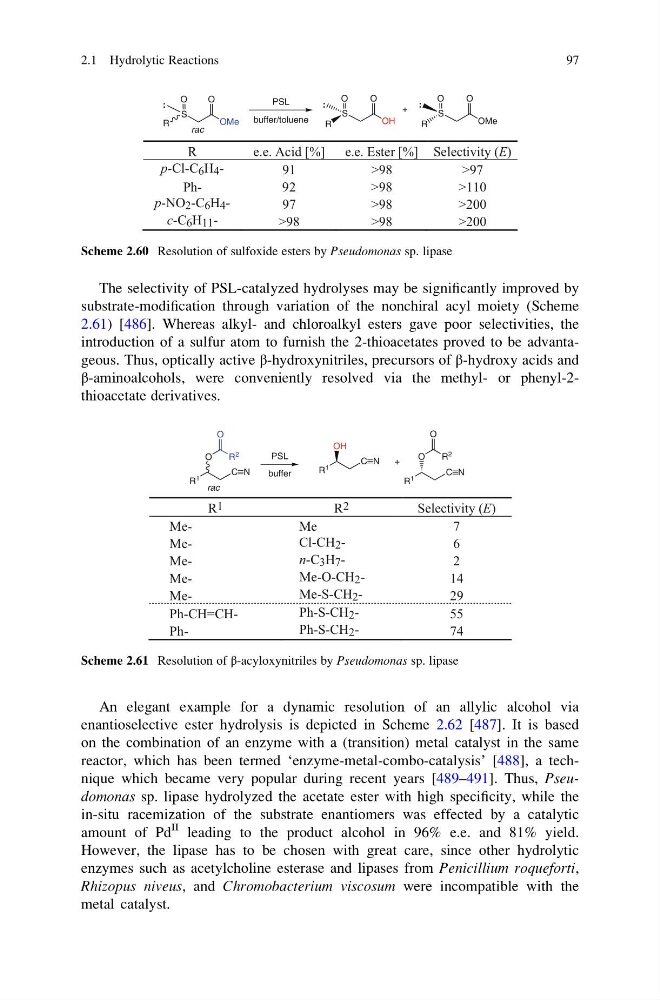
The selectivity of PSL-catalyzed hydrolyses may be significantly improved by
substrate-modification through variation of the nonchiral acyl moiety (Scheme
2.61) [486]. Whereas alkyl- and chloroalkyl esters gave poor selectivities, the
introduction of a sulfur atom to furnish the 2-thioacetates proved to be advantageous. Thus, optically active β-hydroxynitriles, precursors of β-hydroxy acids and
β-aminoalcohols, were conveniently resolved via the methyl- or phenyl-2thioacetate derivatives.
An elegant example for a dynamic resolution of an allylic alcohol via
enantioselective ester hydrolysis is depicted in Scheme 2.62 [487]. It is based
on the combination of an enzyme with a (transition) metal catalyst in the same
reactor, which has been termed ‘enzyme-metal-combo-catalysis’ [488], a technique which became very popular during recent years [489–491]. Thus, Pseudomonas sp. lipase hydrolyzed the acetate ester with high specificity, while the
in-situ racemization of the substrate enantiomers was effected by a catalytic
amount of Pd
II leading to the product alcohol in 96% e.e. and 81% yield.
However, the lipase has to be chosen with great care, since other hydrolytic
enzymes such as acetylcholine esterase and lipases from Penicillium roqueforti,
Rhizopus niveus, and Chromobacterium viscosum were incompatible with the
metal catalyst.
:
O
O
OMe
S
R
:
O
O
OH
S
R
:
O
O
OMe
S
R
buffer/toluene
PSL
+
rac
R
e.e. Acid [%] e.e. Ester [%] Selectivity (E)
p-Cl-C 6 H 4 -
91
>98
>97
Ph92
>98
>110
p-NO 2 -C 6 H 4 -
97
>98
>200
c-C 6 H 11 -
>98
>98
>200
Scheme 2.60 Resolution of sulfoxide esters by Pseudomonas sp. lipase
R
2
O
O
C≡N
R
1
OH
C≡N
R
1
R
2
O
O
C≡N
R
1
buffer
PSL
+
rac
R 1
R 2
Selectivity (E)
MeMe
7
MeCl-CH 2 -
6
Men-C 3 H 7 -
2
MeMe-O-CH 2 -
14
MeMe-S-CH 2 -
29
Ph-CH=CHPh-S-CH 2 -
55
PhPh-S-CH 2 -
74
Scheme 2.61 Resolution of β-acyloxynitriles by Pseudomonas sp. lipase
2.1 Hydrolytic Reactions
97
substrate-modification through variation of the nonchiral acyl moiety (Scheme
2.61) [486]. Whereas alkyl- and chloroalkyl esters gave poor selectivities, the
introduction of a sulfur atom to furnish the 2-thioacetates proved to be advantageous. Thus, optically active β-hydroxynitriles, precursors of β-hydroxy acids and
β-aminoalcohols, were conveniently resolved via the methyl- or phenyl-2thioacetate derivatives.
An elegant example for a dynamic resolution of an allylic alcohol via
enantioselective ester hydrolysis is depicted in Scheme 2.62 [487]. It is based
on the combination of an enzyme with a (transition) metal catalyst in the same
reactor, which has been termed ‘enzyme-metal-combo-catalysis’ [488], a technique which became very popular during recent years [489–491]. Thus, Pseudomonas sp. lipase hydrolyzed the acetate ester with high specificity, while the
in-situ racemization of the substrate enantiomers was effected by a catalytic
amount of Pd
II leading to the product alcohol in 96% e.e. and 81% yield.
However, the lipase has to be chosen with great care, since other hydrolytic
enzymes such as acetylcholine esterase and lipases from Penicillium roqueforti,
Rhizopus niveus, and Chromobacterium viscosum were incompatible with the
metal catalyst.
:
O
O
OMe
S
R
:
O
O
OH
S
R
:
O
O
OMe
S
R
buffer/toluene
PSL
+
rac
R
e.e. Acid [%] e.e. Ester [%] Selectivity (E)
p-Cl-C 6 H 4 -
91
>98
>97
Ph92
>98
>110
p-NO 2 -C 6 H 4 -
97
>98
>200
c-C 6 H 11 -
>98
>98
>200
Scheme 2.60 Resolution of sulfoxide esters by Pseudomonas sp. lipase
R
2
O
O
C≡N
R
1
OH
C≡N
R
1
R
2
O
O
C≡N
R
1
buffer
PSL
+
rac
R 1
R 2
Selectivity (E)
MeMe
7
MeCl-CH 2 -
6
Men-C 3 H 7 -
2
MeMe-O-CH 2 -
14
MeMe-S-CH 2 -
29
Ph-CH=CHPh-S-CH 2 -
55
PhPh-S-CH 2 -
74
Scheme 2.61 Resolution of β-acyloxynitriles by Pseudomonas sp. lipase
2.1 Hydrolytic Reactions
97