

Kinetic inhibition experiments revealed that the molecular action of the base on
the lipase is a noncompetitive inhibition – i.e., the base attaches itself to the lipase at
a site other than the active site, also denoted as ‘allosteric effect’ – which inhibits
the transformation of one enantiomer but not that of its mirror image. Surprisingly,
the chirality of the base has only a marginal impact on the selectivity enhancement
effect. The applicability of this method – impeded by the high cost of morphinan
alkaloids and their questionable use for large-scale synthesis – has been extended
by the use of more simple amines such as N, N-dimethyl-4-methoxyphenethylamine
(DMPA) [250].
2.1.3.3 Hydrolysis of Lactones
Owing to their cyclic structure, lactones are more stable than open-chain esters and
thus are generally not hydrolyzed by ‘standard’ ester hydrolases. They can be
hydrolyzed by lactonases [530], which are involved in the metabolism of aldoses
[531] and the deactivation of bioactive lactones, such as N-acyl homoserine lactone
[532]. In the hydrolytic kinetic resolution of lactones, the separation of the formed
(water-soluble) hydroxycarboxylic acid from unreacted (lipophilic) lactone is particularly easy via extraction using an aqueous-organic system.
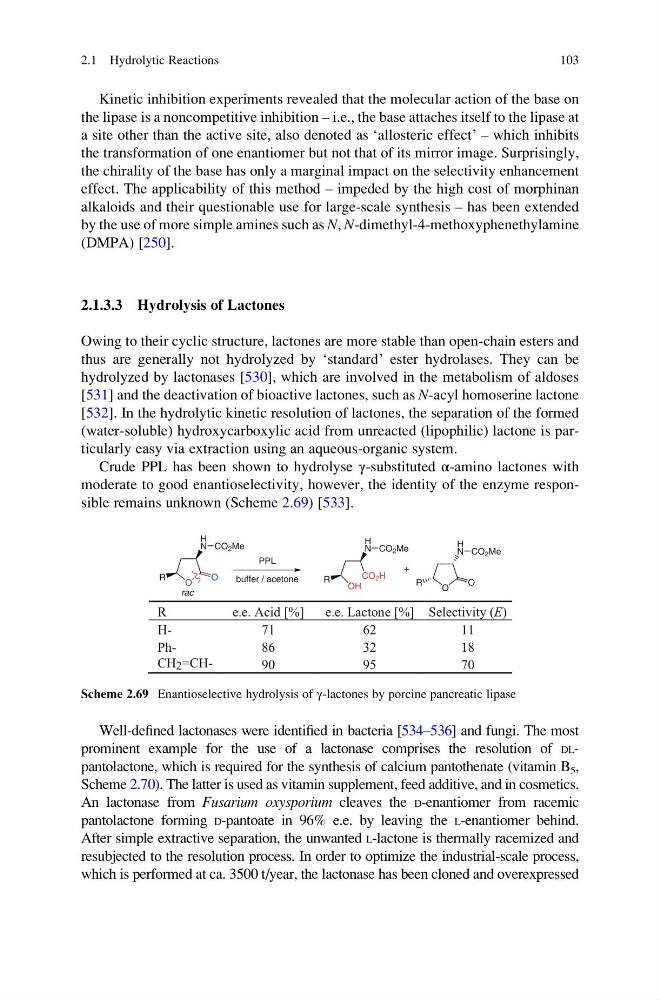
Crude PPL has been shown to hydrolyse γ-substituted α-amino lactones with
moderate to good enantioselectivity, however, the identity of the enzyme responsible remains unknown (Scheme 2.69) [533].
Well-defined lactonases were identified in bacteria [534–536] and fungi. The most
prominent example for the use of a lactonase comprises the resolution of DLpantolactone, which is required for the synthesis of calcium pantothenate (vitamin B 5 ,
Scheme 2.70). The latter is used as vitamin supplement, feed additive, and in cosmetics.
An lactonase from Fusarium oxysporium cleaves the D-enantiomer from racemic
pantolactone forming D-pantoate in 96% e.e. by leaving the L-enantiomer behind.
After simple extractive separation, the unwanted L-lactone is thermally racemized and
resubjected to the resolution process. In order to optimize the industrial-scale process,
which is performed at ca. 3500 t/year, the lactonase has been cloned and overexpressed
CO 2 Me
H
N
O
R
O
OH
CO 2 Me
H
N
R
CO 2 H
CO 2 Me
H
N
O
R
O
buffer / acetone
PPL
rac
+
R
e.e. Acid [%]
e.e. Lactone [%] Selectivity (E)
H71
62
11
Ph86
32
18
CH 2 =CH90
95
70
Scheme 2.69 Enantioselective hydrolysis of γ-lactones by porcine pancreatic lipase
2.1 Hydrolytic Reactions
103
the lipase is a noncompetitive inhibition – i.e., the base attaches itself to the lipase at
a site other than the active site, also denoted as ‘allosteric effect’ – which inhibits
the transformation of one enantiomer but not that of its mirror image. Surprisingly,
the chirality of the base has only a marginal impact on the selectivity enhancement
effect. The applicability of this method – impeded by the high cost of morphinan
alkaloids and their questionable use for large-scale synthesis – has been extended
by the use of more simple amines such as N, N-dimethyl-4-methoxyphenethylamine
(DMPA) [250].
2.1.3.3 Hydrolysis of Lactones
Owing to their cyclic structure, lactones are more stable than open-chain esters and
thus are generally not hydrolyzed by ‘standard’ ester hydrolases. They can be
hydrolyzed by lactonases [530], which are involved in the metabolism of aldoses
[531] and the deactivation of bioactive lactones, such as N-acyl homoserine lactone
[532]. In the hydrolytic kinetic resolution of lactones, the separation of the formed
(water-soluble) hydroxycarboxylic acid from unreacted (lipophilic) lactone is particularly easy via extraction using an aqueous-organic system.
Crude PPL has been shown to hydrolyse γ-substituted α-amino lactones with
moderate to good enantioselectivity, however, the identity of the enzyme responsible remains unknown (Scheme 2.69) [533].
Well-defined lactonases were identified in bacteria [534–536] and fungi. The most
prominent example for the use of a lactonase comprises the resolution of DLpantolactone, which is required for the synthesis of calcium pantothenate (vitamin B 5 ,
Scheme 2.70). The latter is used as vitamin supplement, feed additive, and in cosmetics.
An lactonase from Fusarium oxysporium cleaves the D-enantiomer from racemic
pantolactone forming D-pantoate in 96% e.e. by leaving the L-enantiomer behind.
After simple extractive separation, the unwanted L-lactone is thermally racemized and
resubjected to the resolution process. In order to optimize the industrial-scale process,
which is performed at ca. 3500 t/year, the lactonase has been cloned and overexpressed
CO 2 Me
H
N
O
R
O
OH
CO 2 Me
H
N
R
CO 2 H
CO 2 Me
H
N
O
R
O
buffer / acetone
PPL
rac
+
R
e.e. Acid [%]
e.e. Lactone [%] Selectivity (E)
H71
62
11
Ph86
32
18
CH 2 =CH90
95
70
Scheme 2.69 Enantioselective hydrolysis of γ-lactones by porcine pancreatic lipase
2.1 Hydrolytic Reactions
103