

72
z. SIMON, D. FARCAS, and A. CRISTEA
(6)
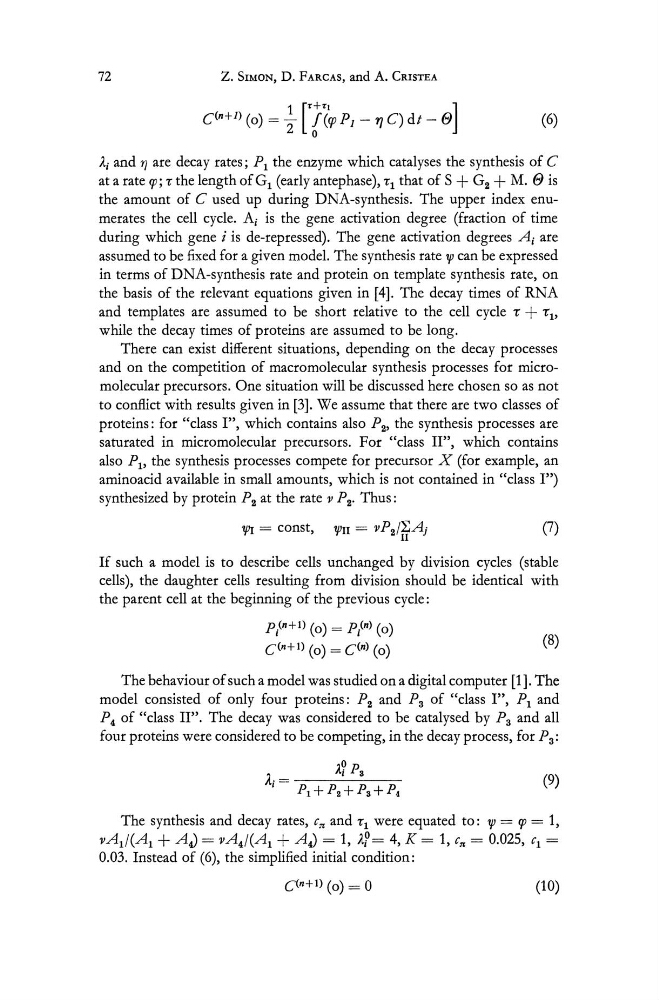
Ai and ' Y) are decay rates; PI the enzyme which catalyses the synthesis of C
at a rate ({!; ithelength ofG l (earlyantephase), i l that of S + G 2 + M. e is
the amount of C used up during DNA-synthesis. The upper index enumerates the cell cycle. Ai is the gene activation degree (fraction of time
during which gene i is de-repressed). The gene activation degrees Ai are
assumed to be fixed for a given model. The synthesis rate 1J! can be expressed
in terms of DNA-synthesis rate and protein on template synthesis rate, on
the basis of the relevant equations given in [4]. The decay times of RNA
and templates are assumed to be short relative to the cell cycle i + iI'
while the decay times of proteins are assumed to be long.
There can exist different situations, depending on the decay processes
and on the competition of macromolecular synthesis processes for micromolecular precursors. One situation will be discussed here chosen so as not
to conflict with results given in [3]. We assume that there are two classes of
proteins: for "class I", which contains also P 2 , the synthesis processes are
saturated in micromolecular precursors. For "class II", which contains
also PI' the synthesis processes compete for precursor X (for example, an
amino acid available in small amounts, which is not contained in "class I")
synthesized by protein P 2 at the rate ' V P 2 • Thus:
1J!I = const,
(7)
If such a model is to describe cells unchanged by division cycles (stable
cells), the daughter cells resulting from division should be identical with
the parent cell at the beginning of the previous cycle:
p/n+l) (0) = p/n) (0)
c(n+l) (0) = c(n) (0)
(8)
The behaviour of such a model was studied on a digital computer [1]. The
model consisted of only four proteins: P 2 and P a of "class I", PI and
P 4 of "class II". The decay was considered to be catalysed by P a and all
four proteins were considered to be competing, in the decay process, for P a:
(9)
The synthesis and decay rates, Cn and i l were equated to: 1J! = ({! = 1,
'VAI/(Al + AJ = 'VA4/(Al + A4) = 1, AP= 4, K = 1, Cn = 0.025, Cl =
0.03. Instead of (6), the simplified initial condition:
c(n+l) (0) = 0
(10)
z. SIMON, D. FARCAS, and A. CRISTEA
(6)
Ai and ' Y) are decay rates; PI the enzyme which catalyses the synthesis of C
at a rate ({!; ithelength ofG l (earlyantephase), i l that of S + G 2 + M. e is
the amount of C used up during DNA-synthesis. The upper index enumerates the cell cycle. Ai is the gene activation degree (fraction of time
during which gene i is de-repressed). The gene activation degrees Ai are
assumed to be fixed for a given model. The synthesis rate 1J! can be expressed
in terms of DNA-synthesis rate and protein on template synthesis rate, on
the basis of the relevant equations given in [4]. The decay times of RNA
and templates are assumed to be short relative to the cell cycle i + iI'
while the decay times of proteins are assumed to be long.
There can exist different situations, depending on the decay processes
and on the competition of macromolecular synthesis processes for micromolecular precursors. One situation will be discussed here chosen so as not
to conflict with results given in [3]. We assume that there are two classes of
proteins: for "class I", which contains also P 2 , the synthesis processes are
saturated in micromolecular precursors. For "class II", which contains
also PI' the synthesis processes compete for precursor X (for example, an
amino acid available in small amounts, which is not contained in "class I")
synthesized by protein P 2 at the rate ' V P 2 • Thus:
1J!I = const,
(7)
If such a model is to describe cells unchanged by division cycles (stable
cells), the daughter cells resulting from division should be identical with
the parent cell at the beginning of the previous cycle:
p/n+l) (0) = p/n) (0)
c(n+l) (0) = c(n) (0)
(8)
The behaviour of such a model was studied on a digital computer [1]. The
model consisted of only four proteins: P 2 and P a of "class I", PI and
P 4 of "class II". The decay was considered to be catalysed by P a and all
four proteins were considered to be competing, in the decay process, for P a:
(9)
The synthesis and decay rates, Cn and i l were equated to: 1J! = ({! = 1,
'VAI/(Al + AJ = 'VA4/(Al + A4) = 1, AP= 4, K = 1, Cn = 0.025, Cl =
0.03. Instead of (6), the simplified initial condition:
c(n+l) (0) = 0
(10)