

Functioning of a Cell Model
73
was chosen. For a great variety of initial protein quantities pP) (0) (all
0.1000; all 0.0050; PI = 0.0060, P 2 = 0.0400, P 3 = 0.0200; P 4 = 0.0000),
the Nn) (0) values tend towards PI = P 4 = 0.0061, P 2 = P 3 = 0.0195 and
the cell cycle length towards T + TI = 0.37. Condition (8) is thus fulfilled
for this model. With stabilized behaviour the protein concentrations
remain unchanged, during the whole cell cycle and from one cell cycle to
the next.
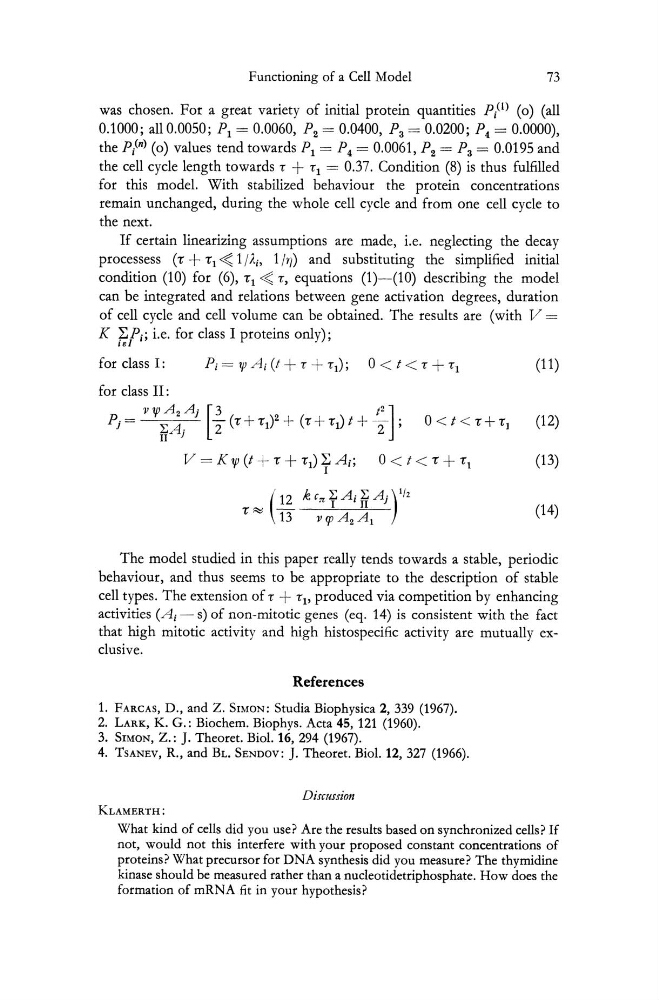
If certain linearizing assumptions are made, i.e. neglecting the decay
processess ('/: + '/:1 < 1/ Ai, 1/1)) and substituting the simplified initial
condition (10) for (6), '/:1 < T, equations (1)-(10) describing the model
can be integrated and relations between gene activation degrees, duration
of cell cycle and cell volume can be obtained. The results are (with V =
K "J.P i ; i.e. for class I proteins only);
leI
for class I:
(11)
(12)
(13)
(14)
The model studied in this paper really tends towards a stable, periodic
behaviour, and thus seems to be appropriate to the description of stable
cell types. The extension of T + T I , produced via competition by enhancing
activities (Ai - s) of non-mitotic genes (eq. 14) is consistent with the fact
that high mitotic activity and high histospecific activity are mutually exclusive.
References
1. FARCAS, D., and Z. SIMON: Studia Biophysica 2, 339 (1967).
2. LARK, K. G.: Biochem. Biophys. Acta 45, 121 (1960).
3. SIMON, Z.: ]. Theoret. Biol.16, 294 (1967).
4. TSANEV, R., and BL. SENDOV: ]. Theoret. BioI. 12, 327 (1966).
Discussion
KLAMERTH:
What kind of cells did you use? Are the results based on synchronized cells? If
not, would not this interfere with your proposed constant concentrations of
proteins? What precursor for DNA synthesis did you measure? The thymidine
kinase should be measured rather than a nudeotidetriphosphate. How does the
formation of mRNA fit in your hypothesis?
73
was chosen. For a great variety of initial protein quantities pP) (0) (all
0.1000; all 0.0050; PI = 0.0060, P 2 = 0.0400, P 3 = 0.0200; P 4 = 0.0000),
the Nn) (0) values tend towards PI = P 4 = 0.0061, P 2 = P 3 = 0.0195 and
the cell cycle length towards T + TI = 0.37. Condition (8) is thus fulfilled
for this model. With stabilized behaviour the protein concentrations
remain unchanged, during the whole cell cycle and from one cell cycle to
the next.
If certain linearizing assumptions are made, i.e. neglecting the decay
processess ('/: + '/:1 < 1/ Ai, 1/1)) and substituting the simplified initial
condition (10) for (6), '/:1 < T, equations (1)-(10) describing the model
can be integrated and relations between gene activation degrees, duration
of cell cycle and cell volume can be obtained. The results are (with V =
K "J.P i ; i.e. for class I proteins only);
leI
for class I:
(11)
(12)
(13)
(14)
The model studied in this paper really tends towards a stable, periodic
behaviour, and thus seems to be appropriate to the description of stable
cell types. The extension of T + T I , produced via competition by enhancing
activities (Ai - s) of non-mitotic genes (eq. 14) is consistent with the fact
that high mitotic activity and high histospecific activity are mutually exclusive.
References
1. FARCAS, D., and Z. SIMON: Studia Biophysica 2, 339 (1967).
2. LARK, K. G.: Biochem. Biophys. Acta 45, 121 (1960).
3. SIMON, Z.: ]. Theoret. Biol.16, 294 (1967).
4. TSANEV, R., and BL. SENDOV: ]. Theoret. BioI. 12, 327 (1966).
Discussion
KLAMERTH:
What kind of cells did you use? Are the results based on synchronized cells? If
not, would not this interfere with your proposed constant concentrations of
proteins? What precursor for DNA synthesis did you measure? The thymidine
kinase should be measured rather than a nudeotidetriphosphate. How does the
formation of mRNA fit in your hypothesis?