

Functioning of a Cell Model
Z. SIMON, D. FARCA~, and A. CRISTEA
Abstract
The functioning of a cell model is studied in which DNA synthesis starts at
moment T when the concentration of a DNA precursor C reaches a threshold
value. The synthesis rate of C is considered to be proportional to the quantity of a
mitotic enzyme and the cell volume to the total protein quantity. A model of this
type with only four proteins tends towards a stable, periodic behaviour. Relations
between gene activation degree, cell volume and cell cycle length are discussed.
In the present model we suppose that the DNA-synthesis is triggered at
moment T when the concentration c = CIV of a DNA precursor C reaches
a threshold value c,,; in reality, a periodic DNA synthesis in synchronized
bacterial cultures becomes continuous if all four deoxyribonucleosidetriphosphates are present in concentrations of 10- 4 M [2]. The other periods
of the cell cycle (DNA synthesis S, antephase G 2 and mitosis M) are
supposed to set in automatically and to be completed during a constant
time length iI' once the above condition is satisfied. The cell volume V is
considered as proportional to the total protein amount. These assumptions were used in a preceding note [3] in which, for the sake of simplicity,
V and the protein concentrations Pi/V were considered constant. Our aim
here is to study the behaviour of such a model in which the volume variation during the cell cycle is also taken into account.
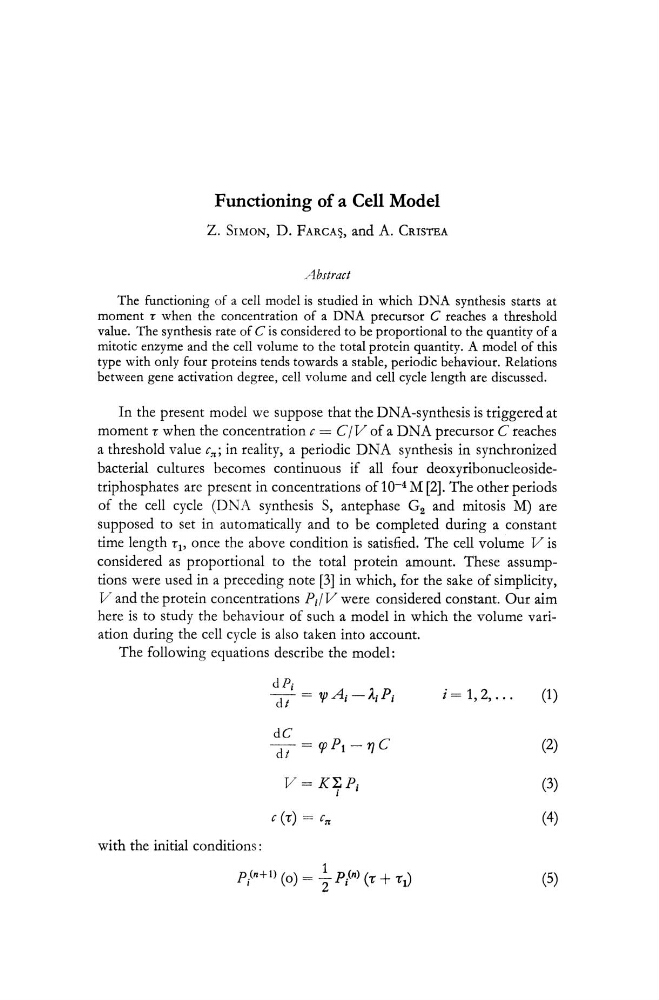
The following equations describe the model:
with the initial conditions:
dC
-
= CPP1-'Y}C
dt
V=K'f.P· i I
i = 1,2, ...
(1)
(2)
(3)
(4)
(5)
Z. SIMON, D. FARCA~, and A. CRISTEA
Abstract
The functioning of a cell model is studied in which DNA synthesis starts at
moment T when the concentration of a DNA precursor C reaches a threshold
value. The synthesis rate of C is considered to be proportional to the quantity of a
mitotic enzyme and the cell volume to the total protein quantity. A model of this
type with only four proteins tends towards a stable, periodic behaviour. Relations
between gene activation degree, cell volume and cell cycle length are discussed.
In the present model we suppose that the DNA-synthesis is triggered at
moment T when the concentration c = CIV of a DNA precursor C reaches
a threshold value c,,; in reality, a periodic DNA synthesis in synchronized
bacterial cultures becomes continuous if all four deoxyribonucleosidetriphosphates are present in concentrations of 10- 4 M [2]. The other periods
of the cell cycle (DNA synthesis S, antephase G 2 and mitosis M) are
supposed to set in automatically and to be completed during a constant
time length iI' once the above condition is satisfied. The cell volume V is
considered as proportional to the total protein amount. These assumptions were used in a preceding note [3] in which, for the sake of simplicity,
V and the protein concentrations Pi/V were considered constant. Our aim
here is to study the behaviour of such a model in which the volume variation during the cell cycle is also taken into account.
The following equations describe the model:
with the initial conditions:
dC
-
= CPP1-'Y}C
dt
V=K'f.P· i I
i = 1,2, ...
(1)
(2)
(3)
(4)
(5)