

Turnover Compartmentalization
69
the parathyroid extract; it seems reasonable to identify the later turnover
compartments, which are here not observed, with the slowly exchangeable
bone calcium.
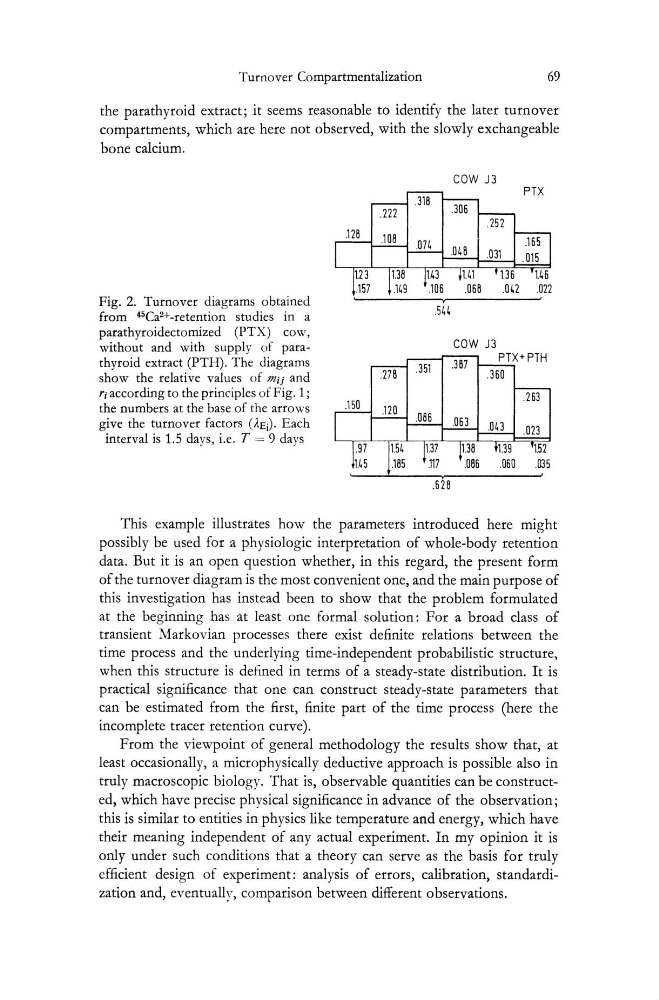
Fig. 2. Turnover diagrams obtained
from 45Ca2+ -retention studies in a
parathyroidectomized (PTX) cow,
without and with supply of parathyroid extract (PTH). The diagrams
show the relative values of mij and
ri according to the principles of Fig. 1;
the numbers at the base of the arrows
give the turnover factors (hD. Each
interval is 1.5 days, i.e. T= 9 days
.222
.278
.318
.351
COW J3
PTX
.306
.252
COW J3
.367
PTX+ PTH
.360
.263
This example illustrates how the parameters introduced here might
possibly be used for a physiologic interpretation of whole-body retention
data. But it is an open question whether, in this regard, the present form
of the turnover diagram is the most convenient one, and the main purpose of
this investigation has instead been to show that the problem formulated
at the beginning has at least one formal solution: For a broad class of
transient Markovian processes there exist definite relations between the
time process and the underlying time-independent probabilistic structure,
when this structure is defined in terms of a steady-state distribution. It is
practical significance that one can construct steady-state parameters that
can be estimated from the first, finite part of the time process (here the
incomplete tracer retention curve).
From the viewpoint of general methodology the results show that, at
least occasionally, a microphysically deductive approach is possible also in
truly macroscopic biology. That is, observable quantities can be constructed, which have precise physical significance in advance of the observation;
this is similar to entities in physics like temperature and energy, which have
their meaning independent of any actual experiment. In my opinion it is
only under such conditions that a theory can serve as the basis for truly
efficient design of experiment: analysis of errors, calibration, standardization and, eventually, comparison between different observations.
69
the parathyroid extract; it seems reasonable to identify the later turnover
compartments, which are here not observed, with the slowly exchangeable
bone calcium.
Fig. 2. Turnover diagrams obtained
from 45Ca2+ -retention studies in a
parathyroidectomized (PTX) cow,
without and with supply of parathyroid extract (PTH). The diagrams
show the relative values of mij and
ri according to the principles of Fig. 1;
the numbers at the base of the arrows
give the turnover factors (hD. Each
interval is 1.5 days, i.e. T= 9 days
.222
.278
.318
.351
COW J3
PTX
.306
.252
COW J3
.367
PTX+ PTH
.360
.263
This example illustrates how the parameters introduced here might
possibly be used for a physiologic interpretation of whole-body retention
data. But it is an open question whether, in this regard, the present form
of the turnover diagram is the most convenient one, and the main purpose of
this investigation has instead been to show that the problem formulated
at the beginning has at least one formal solution: For a broad class of
transient Markovian processes there exist definite relations between the
time process and the underlying time-independent probabilistic structure,
when this structure is defined in terms of a steady-state distribution. It is
practical significance that one can construct steady-state parameters that
can be estimated from the first, finite part of the time process (here the
incomplete tracer retention curve).
From the viewpoint of general methodology the results show that, at
least occasionally, a microphysically deductive approach is possible also in
truly macroscopic biology. That is, observable quantities can be constructed, which have precise physical significance in advance of the observation;
this is similar to entities in physics like temperature and energy, which have
their meaning independent of any actual experiment. In my opinion it is
only under such conditions that a theory can serve as the basis for truly
efficient design of experiment: analysis of errors, calibration, standardization and, eventually, comparison between different observations.