

Causality, Complexity and Computers
Character
1. Body weight
2. % Fat
3. Fatty acid composition
4. Pancreas
5. Resistance to cold
6. Blood glucose
7. Mating behaviour
8. Cholesterol on fasting
9. Liver glycogen turnover
10. Retention of steroid
hormones
11. Ketone levels
12. Enzyme levels
(a) Citrate cleavage
(b) Isocitric dehydrogenase
(c) Pyruvate kinase
(d) Malic enzyme
(e) Monoglyceride lipase
(f) Pancreatic lipase
(g) Malic dehydrogenase
(h) Lactate dehydrogenase
(i) Fumarase
Table 1
Obese litter mate
60gm.
33
normal
increased insulin
secretion
drastically reduced
hyperglycaemic
absent
increased
high
high
slightly high
300
120
180
200
20
70
100
100
100
17
Normal
litter mate
30gm.
12
normal
normal
normal
normal
normal
normal
normal
normal
normal
100
100
100
100
100
100
100
100
100
References 1-11 inclusive from: JEAN MAYER, Amer. Jour. of Clin. Nutr. 8,
712 (1960).
to escalate the situation, some tending to stabilise it, some making no
impact on the net result. A complete enumeration of changes does not
allow us to make a decision.
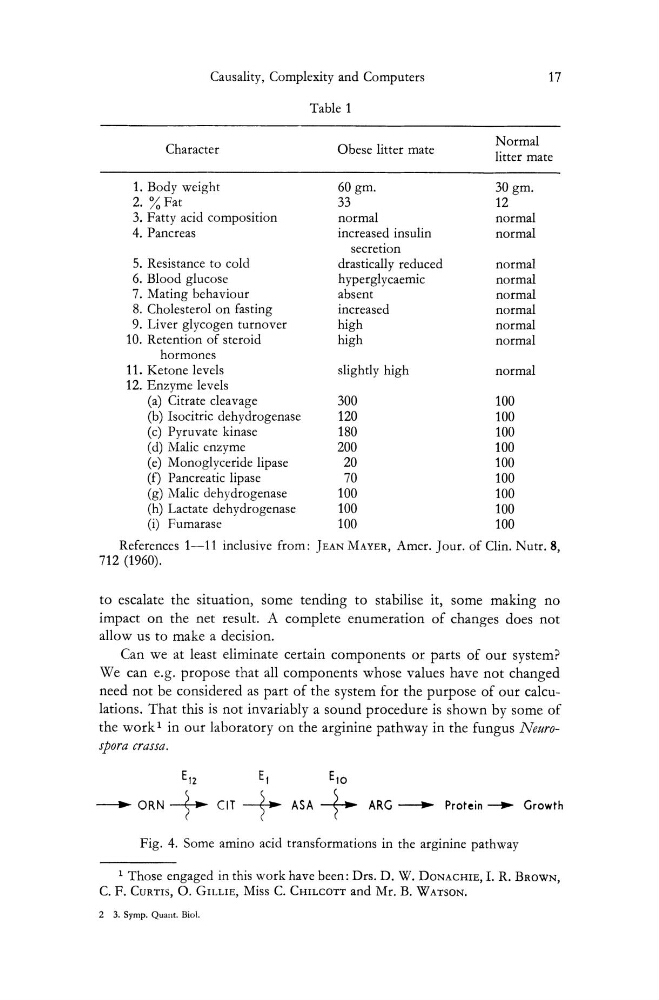
Can we at least eliminate certain components or parts of our system?
We can e.g. propose that all components whose values have not changed
need not be considered as part of the system for the purpose of our calculations. That this is not invariably a sound procedure is shown by some of
the work 1 in our laboratory on the arginine pathway in the fungus Neurospora crassa.
E to
ASA+ ARG ---. Protein - . . Growth
Fig. 4. Some amino acid transformations in the arginine pathway
1 Those engaged in this work have been: Drs. D. W. DO:-
2 3. Symp. Quant. BiD!.
Character
1. Body weight
2. % Fat
3. Fatty acid composition
4. Pancreas
5. Resistance to cold
6. Blood glucose
7. Mating behaviour
8. Cholesterol on fasting
9. Liver glycogen turnover
10. Retention of steroid
hormones
11. Ketone levels
12. Enzyme levels
(a) Citrate cleavage
(b) Isocitric dehydrogenase
(c) Pyruvate kinase
(d) Malic enzyme
(e) Monoglyceride lipase
(f) Pancreatic lipase
(g) Malic dehydrogenase
(h) Lactate dehydrogenase
(i) Fumarase
Table 1
Obese litter mate
60gm.
33
normal
increased insulin
secretion
drastically reduced
hyperglycaemic
absent
increased
high
high
slightly high
300
120
180
200
20
70
100
100
100
17
Normal
litter mate
30gm.
12
normal
normal
normal
normal
normal
normal
normal
normal
normal
100
100
100
100
100
100
100
100
100
References 1-11 inclusive from: JEAN MAYER, Amer. Jour. of Clin. Nutr. 8,
712 (1960).
to escalate the situation, some tending to stabilise it, some making no
impact on the net result. A complete enumeration of changes does not
allow us to make a decision.
Can we at least eliminate certain components or parts of our system?
We can e.g. propose that all components whose values have not changed
need not be considered as part of the system for the purpose of our calculations. That this is not invariably a sound procedure is shown by some of
the work 1 in our laboratory on the arginine pathway in the fungus Neurospora crassa.
E to
ASA+ ARG ---. Protein - . . Growth
Fig. 4. Some amino acid transformations in the arginine pathway
1 Those engaged in this work have been: Drs. D. W. DO:-
2 3. Symp. Quant. BiD!.