

16
H. KAesER, and J. A. BURNS
We may not have come much nearer to answering the question as to
how many elements must be considered in defining a system but at least we
are now aware that the search for the master reaction may be a futile one
and we must find other criteria to assess the importance of any component.
How difficult this can be is perhaps demonstrated by some of the work
by Mr. G. BULFIELD in our laboratory.
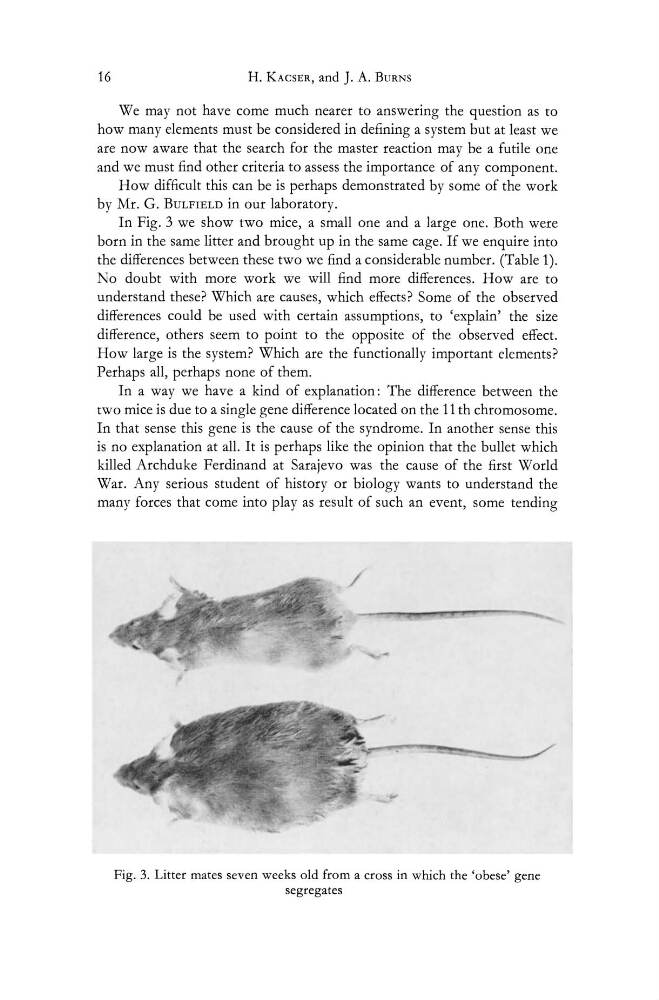
In Fig. 3 we show two mice, a small one and a large one. Both were
born in the same litter and brought up in the same cage. If we enquire into
the differences between these two we find a considerable number. (Table 1).
No doubt with more work we will find more differences. How are to
understand these? Which are causes, which effects? Some of the observed
differences could be used with certain assumptions, to 'explain' the size
difference, others seem to point to the opposite of the observed effect.
How large is the system? Which are the functionally important elements?
Perhaps all, perhaps none of them.
In a way we have a kind of explanation: The difference between the
two mice is due to a single gene difference located on the 11 th chromosome.
In that sense this gene is the cause of the syndrome. In another sense this
is no explanation at all. It is perhaps like the opinion that the bullet which
killed Archduke Ferdinand at Sarajevo was the cause of the first World
War. Any serious student of history or biology wants to understand the
many forces that come into playas result of such an event, some tending
/
Fig. 3. Litter mates seven weeks old from a cross in which the 'obese' gene
segregates
H. KAesER, and J. A. BURNS
We may not have come much nearer to answering the question as to
how many elements must be considered in defining a system but at least we
are now aware that the search for the master reaction may be a futile one
and we must find other criteria to assess the importance of any component.
How difficult this can be is perhaps demonstrated by some of the work
by Mr. G. BULFIELD in our laboratory.
In Fig. 3 we show two mice, a small one and a large one. Both were
born in the same litter and brought up in the same cage. If we enquire into
the differences between these two we find a considerable number. (Table 1).
No doubt with more work we will find more differences. How are to
understand these? Which are causes, which effects? Some of the observed
differences could be used with certain assumptions, to 'explain' the size
difference, others seem to point to the opposite of the observed effect.
How large is the system? Which are the functionally important elements?
Perhaps all, perhaps none of them.
In a way we have a kind of explanation: The difference between the
two mice is due to a single gene difference located on the 11 th chromosome.
In that sense this gene is the cause of the syndrome. In another sense this
is no explanation at all. It is perhaps like the opinion that the bullet which
killed Archduke Ferdinand at Sarajevo was the cause of the first World
War. Any serious student of history or biology wants to understand the
many forces that come into playas result of such an event, some tending
/
Fig. 3. Litter mates seven weeks old from a cross in which the 'obese' gene
segregates