

Theoretical Models for Thermoregulation in Man
265
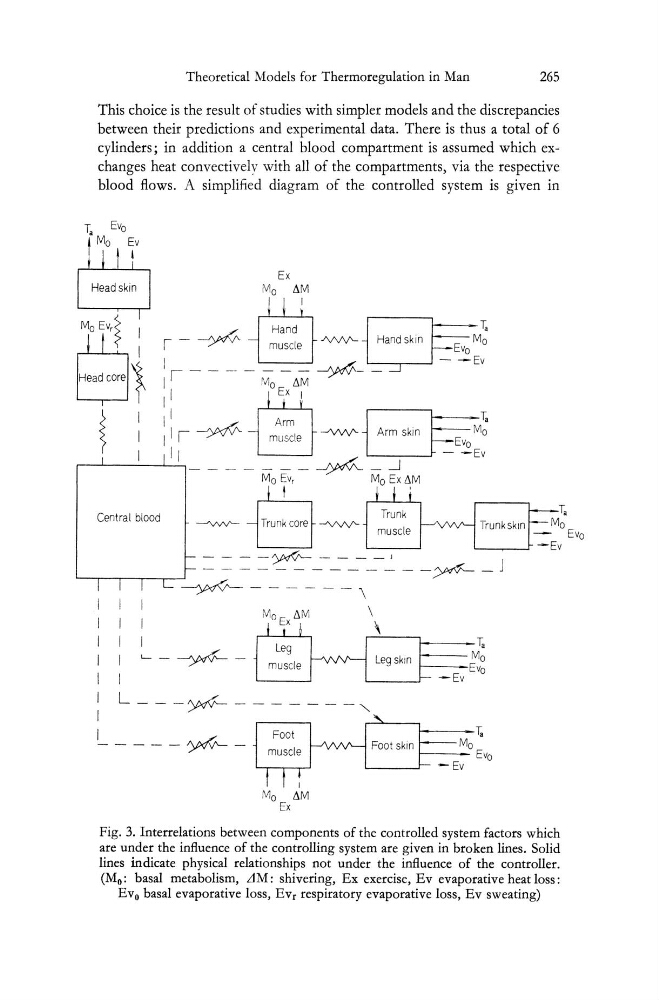
This choice is the result of studies with simpler models and the discrepancies
between their predictions and experimental data. There is thus a total of 6
cylinders; in addition a central blood compartment is assumed which exchanges heat convectivelv with all of the compartments, via the respective
blood flows. j\ simplified diagram of the controlled system is given in
Ex
Mo
t1M
I
Mo Evrt
I I-~
Hand
T.
~i
muscle
./VVv"Hand skin
Evo
Mo
I
-y4- -Ev
,- - -
I
Mo
t1M
II
Ex I
t
II
Arm
T.
II,~ muscle
-A./VV"Arm skin
Mo
Evo
III
- -Ev
I
-~- -~
- - - - - -
Mo EVr
Mo Ex ~M
J I
Ta
Central blood
Trunk
~ - Trunk core ----'VVV'-Trunkskln
Mo
muscle
-Ev
- - - - -yW----- -j
- - -- - - - - - _-_-_-___ ~ _ J
L-..,I--r l ----,- I,--JL~
- -"\
I I I
Mo E tlM
x ,I
\
\
Leg
I '--~
muscle
I
i - i - - - - T a
Leg skin I----Mo
t-----Evo
-Ev
L - - -')Aff-- - - - - - - - "I
I
I
-----yx//--Foot
muscle
1-1----T.
1--/\/\/\"'-------' Foot skin
Mo
1 - - - - Evo
L -_ _ ..r- -Ev
I
Mo
tiM
Ex
Fig. 3. Interrelations between components of the controlled system factors which
are under the influence of the controlling system are given in broken lines. Solid
lines indicate physical relationships not under the influence of the controller.
(Mo: basal metabolism, LIM: shivering, Ex exercise, Ev evaporative heat loss:
Evo basal evaporative loss, EVr respiratory evaporative loss, Ev sweating)
Evo
265
This choice is the result of studies with simpler models and the discrepancies
between their predictions and experimental data. There is thus a total of 6
cylinders; in addition a central blood compartment is assumed which exchanges heat convectivelv with all of the compartments, via the respective
blood flows. j\ simplified diagram of the controlled system is given in
Ex
Mo
t1M
I
Mo Evrt
I I-~
Hand
T.
~i
muscle
./VVv"Hand skin
Evo
Mo
I
-y4- -Ev
,- - -
I
Mo
t1M
II
Ex I
t
II
Arm
T.
II,~ muscle
-A./VV"Arm skin
Mo
Evo
III
- -Ev
I
-~- -~
- - - - - -
Mo EVr
Mo Ex ~M
J I
Ta
Central blood
Trunk
~ - Trunk core ----'VVV'-Trunkskln
Mo
muscle
-Ev
- - - - -yW----- -j
- - -- - - - - - _-_-_-___ ~ _ J
L-..,I--r l ----,- I,--JL~
- -"\
I I I
Mo E tlM
x ,I
\
\
Leg
I '--~
muscle
I
i - i - - - - T a
Leg skin I----Mo
t-----Evo
-Ev
L - - -')Aff-- - - - - - - - "I
I
I
-----yx//--Foot
muscle
1-1----T.
1--/\/\/\"'-------' Foot skin
Mo
1 - - - - Evo
L -_ _ ..r- -Ev
I
Mo
tiM
Ex
Fig. 3. Interrelations between components of the controlled system factors which
are under the influence of the controlling system are given in broken lines. Solid
lines indicate physical relationships not under the influence of the controller.
(Mo: basal metabolism, LIM: shivering, Ex exercise, Ev evaporative heat loss:
Evo basal evaporative loss, EVr respiratory evaporative loss, Ev sweating)
Evo