

Steady State Nature of Evolution, Learning, etc.
251
matching response, i.e. an amplification of sensing, knowing and attending
[15] by the organism, an experience of increased meaning or in GELPKE'S
words "a torrential flood of inner sensation" [14)3.
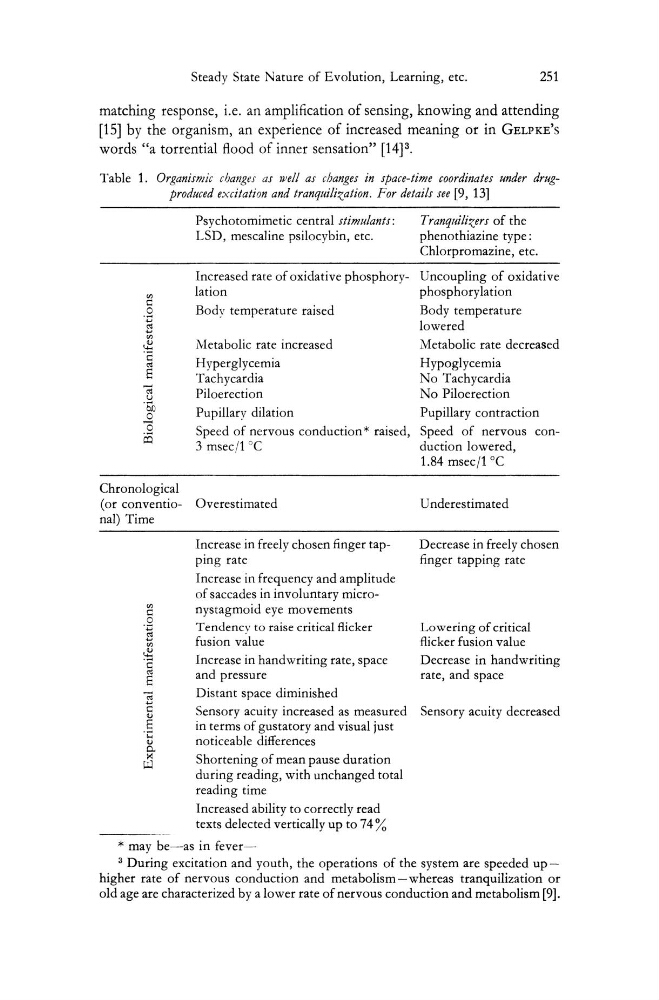
Table 1. Organismic changes as well as changes in space-time coordinates under drugproduced excitation and tranquilization. For details see [9, 13]
Chronological
(or conventional) Time
Psychotomimetic central stimulants:
LSD, mescaline psilocybin, etc.
Increased rate of oxidative phosphorylation
Bodv temperature raised
Metabolic rate increased
Hyperglycemia
Tachycardia
Piloerection
Pupillary dilation
Speed of nervous conduction* raised,
3 msec/l °C
Overestimated
Increase in freely chosen finger tapping rate
Increase in frequency and amplitude
of saccades in involuntary micronystagmoid eye movements
Tendencv to raise critical flicker
fusion value
Increase in handwriting rate, space
and pressure
Distant space diminished
Sensory acuity increased as measured
in terms of gustatory and visual just
noticeable differences
Shortening of mean pause duration
during reading, with unchanged total
reading time
Increased ability to correctly read
texts delected vertically up to 74%
* may be~as in fever~
Tranquilizers of the
phenothiazine type:
Chlorpromazine, etc.
Uncoupling of oxidative
phosphorylation
Body temperature
lowered
;Vletabolic rate decreased
Hypoglycemia
No Tachycardia
No Piloerection
Pupillary contraction
Speed of nervous conduction lowered,
1.84 msec/l °C
Underestimated
Decrease in freely chosen
finger tapping rate
Lowering of critical
flicker fusion value
Decrease in handwriting
rate, and space
Sensory acuity decreased
3 During excitation and youth, the operations of the system are speeded uphigher rate of nervous conduction and metabolism-whereas tranquilization or
old age are characterized by a lower rate of nervous conduction and metabolism [9].
251
matching response, i.e. an amplification of sensing, knowing and attending
[15] by the organism, an experience of increased meaning or in GELPKE'S
words "a torrential flood of inner sensation" [14)3.
Table 1. Organismic changes as well as changes in space-time coordinates under drugproduced excitation and tranquilization. For details see [9, 13]
Chronological
(or conventional) Time
Psychotomimetic central stimulants:
LSD, mescaline psilocybin, etc.
Increased rate of oxidative phosphorylation
Bodv temperature raised
Metabolic rate increased
Hyperglycemia
Tachycardia
Piloerection
Pupillary dilation
Speed of nervous conduction* raised,
3 msec/l °C
Overestimated
Increase in freely chosen finger tapping rate
Increase in frequency and amplitude
of saccades in involuntary micronystagmoid eye movements
Tendencv to raise critical flicker
fusion value
Increase in handwriting rate, space
and pressure
Distant space diminished
Sensory acuity increased as measured
in terms of gustatory and visual just
noticeable differences
Shortening of mean pause duration
during reading, with unchanged total
reading time
Increased ability to correctly read
texts delected vertically up to 74%
* may be~as in fever~
Tranquilizers of the
phenothiazine type:
Chlorpromazine, etc.
Uncoupling of oxidative
phosphorylation
Body temperature
lowered
;Vletabolic rate decreased
Hypoglycemia
No Tachycardia
No Piloerection
Pupillary contraction
Speed of nervous conduction lowered,
1.84 msec/l °C
Underestimated
Decrease in freely chosen
finger tapping rate
Lowering of critical
flicker fusion value
Decrease in handwriting
rate, and space
Sensory acuity decreased
3 During excitation and youth, the operations of the system are speeded uphigher rate of nervous conduction and metabolism-whereas tranquilization or
old age are characterized by a lower rate of nervous conduction and metabolism [9].