

252
Chronological
(or conventional) Time
R. FISCHER
Table 1 continued
Overestimated
"Torrential flood of inner sensation"
"A hundred years would not suffice
to describe the fullness of experience
contained in a single minute"
Hofmann's impression of "not getting
ahead (on the bicycle), whereas my
escort stated that we were rolling
along at a good speed".
Arriving early to appointments
Increase in data content per chronological time unit (chronosystole or
time contraction)
Increase in meaning
Underestimated
"Time appears to pass by
like magic"
Arriving late to appointments
Decrease in data content
per chronological time
unit
Decrease in meaning
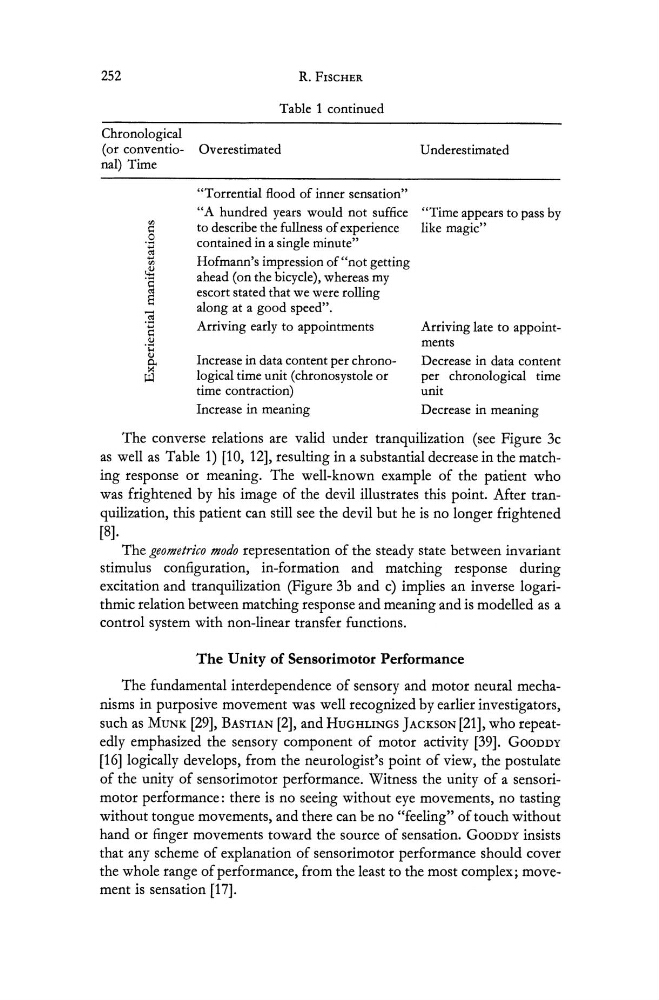
The converse relations are valid under tranquilization (see Figure 3c
as well as Table 1) [10, 12], resulting in a substantial decrease in the matching response or meaning. The well-known example of the patient who
was frightened by his image of the devil illustrates this point. After tranquilization, this patient can still see the devil but he is no longer frightened
[8].
The geometrico modo representation of the steady state between invariant
stimulus configuration, in-formation and matching response during
excitation and tranquilization (Figure 3b and c) implies an inverse logarithmic relation between matching response and meaning and is modelled as a
control system with non-linear transfer functions.
The Unity of Sensorimotor Performance
The fundamental interdependence of sensory and motor neural mechanisms in purposive movement was well recognized by earlier investigators,
such as MUNK [29], BASTIAN [2], and HUGHLINGS JACKSON [21], who repeatedly emphasized the sensory component of motor activity [39]. GOODDY
[16] logically develops, from the neurologist's point of view, the postulate
of the unity of sensorimotor performance. Witness the unity of a sensorimotor performance: there is no seeing without eye movements, no tasting
without tongue movements, and there can be no "feeling" of touch without
hand or finger movements toward the source of sensation. GOODDY insists
that any scheme of explanation of sensorimotor performance should cover
the whole range of performance, from the least to the most complex; movement is sensation [17].
Chronological
(or conventional) Time
R. FISCHER
Table 1 continued
Overestimated
"Torrential flood of inner sensation"
"A hundred years would not suffice
to describe the fullness of experience
contained in a single minute"
Hofmann's impression of "not getting
ahead (on the bicycle), whereas my
escort stated that we were rolling
along at a good speed".
Arriving early to appointments
Increase in data content per chronological time unit (chronosystole or
time contraction)
Increase in meaning
Underestimated
"Time appears to pass by
like magic"
Arriving late to appointments
Decrease in data content
per chronological time
unit
Decrease in meaning
The converse relations are valid under tranquilization (see Figure 3c
as well as Table 1) [10, 12], resulting in a substantial decrease in the matching response or meaning. The well-known example of the patient who
was frightened by his image of the devil illustrates this point. After tranquilization, this patient can still see the devil but he is no longer frightened
[8].
The geometrico modo representation of the steady state between invariant
stimulus configuration, in-formation and matching response during
excitation and tranquilization (Figure 3b and c) implies an inverse logarithmic relation between matching response and meaning and is modelled as a
control system with non-linear transfer functions.
The Unity of Sensorimotor Performance
The fundamental interdependence of sensory and motor neural mechanisms in purposive movement was well recognized by earlier investigators,
such as MUNK [29], BASTIAN [2], and HUGHLINGS JACKSON [21], who repeatedly emphasized the sensory component of motor activity [39]. GOODDY
[16] logically develops, from the neurologist's point of view, the postulate
of the unity of sensorimotor performance. Witness the unity of a sensorimotor performance: there is no seeing without eye movements, no tasting
without tongue movements, and there can be no "feeling" of touch without
hand or finger movements toward the source of sensation. GOODDY insists
that any scheme of explanation of sensorimotor performance should cover
the whole range of performance, from the least to the most complex; movement is sensation [17].