

Changes in Metabolite Concentrations in Ischemic and Transplanted Kidneys 191
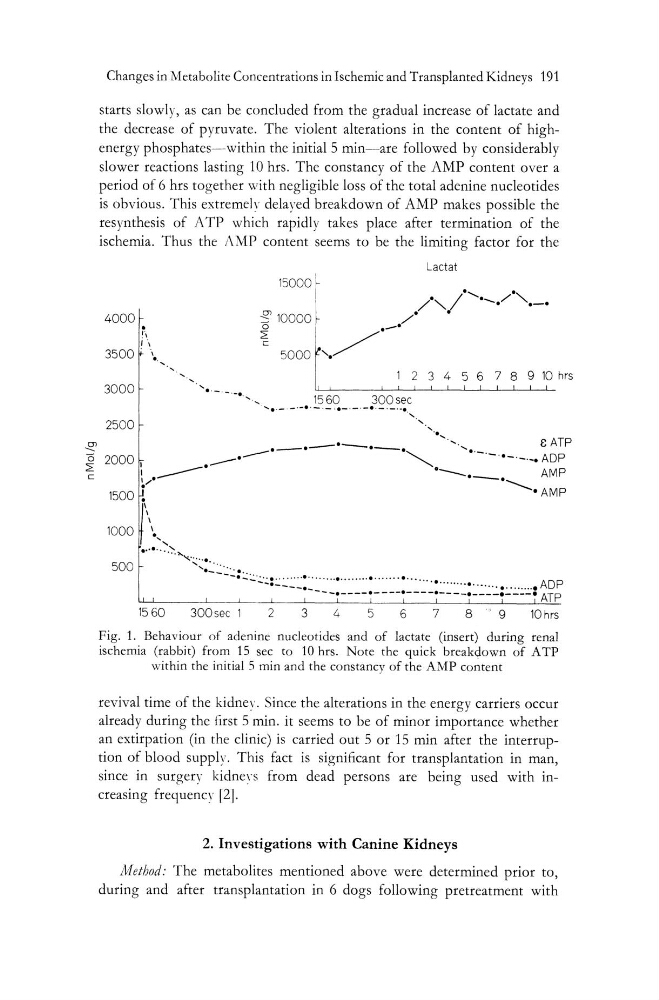
starts slowly, as can be concluded from the gradual increase of lactate and
the decrease of pyruvate. The violent alterations in the content of highenergy phosphates-within the initialS min-are followed by considerably
slower reactions lasting 10 hrs. The constancy of the AMP content over a
period of 6 hrs together with negligible loss of the total adenine nucleotides
is obvious. This extremely delayed breakdown of AMP makes possible the
resynthesis of ATP which rapidly takes place after termination of the
ischemia. Thus the AMP content seems to be the limiting factor for the
4000
° ~\
I ..
3500
...
o.
" .
3000
2500
'. '. 'e·_·_·_e.
Lactat
15000
g'10000
o
~
c
5000
".,
~
._0_0....
eATP
a 2000 I
0 ___ 0---0-. . . . . . . . . . . . . . . . o'-'-,o_'_.-e ADP
~
\ 0___
°-- 0 _ 0 AMP
0/
--'AMP
1500
1000
500
o ,
\
, ,
0, ....
•..... . ''''.,;:~~":".",,,,:::: ~::::::::::::~:·:::::::::::,:C"". ~~~
1560
300sec 1
2
3
4
5
6
7
8
9
10 hrs
Fig. 1. Behaviour of adenine nucleotides and of lactate (insert) during renal
ischemia (rabbit) from 15 sec to 10 hrs. Note the quick breakQ.own of ATP
within the initialS min and the constancy of the AMP content
revival time of the kidney. Since the alterations in the energy carriers occur
already during the first 5 min. it seems to be of minor importance whether
an extirpation (in the clinic) is carried out 5 or 15 min after the interruption of blood supply. This fact is significant for transplantation in man,
since in surgery kidneys from dead persons are being used with increasing frequency [21.
2. Investigations with Canine Kidneys
Method: The metabolites mentioned above were determined prior to,
during and after transplantation in 6 dogs following pretreatment with
starts slowly, as can be concluded from the gradual increase of lactate and
the decrease of pyruvate. The violent alterations in the content of highenergy phosphates-within the initialS min-are followed by considerably
slower reactions lasting 10 hrs. The constancy of the AMP content over a
period of 6 hrs together with negligible loss of the total adenine nucleotides
is obvious. This extremely delayed breakdown of AMP makes possible the
resynthesis of ATP which rapidly takes place after termination of the
ischemia. Thus the AMP content seems to be the limiting factor for the
4000
° ~\
I ..
3500
...
o.
" .
3000
2500
'. '. 'e·_·_·_e.
Lactat
15000
g'10000
o
~
c
5000
".,
~
._0_0....
eATP
a 2000 I
0 ___ 0---0-. . . . . . . . . . . . . . . . o'-'-,o_'_.-e ADP
~
\ 0___
°-- 0 _ 0 AMP
0/
--'AMP
1500
1000
500
o ,
\
, ,
0, ....
•..... . ''''.,;:~~":".",,,,:::: ~::::::::::::~:·:::::::::::,:C"". ~~~
1560
300sec 1
2
3
4
5
6
7
8
9
10 hrs
Fig. 1. Behaviour of adenine nucleotides and of lactate (insert) during renal
ischemia (rabbit) from 15 sec to 10 hrs. Note the quick breakQ.own of ATP
within the initialS min and the constancy of the AMP content
revival time of the kidney. Since the alterations in the energy carriers occur
already during the first 5 min. it seems to be of minor importance whether
an extirpation (in the clinic) is carried out 5 or 15 min after the interruption of blood supply. This fact is significant for transplantation in man,
since in surgery kidneys from dead persons are being used with increasing frequency [21.
2. Investigations with Canine Kidneys
Method: The metabolites mentioned above were determined prior to,
during and after transplantation in 6 dogs following pretreatment with