

Inhibitory Action of Radiolytic Compounds on Cell Function
179
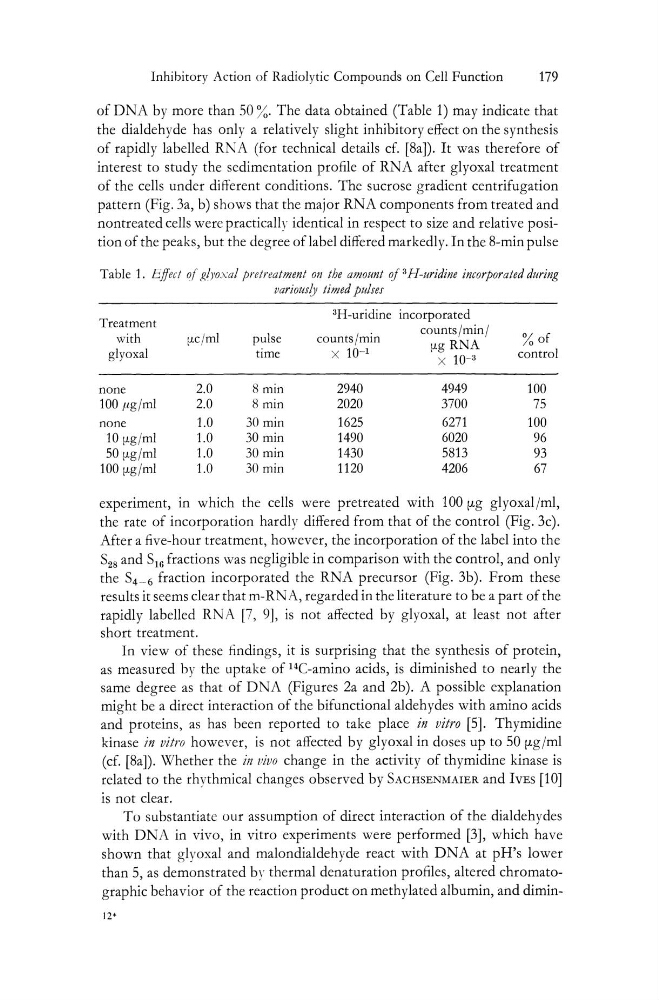
of DNA by more than 50 %. The data obtained (Table 1) may indicate that
the dialdehyde has only a relatively slight inhibitory effect on the synthesis
of rapidly labelled RNA (for technical details cf. [8a]). It was therefore of
interest to study the sedimentation profile of RN A after glyoxal treatment
of the cells under different conditions. The sucrose gradient centrifugation
pattern (Fig. 3a, b) shows that the major RNA components from treated and
nontreated cells were practicalh' identical in respect to size and relative position of the peaks, but the degree of label differed markedly. In the 8-min pulse
Table 1. bffect of gl),o.'X'al pretreatment on tbe amount of 3 H-uridine incorporated during
variously timed pulses
Treatment
3H-uridine incorporated
with
fLc/ml
pulse
counts/min
counts/mini
% of
fLg RNA
glyoxal
time
X 10-1
X 10- 3
control
none
2.0
8 min
2940
4949
100
100,ug/ml
2.0
8 min
2020
3700
75
none
1.0
30 min
1625
6271
100
10 fLg/ml
1.0
30 min
1490
6020
96
50 fLg/ml
1.0
30 min
1430
5813
93
100 fLg/ml
1.0
30 min
1120
4206
67
experiment, in which the cells were pretreated with 100 fLg glyoxal/ml,
the rate of incorporation hardly differed from that of the control (Fig. 3c).
After a five-hour treatment, however, the incorporation of the label into the
S28 and SI6 fractions was negligible in comparison with the control, and only
the S4-6 fraction incorporated the RNA precursor (Fig. 3b). From these
results it seems clear that m-RNA, regarded in the literature to be a part of the
rapidly labelled RNA [7, 9), is not affected by glyoxal, at least not after
short treatment.
In view of these findings, it is surprising that the synthesis of protein,
as measured by the uptake of 14C-amino acids, is diminished to nearly the
same degree as that of DNA (Figures 2a and 2b). A possible explanation
might be a direct interaction of the bifunctional aldehydes with amino acids
and proteins, as has been reported to take place in vitro [5]. Thymidine
kinase in vitro however, is not affected by glyoxal in doses up to 50 fLg/ml
(cf. [8a]). Whether the in lIiv() change in the activity of thymidine kinase is
related to the rhythmical changes observed by SACHSENMAIER and IVES [10]
is not clear.
To substantiate our assumption of direct interaction of the dialdehydes
with DNA in vivo, in vitro experiments were performed [3], which have
shown that glyoxal and malondialdehyde react with DNA at pH's lower
than 5, as demonstrated bv thermal denaturation profiles, altered chromatographic behavior of the reaction product on methylated albumin, and dimin12*
179
of DNA by more than 50 %. The data obtained (Table 1) may indicate that
the dialdehyde has only a relatively slight inhibitory effect on the synthesis
of rapidly labelled RNA (for technical details cf. [8a]). It was therefore of
interest to study the sedimentation profile of RN A after glyoxal treatment
of the cells under different conditions. The sucrose gradient centrifugation
pattern (Fig. 3a, b) shows that the major RNA components from treated and
nontreated cells were practicalh' identical in respect to size and relative position of the peaks, but the degree of label differed markedly. In the 8-min pulse
Table 1. bffect of gl),o.'X'al pretreatment on tbe amount of 3 H-uridine incorporated during
variously timed pulses
Treatment
3H-uridine incorporated
with
fLc/ml
pulse
counts/min
counts/mini
% of
fLg RNA
glyoxal
time
X 10-1
X 10- 3
control
none
2.0
8 min
2940
4949
100
100,ug/ml
2.0
8 min
2020
3700
75
none
1.0
30 min
1625
6271
100
10 fLg/ml
1.0
30 min
1490
6020
96
50 fLg/ml
1.0
30 min
1430
5813
93
100 fLg/ml
1.0
30 min
1120
4206
67
experiment, in which the cells were pretreated with 100 fLg glyoxal/ml,
the rate of incorporation hardly differed from that of the control (Fig. 3c).
After a five-hour treatment, however, the incorporation of the label into the
S28 and SI6 fractions was negligible in comparison with the control, and only
the S4-6 fraction incorporated the RNA precursor (Fig. 3b). From these
results it seems clear that m-RNA, regarded in the literature to be a part of the
rapidly labelled RNA [7, 9), is not affected by glyoxal, at least not after
short treatment.
In view of these findings, it is surprising that the synthesis of protein,
as measured by the uptake of 14C-amino acids, is diminished to nearly the
same degree as that of DNA (Figures 2a and 2b). A possible explanation
might be a direct interaction of the bifunctional aldehydes with amino acids
and proteins, as has been reported to take place in vitro [5]. Thymidine
kinase in vitro however, is not affected by glyoxal in doses up to 50 fLg/ml
(cf. [8a]). Whether the in lIiv() change in the activity of thymidine kinase is
related to the rhythmical changes observed by SACHSENMAIER and IVES [10]
is not clear.
To substantiate our assumption of direct interaction of the dialdehydes
with DNA in vivo, in vitro experiments were performed [3], which have
shown that glyoxal and malondialdehyde react with DNA at pH's lower
than 5, as demonstrated bv thermal denaturation profiles, altered chromatographic behavior of the reaction product on methylated albumin, and dimin12*