

o-S:
o
2
c o
u
178
~ 80
2
8 60
~
o
~ 40
E
:::J
-' =
~ 20
O. L. KLAMERTH
25
50
75
100
Malondialdehyde ([Lg/ml)
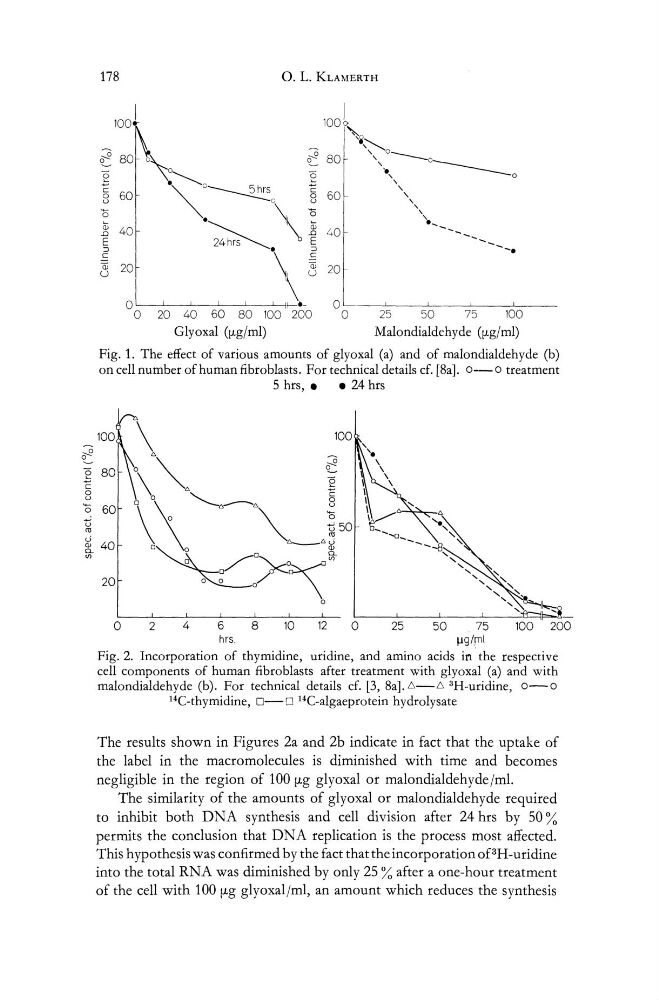
Fig. 1. The effect of various amounts of glyoxal (a) and of malondialdehyde (b)
on cell number of human fibroblasts. For technical details cf. [8a]. 0 - 0 treatment
5 hrs, •
• 24 hrs
o 60
.,..;
u
ro
g 40
0
o
2
4
6
8
hrs.
10
12
o
25
50
75
~g/ml
Fig. 2. Incorporation of thymidine, uridine, and amino acids in the respective
cell components of human fibroblasts after treatment with glyoxal (a) and with
malondialdehyde (b). For technical details cf. [3, Ba]. 6 - 6 3H-uridine, 0 - 0
He-thymidine, 0 - 0 14C-algaeprotein hydrolysate
The results shown in Figures 2a and 2b indicate in fact that the uptake of
the label in the macromolecules is diminished with time and becomes
negligible in the region of 100 (J.g glyoxal or malondialdehyde/ml.
The similarity of the amounts of glyoxal or malondialdehyde required
to inhibit both DNA synthesis and cell division after 24 hrs by 50 %
permits the conclusion that DNA replication is the process most affected.
This hypothesis was confirmed by the fact that the incorporation of3H -uri dine
into the total RNA was diminished by only 25 % after a one-hour treatment
of the cell with 100 (J.g glyoxal/ml, an amount which reduces the synthesis
o
2
c o
u
178
~ 80
2
8 60
~
o
~ 40
E
:::J
-' =
~ 20
O. L. KLAMERTH
25
50
75
100
Malondialdehyde ([Lg/ml)
Fig. 1. The effect of various amounts of glyoxal (a) and of malondialdehyde (b)
on cell number of human fibroblasts. For technical details cf. [8a]. 0 - 0 treatment
5 hrs, •
• 24 hrs
o 60
.,..;
u
ro
g 40
0
o
2
4
6
8
hrs.
10
12
o
25
50
75
~g/ml
Fig. 2. Incorporation of thymidine, uridine, and amino acids in the respective
cell components of human fibroblasts after treatment with glyoxal (a) and with
malondialdehyde (b). For technical details cf. [3, Ba]. 6 - 6 3H-uridine, 0 - 0
He-thymidine, 0 - 0 14C-algaeprotein hydrolysate
The results shown in Figures 2a and 2b indicate in fact that the uptake of
the label in the macromolecules is diminished with time and becomes
negligible in the region of 100 (J.g glyoxal or malondialdehyde/ml.
The similarity of the amounts of glyoxal or malondialdehyde required
to inhibit both DNA synthesis and cell division after 24 hrs by 50 %
permits the conclusion that DNA replication is the process most affected.
This hypothesis was confirmed by the fact that the incorporation of3H -uri dine
into the total RNA was diminished by only 25 % after a one-hour treatment
of the cell with 100 (J.g glyoxal/ml, an amount which reduces the synthesis