

170
J. KIEFER
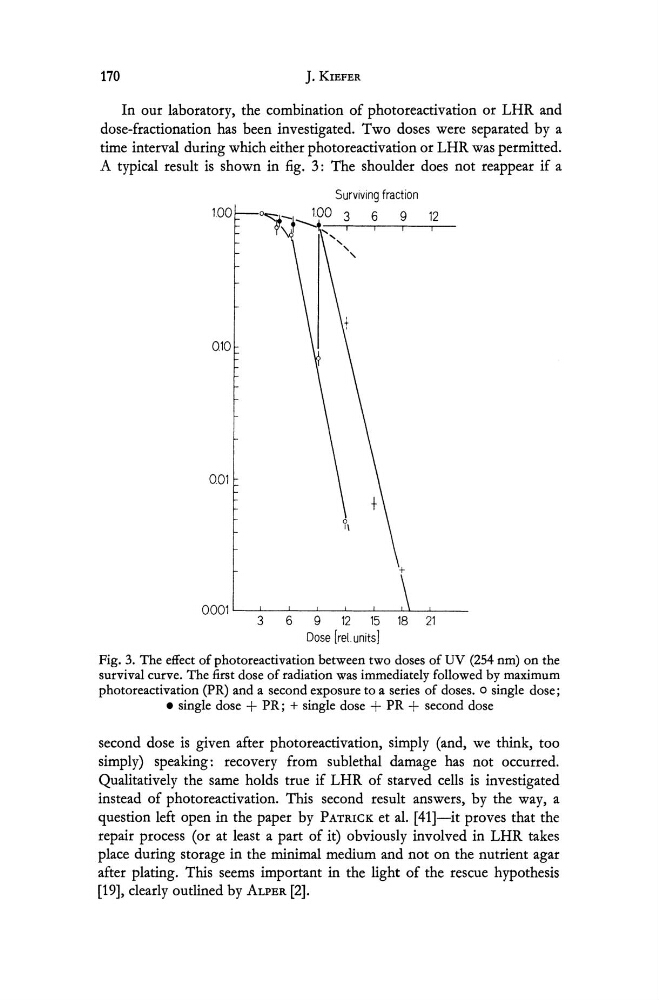
In our laboratory, the combination of photoreactivation or LHR and
dose-fractionation has been investigated. Two doses were separated by a
time interval during which either photoreactivation or LHR was permitted.
A typical result is shown in fig. 3: The shoulder does not reappear if a
Surviving fraction
1.00
1.00 3
6
9
12
010
001
+
0001 L------'---_"---'-_"---'-_L..I--'-_ _
3 6 9 ~ 5 ffi ~
Dose [reI units 1
Fig. 3. The effect of photoreactivation between two doses of UV (254 nm) on the
survival curve. The first dose of radiation was immediately followed by maximum
photoreactivation CPR) and a second exposure to a series of doses. 0 single dose;
• single dose + PR; + single dose + PR + second dose
second dose is given after photoreactivation, simply (and, we think, too
simply) speaking: recovery from sublethal damage has not occurred.
Qualitatively the same holds true if LHR of starved cells is investigated
instead of photoreactivation. This second result answers, by the way, a
question left open in the paper by PATRICK et al. [41]-it proves that the
repair process (or at least a part of it) obviously involved in LHR takes
place during storage in the minimal medium and not on the nutrient agar
after plating. This seems important in the light of the rescue hypothesis
[19], clearly outlined by ALPER [2].
J. KIEFER
In our laboratory, the combination of photoreactivation or LHR and
dose-fractionation has been investigated. Two doses were separated by a
time interval during which either photoreactivation or LHR was permitted.
A typical result is shown in fig. 3: The shoulder does not reappear if a
Surviving fraction
1.00
1.00 3
6
9
12
010
001
+
0001 L------'---_"---'-_"---'-_L..I--'-_ _
3 6 9 ~ 5 ffi ~
Dose [reI units 1
Fig. 3. The effect of photoreactivation between two doses of UV (254 nm) on the
survival curve. The first dose of radiation was immediately followed by maximum
photoreactivation CPR) and a second exposure to a series of doses. 0 single dose;
• single dose + PR; + single dose + PR + second dose
second dose is given after photoreactivation, simply (and, we think, too
simply) speaking: recovery from sublethal damage has not occurred.
Qualitatively the same holds true if LHR of starved cells is investigated
instead of photoreactivation. This second result answers, by the way, a
question left open in the paper by PATRICK et al. [41]-it proves that the
repair process (or at least a part of it) obviously involved in LHR takes
place during storage in the minimal medium and not on the nutrient agar
after plating. This seems important in the light of the rescue hypothesis
[19], clearly outlined by ALPER [2].