

Intracellular Recovery after Irradiation
169
not altered by application ofRNA-, DNA- and protein-synthesis-inhibitors,
but requires oxygen and an intact respiration apparatus, as revealed by the
application of KCN, azide and 2,4-dinitrophenol [42] or by the fact that
"petite" mutants of yeast, being defective in cellular respiration, do not
show LHR [28].
All these findings point to an enzymatic, energy-dependent process.
Starved yeast (obtained by the procedure described above) also exhibits
LHR, although we have indications that it is enhanced if glucose is present
in the medium [34]. This agrees with the finding that exogenous A TP increases dark-recovery in unstarved yeast [42]. KOROGODIN et al. [36-38]
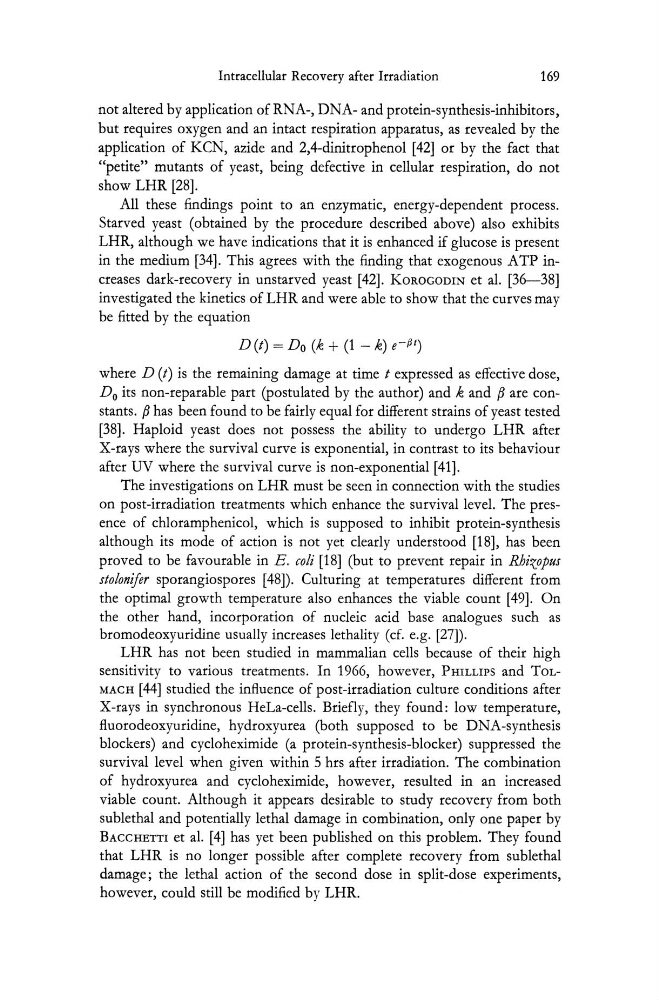
investigated the kinetics of LHR and were able to show that the curves may
be fitted by the equation
D(t) = Do (k + (1 - k) r{Jt)
where D (t) is the remaining damage at time t expressed as effective dose,
Do its non-reparable part (postulated by the author) and k and {J are constants. {J has been found to be fairly equal for different strains of yeast tested
[38]. Haploid yeast does not possess the ability to undergo LHR after
X-rays where the survival curve is exponential, in contrast to its behaviour
after UV where the survival curve is non-exponential [41].
The investigations on LHR must be seen in connection with the studies
on post-irradiation treatments which enhance the survival level. The presence of chloramphenicol, which is supposed to inhibit protein-synthesis
although its mode of action is not yet clearly understood [18], has been
proved to be favourable in E. coli [18] (but to prevent repair in Rhizopus
stolonifer sporangiospores [48]). Culturing at temperatures different from
the optimal growth temperature also enhances the viable count [49]. On
the other hand, incorporation of nucleic acid base analogues such as
bromodeoxyuridine usually increases lethality (cf. e.g. [27]).
LHR has not been studied in mammalian cells because of their high
sensitivity to various treatments. In 1966, however, PHILLIPS and TOLMACH [44] studied the influence of post-irradiation culture conditions after
X-rays in synchronous HeLa-cells. Briefly, they found: low temperature,
fluorodeoxyuridine, hydroxyurea (both supposed to be DNA-synthesis
blockers) and cycloheximide (a protein-synthesis-blocker) suppressed the
survival level when given within 5 hrs after irradiation. The combination
of hydroxyurea and cycloheximide, however, resulted in an increased
viable count. Although it appears desirable to study recovery from both
sublethal and potentially lethal damage in combination, only one paper by
BACCHETTI et al. [4] has yet been published on this problem. They found
that LHR is no longer possible after complete recovery from sublethal
damage; the lethal action of the second dose in split-dose experiments,
however, could still be modified by LHR.
169
not altered by application ofRNA-, DNA- and protein-synthesis-inhibitors,
but requires oxygen and an intact respiration apparatus, as revealed by the
application of KCN, azide and 2,4-dinitrophenol [42] or by the fact that
"petite" mutants of yeast, being defective in cellular respiration, do not
show LHR [28].
All these findings point to an enzymatic, energy-dependent process.
Starved yeast (obtained by the procedure described above) also exhibits
LHR, although we have indications that it is enhanced if glucose is present
in the medium [34]. This agrees with the finding that exogenous A TP increases dark-recovery in unstarved yeast [42]. KOROGODIN et al. [36-38]
investigated the kinetics of LHR and were able to show that the curves may
be fitted by the equation
D(t) = Do (k + (1 - k) r{Jt)
where D (t) is the remaining damage at time t expressed as effective dose,
Do its non-reparable part (postulated by the author) and k and {J are constants. {J has been found to be fairly equal for different strains of yeast tested
[38]. Haploid yeast does not possess the ability to undergo LHR after
X-rays where the survival curve is exponential, in contrast to its behaviour
after UV where the survival curve is non-exponential [41].
The investigations on LHR must be seen in connection with the studies
on post-irradiation treatments which enhance the survival level. The presence of chloramphenicol, which is supposed to inhibit protein-synthesis
although its mode of action is not yet clearly understood [18], has been
proved to be favourable in E. coli [18] (but to prevent repair in Rhizopus
stolonifer sporangiospores [48]). Culturing at temperatures different from
the optimal growth temperature also enhances the viable count [49]. On
the other hand, incorporation of nucleic acid base analogues such as
bromodeoxyuridine usually increases lethality (cf. e.g. [27]).
LHR has not been studied in mammalian cells because of their high
sensitivity to various treatments. In 1966, however, PHILLIPS and TOLMACH [44] studied the influence of post-irradiation culture conditions after
X-rays in synchronous HeLa-cells. Briefly, they found: low temperature,
fluorodeoxyuridine, hydroxyurea (both supposed to be DNA-synthesis
blockers) and cycloheximide (a protein-synthesis-blocker) suppressed the
survival level when given within 5 hrs after irradiation. The combination
of hydroxyurea and cycloheximide, however, resulted in an increased
viable count. Although it appears desirable to study recovery from both
sublethal and potentially lethal damage in combination, only one paper by
BACCHETTI et al. [4] has yet been published on this problem. They found
that LHR is no longer possible after complete recovery from sublethal
damage; the lethal action of the second dose in split-dose experiments,
however, could still be modified by LHR.