

Intracellular Recovery after Irradiation
171
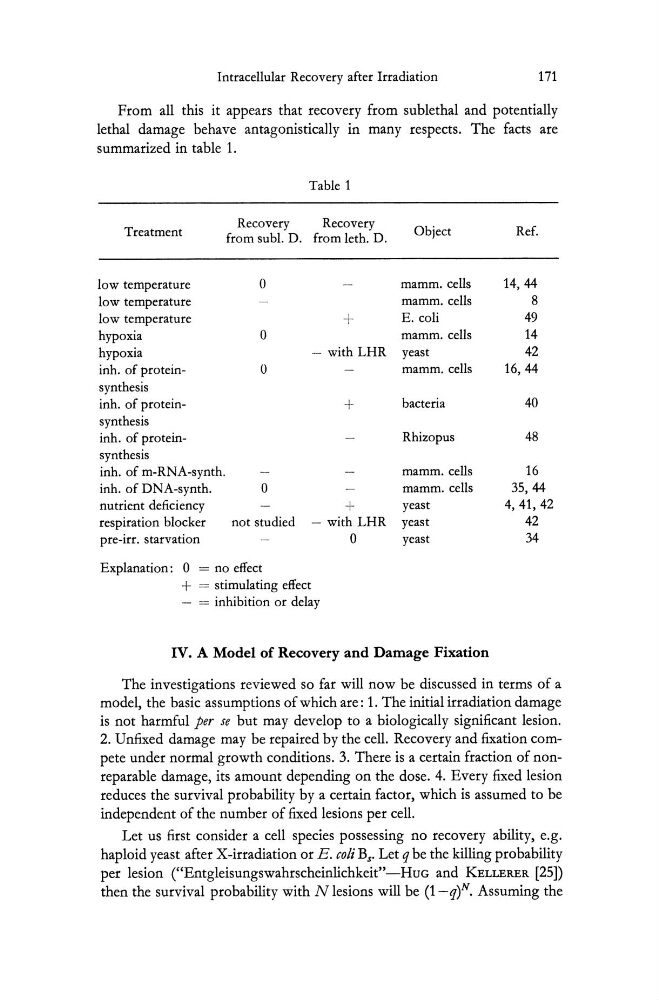
From all this it appears that recovery from sublethal and potentially
lethal damage behave antagonistically in many respects. The facts are
summarized in table 1.
Table 1
Treatment
Recovery
Recovery
from sub!. D. from leth. D.
low temperature
0
low temperature
low temperature
-+
hypoxia
0
hypoxia
-- with LHR
inh. of protein0
synthesis
inh. of protein+
synthesis
inh. of proteinsynthesis
inh. of m-RNA-synth.
inh. of DNA-synth.
0
nutrient deficiency
I
T
respiration blocker
not studied - with LHR
pre-irr. starvation
0
Explanation: 0 = no effect
+ = stimulating effect
= inhibition or delay
Object
mamm. cells
mamm. cells
E. coli
mamm. cells
yeast
mamm. cells
bacteria
Rhizopus
mamm. cells
mamm. cells
yeast
yeast
yeast
IV. A Model of Recovery and Damage Fixation
Ref.
14,44
8
49
14
42
16,44
40
48
16
35,44
4,41,42
42
34
The investigations reviewed so far will now be discussed in terms of a
model, the basic assumptions of which are: 1. The initial irradiation damage
is not harmful per se but may develop to a biologically significant lesion.
2. Unfixed damage may be repaired by the cell. Recovery and fixation compete under normal growth conditions. 3. There is a certain fraction of nonreparable damage, its amount depending on the dose. 4. Every fixed lesion
reduces the survival probability by a certain factor, which is assumed to be
independent of the number of fixed lesions per cell.
Let us first consider a cell species possessing no recovery ability, e.g.
haploid yeast after X-irradiation or E. coli Bs. Let q be the killing probability
per lesion ("Entgleisungswahrscheinlichkeit"-HuG and KELLERER [25])
then the survival probability with N lesions will be (l-q)N. Assuming the
171
From all this it appears that recovery from sublethal and potentially
lethal damage behave antagonistically in many respects. The facts are
summarized in table 1.
Table 1
Treatment
Recovery
Recovery
from sub!. D. from leth. D.
low temperature
0
low temperature
low temperature
-+
hypoxia
0
hypoxia
-- with LHR
inh. of protein0
synthesis
inh. of protein+
synthesis
inh. of proteinsynthesis
inh. of m-RNA-synth.
inh. of DNA-synth.
0
nutrient deficiency
I
T
respiration blocker
not studied - with LHR
pre-irr. starvation
0
Explanation: 0 = no effect
+ = stimulating effect
= inhibition or delay
Object
mamm. cells
mamm. cells
E. coli
mamm. cells
yeast
mamm. cells
bacteria
Rhizopus
mamm. cells
mamm. cells
yeast
yeast
yeast
IV. A Model of Recovery and Damage Fixation
Ref.
14,44
8
49
14
42
16,44
40
48
16
35,44
4,41,42
42
34
The investigations reviewed so far will now be discussed in terms of a
model, the basic assumptions of which are: 1. The initial irradiation damage
is not harmful per se but may develop to a biologically significant lesion.
2. Unfixed damage may be repaired by the cell. Recovery and fixation compete under normal growth conditions. 3. There is a certain fraction of nonreparable damage, its amount depending on the dose. 4. Every fixed lesion
reduces the survival probability by a certain factor, which is assumed to be
independent of the number of fixed lesions per cell.
Let us first consider a cell species possessing no recovery ability, e.g.
haploid yeast after X-irradiation or E. coli Bs. Let q be the killing probability
per lesion ("Entgleisungswahrscheinlichkeit"-HuG and KELLERER [25])
then the survival probability with N lesions will be (l-q)N. Assuming the