

Contributions to the Energetics of Animal Growth
117
weight. Under these circumstances we cannot expect the derived value for
the power, it must be higher. I suppose that we find the theoretical value
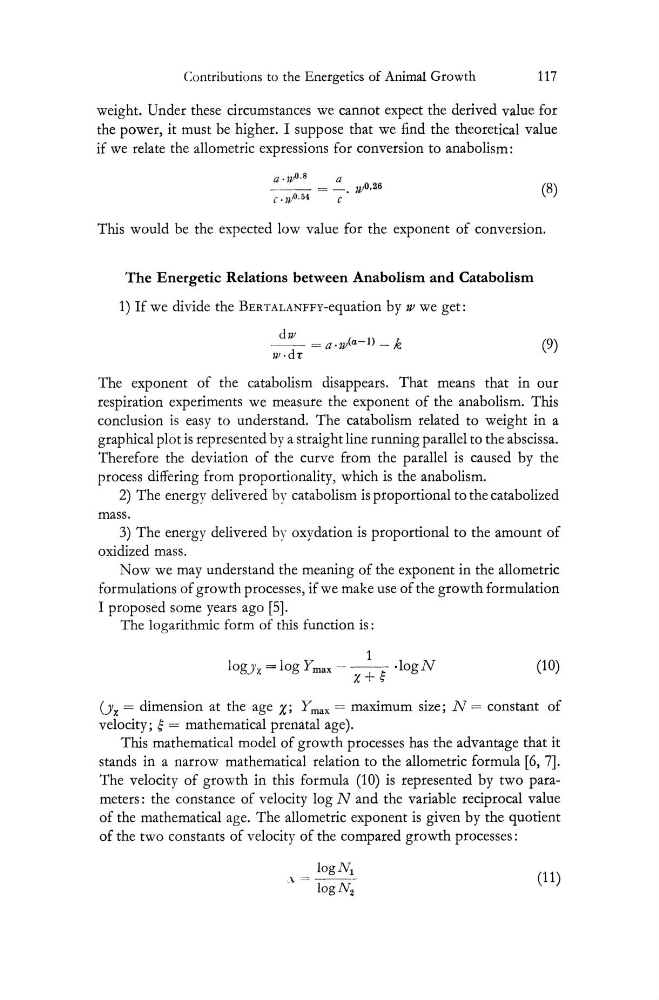
if we relate the allometric expressions for conversion to anabolism:
(8)
This would be the expected low value for the exponent of conversion.
The Energetic Relations between Anabolism and Catabolism
1) If we divide the BERTALANFFy-equation by w we get:
dw
- - =0 a·w(a-I) - k
W·dT
(9)
The exponent of the catabolism disappears. That means that in our
respiration experiments we measure the exponent of the anabolism. This
conclusion is easy to understand. The catabolism related to weight in a
graphical plot is represented by a straight line running parallel to the abscissa.
Therefore the deviation of the curve from the parallel is caused by the
process differing from proportionality, which is the anabolism.
2) The energy delivered by catabolism is proportional to the catabolized
mass.
3) The energy delivered by oxydation is proportional to the amount of
oxidized mass.
Now we may understand the meaning of the exponent in the allometric
formulations of growth processes, if we make use of the growth formulation
I proposed some years ago [5].
The logarithmic form of this function is:
1
logyx = log Y max - - - .log N
X+~
(10)
(yx = dimension at the age X; Y max = maximum size; N = constant of
velocity; ~ = mathematical prenatal age).
This mathematical model of growth processes has the advantage that it
stands in a narrow mathematical relation to the allometric formula [6, 7].
The velocity of growth in this formula (10) is represented by two parameters: the constance of velocity log N and the variable reciprocal value
of the mathematical age. The allometric exponent is given by the quotient
of the two constants of velocity of the compared growth processes:
logl"!
. , = - - -
logN 2
(11)
117
weight. Under these circumstances we cannot expect the derived value for
the power, it must be higher. I suppose that we find the theoretical value
if we relate the allometric expressions for conversion to anabolism:
(8)
This would be the expected low value for the exponent of conversion.
The Energetic Relations between Anabolism and Catabolism
1) If we divide the BERTALANFFy-equation by w we get:
dw
- - =0 a·w(a-I) - k
W·dT
(9)
The exponent of the catabolism disappears. That means that in our
respiration experiments we measure the exponent of the anabolism. This
conclusion is easy to understand. The catabolism related to weight in a
graphical plot is represented by a straight line running parallel to the abscissa.
Therefore the deviation of the curve from the parallel is caused by the
process differing from proportionality, which is the anabolism.
2) The energy delivered by catabolism is proportional to the catabolized
mass.
3) The energy delivered by oxydation is proportional to the amount of
oxidized mass.
Now we may understand the meaning of the exponent in the allometric
formulations of growth processes, if we make use of the growth formulation
I proposed some years ago [5].
The logarithmic form of this function is:
1
logyx = log Y max - - - .log N
X+~
(10)
(yx = dimension at the age X; Y max = maximum size; N = constant of
velocity; ~ = mathematical prenatal age).
This mathematical model of growth processes has the advantage that it
stands in a narrow mathematical relation to the allometric formula [6, 7].
The velocity of growth in this formula (10) is represented by two parameters: the constance of velocity log N and the variable reciprocal value
of the mathematical age. The allometric exponent is given by the quotient
of the two constants of velocity of the compared growth processes:
logl"!
. , = - - -
logN 2
(11)