

116
F. KRUGER
At this time we only are interested in the values of the different exponents.
A value of about 0.7 has been found for the food consumption. The same
value is found for the absorption. This signifies that in relation to body
weight the uptake of food decreases with increasing size and a constant
percentage of the food taken up is not absorbed.
The exponent for the food consumption representing the abolished matter is found to be about 0.8. This exponent agrees with the exponent found
in respiration measurements in fishes.
The exponent of 0.54 for the conversion is astonishingly low. Other
authors stated its value to about 0.7, but they related their results to the
food consumption. Under these conditions the experiments of P ANDIAN
would give the same value. For that reason the low value of the exponent
found by P ANDIAN is verified by other results. The allometric formula
describes the relative growth and we may compare parameters only if all
our measurements are related to the same standard. This is, in our case,
represented by the weight of the fishes.
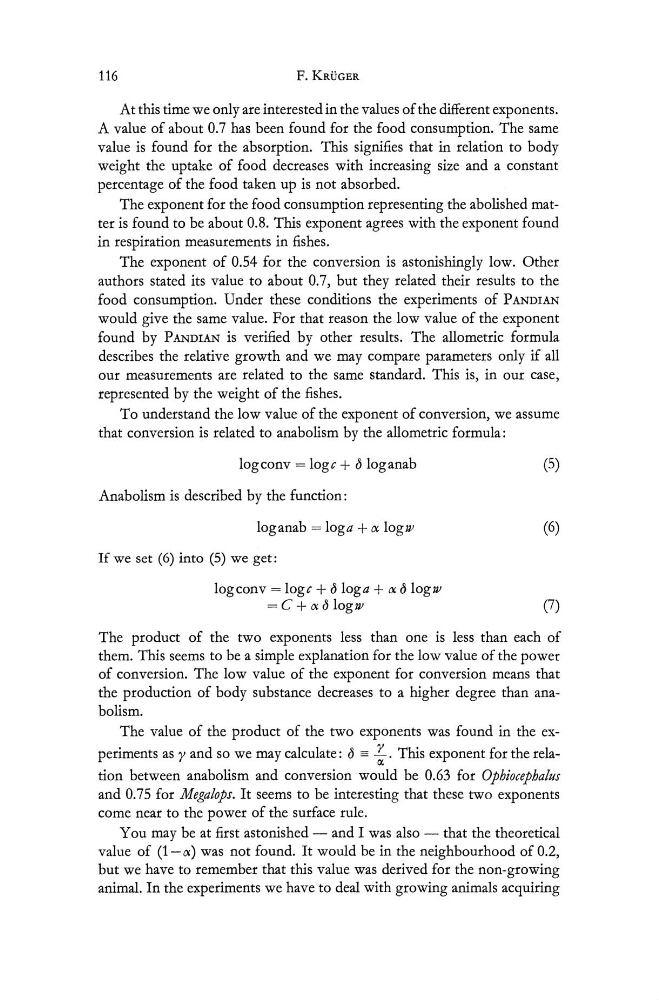
To understand the low value of the exponent of conversion, we assume
that conversion is related to anabolism by the allometric formula:
logconv = loge + a loganab
Anabolism is described by the function:
loganab = loga +
logconv = loge + a loga +
(6)
(7)
The product of the two exponents less than one is less than each of
them. This seems to be a simple explanation for the low value of the power
of conversion. The low value of the exponent for conversion means that
the production of body substance decreases to a higher degree than anabolism.
The value of the product of the two exponents was found in the experiments as y and so we may calculate: a '= 1'-. This exponent for the relaQ(
tion between anabolism and conversion would be 0.63 for Ophioeephalus
and 0.75 for Megalops. It seems to be interesting that these two exponents
come near to the power of the surface rule.
You may be at first astonished - and I was also - that the theoretical
value of (1- eX) was not found. It would be in the neighbourhood of 0.2,
but we have to remember that this value was derived for the non-growing
animal. In the experiments we have to deal with growing animals acquiring
F. KRUGER
At this time we only are interested in the values of the different exponents.
A value of about 0.7 has been found for the food consumption. The same
value is found for the absorption. This signifies that in relation to body
weight the uptake of food decreases with increasing size and a constant
percentage of the food taken up is not absorbed.
The exponent for the food consumption representing the abolished matter is found to be about 0.8. This exponent agrees with the exponent found
in respiration measurements in fishes.
The exponent of 0.54 for the conversion is astonishingly low. Other
authors stated its value to about 0.7, but they related their results to the
food consumption. Under these conditions the experiments of P ANDIAN
would give the same value. For that reason the low value of the exponent
found by P ANDIAN is verified by other results. The allometric formula
describes the relative growth and we may compare parameters only if all
our measurements are related to the same standard. This is, in our case,
represented by the weight of the fishes.
To understand the low value of the exponent of conversion, we assume
that conversion is related to anabolism by the allometric formula:
logconv = loge + a loganab
Anabolism is described by the function:
loganab = loga +
logconv = loge + a loga +
(6)
(7)
The product of the two exponents less than one is less than each of
them. This seems to be a simple explanation for the low value of the power
of conversion. The low value of the exponent for conversion means that
the production of body substance decreases to a higher degree than anabolism.
The value of the product of the two exponents was found in the experiments as y and so we may calculate: a '= 1'-. This exponent for the relaQ(
tion between anabolism and conversion would be 0.63 for Ophioeephalus
and 0.75 for Megalops. It seems to be interesting that these two exponents
come near to the power of the surface rule.
You may be at first astonished - and I was also - that the theoretical
value of (1- eX) was not found. It would be in the neighbourhood of 0.2,
but we have to remember that this value was derived for the non-growing
animal. In the experiments we have to deal with growing animals acquiring